


 Cart
Cart
 sales@molnova.com


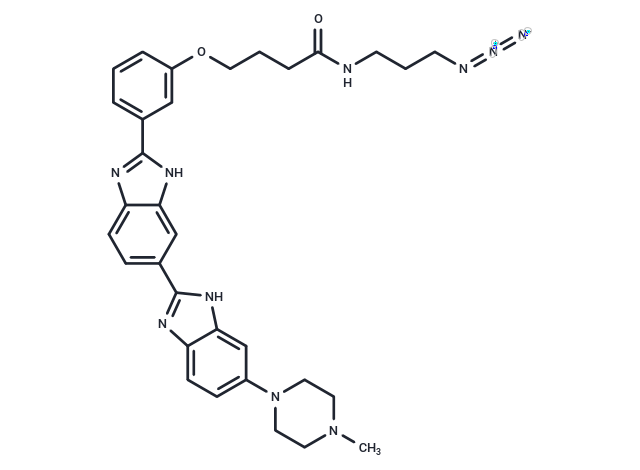
Targapremir-210
CAS No. 1049722-30-6
Targapremir-210( —— )
Catalog No. M33508 CAS No. 1049722-30-6
Targapremir-210 (TGP-210) is a selective and potent inhibitor of miRNA-210 (miRNA-210), which inhibits pre-miR-210 processing and induces apoptosis in breast cancer cells.
Purity : >98% (HPLC)
 COA
Datasheet
HNMR
HPLC
MSDS
Handing Instructions
COA
Datasheet
HNMR
HPLC
MSDS
Handing Instructions
| Size | Price / USD | Stock | Quantity |
| 2MG | 353 | Get Quote |


|
| 500MG | Get Quote | Get Quote |
|
| 1G | Get Quote | Get Quote |
|
Biological Information
-
Product NameTargapremir-210
-
NoteResearch use only, not for human use.
-
Brief DescriptionTargapremir-210 (TGP-210) is a selective and potent inhibitor of miRNA-210 (miRNA-210), which inhibits pre-miR-210 processing and induces apoptosis in breast cancer cells.
-
DescriptionTargapremir-210 (TGP-210) is a potent and selective miR-210 (miRNA-210, microRNA-210) inhibitor. Targapremir-210 inhibits pre-miR-210 processing with high binding affinity (Kd~200 nM). Targapremir-210 is a click chemistry reagent, it contains an Azide group and can undergo copper-catalyzed azide-alkyne cycloaddition reaction (CuAAc) with molecules containing Alkyne groups. Strain-promoted alkyne-azide cycloaddition (SPAAC) can also occur with molecules containing DBCO or BCN groups.
-
In VitroTargapremir-210 decreases mature miR-210 levels in MDA-MB-231 cells cultured under hypoxic conditions, with an IC50 of ~200 nM.Targapremir-210 (200 nM) induces MDA-MB-231 cells apoptosis is selective for the hypoxic environment. Targapremir-210 induces cells apoptosis under hypoxic conditions and does not induce apoptosis in MDA-MB-231 cells cultured in normoxia.
-
In VivoTargapremir-210 (100 μL of 200 nM; single i.p. injection) impedes MDA-MB-231 triple negative breast cancer (TNBC) cells proliferation in vivo. Targapremir-210 is able to reach the tumor and sustain for the entire 21-day period, and decreases tumor burden in a TNBC mouse model.Animal Model:NOD/SCID mice were subcutaneously transplanted cell suspension into breast fat pads.Dosage:100 μL of 200 nM Administration:Single i.p. injection 24 h post-transplantation Result:Decreased tumor growth as assessed by luciferase signal intensity and mass of the resected tumor.
-
Synonyms——
-
PathwayApoptosis
-
TargetApoptosis
-
RecptorApoptosis
-
Research Area——
-
Indication——
Chemical Information
-
CAS Number1049722-30-6
-
Formula Weight592.69
-
Molecular FormulaC32H36N10O2
-
Purity>98% (HPLC)
-
SolubilityIn Vitro:?DMSO : 250 mg/mL (421.81 mM; Ultrasonic )
-
SMILESCN1CCN(CC1)c1ccc2nc([nH]c2c1)-c1ccc2nc([nH]c2c1)-c1cccc(OCCCC(=O)NCCCN=[N+]=[N-])c1
-
Chemical Name——
Shipping & Storage Information
-
Storage(-20℃)
-
ShippingWith Ice Pack
-
Stability≥ 2 years
Reference
1. Costales MG, et al. Small Molecule Inhibition of microRNA-210 Reprograms an Oncogenic Hypoxic Circuit. J Am Chem Soc. 2017 Mar 8; 139(9):3446-3455.?
molnova catalog



related products
-
Iberdomide
Iberdomide is a modulator of cereblon( IC50 value of 60 nM in a competitive TR-FRET assay).
-
Cipepofol
Cipepofol (HSK3486) is a GABAA receptor agonist with sedative properties and protective effects in a variety of cardiovascular diseases.
-
NSC49652
NSC49652 triggers apoptotic cell death dependent on p75NTR and JNK activity in neurons and melanoma cells, and inhibits tumor growth in a melanoma mouse model.
