


 Cart
Cart
 sales@molnova.com


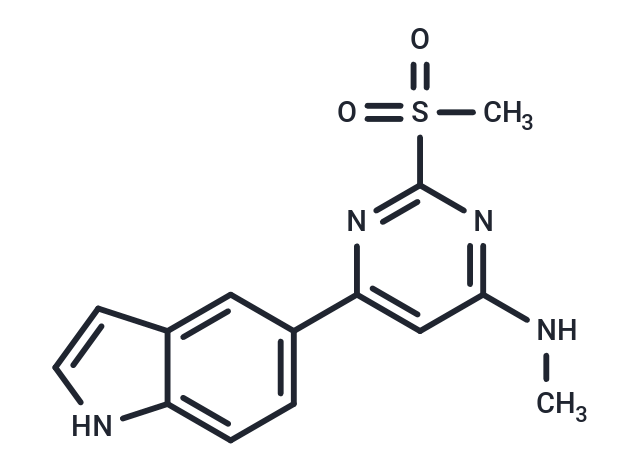
DC-BPi-03
CAS No. 2758411-46-8
DC-BPi-03( —— )
Catalog No. M36511 CAS No. 2758411-46-8
DC-BPi-03 is a potent BPTF-BRD inhibitor, exhibiting an IC50 of 698.3 nM and a Kd of 2.81 μM.
Purity : >98% (HPLC)
 COA
Datasheet
HNMR
HPLC
MSDS
Handing Instructions
COA
Datasheet
HNMR
HPLC
MSDS
Handing Instructions
| Size | Price / USD | Stock | Quantity |
| 1 mL x 10 mM in DMSO | 86 | In Stock |


|
| 5MG | 79 | In Stock |
|
| 10MG | 128 | In Stock |
|
| 25MG | 258 | In Stock |
|
| 50MG | 407 | In Stock |
|
| 100MG | 641 | In Stock |
|
| 200MG | Get Quote | In Stock |
|
| 500MG | Get Quote | In Stock |
|
| 1G | Get Quote | In Stock |
|
Biological Information
-
Product NameDC-BPi-03
-
NoteResearch use only, not for human use.
-
Brief DescriptionDC-BPi-03 is a potent BPTF-BRD inhibitor, exhibiting an IC50 of 698.3 nM and a Kd of 2.81 μM.
-
DescriptionDC-BPi-03 is a potent BPTF-BRD inhibitor with an IC50 of 698.3 nM and a Kd of 2.81 μM.
-
In Vitro——
-
In Vivo——
-
Synonyms——
-
PathwayChromatin/Epigenetic
-
TargetEpigenetic Reader Domain
-
RecptorEpigenetic Reader Domain
-
Research Area——
-
Indication——
Chemical Information
-
CAS Number2758411-46-8
-
Formula Weight302.35
-
Molecular FormulaC14H14N4O2S
-
Purity>98% (HPLC)
-
SolubilityIn Vitro:?DMSO : 33.33 mg/mL (110.24 mM; Ultrasonic (<80°C)
-
SMILESO=S(=O)(C=1N=C(C=C(N1)C2=CC=C3NC=CC3=C2)NC)C
-
Chemical Name——
Shipping & Storage Information
-
Storage(-20℃)
-
ShippingWith Ice Pack
-
Stability≥ 2 years
Reference
1. Tian Lu, et al. Discovery of High-Affinity Inhibitors of the BPTF Bromodomain. J Med Chem. 2021 Aug 26;64(16):12075-12088.?
molnova catalog



related products
-
SGC-SMARCA-BRDVIII
SGC-SMARCA-BRDVIII is a potent and selective inhibitor of SMARCA2, SMARCA4, PB1(2), PB1(3) and PB1(5) with Kds of 35 nM, 36 nM, 3.7 μM, 2.0 μM and 13 nM, respectively.
-
BRD7-IN-1
BRD7-IN-1, a modified derivative of BI7273 (BRD7/9 inhibitor), forms PROTAC VZ185 via linkage to a VHL ligand, demonstrating potent activity against BRD7/9 with DC50 values of 4.5 and 1.8 nM, respectively .
-
CREB inhibitor
666-15 is a potent and selective CREB inhibitor (IC50: 81 nM).
