


 Cart
Cart
 sales@molnova.com


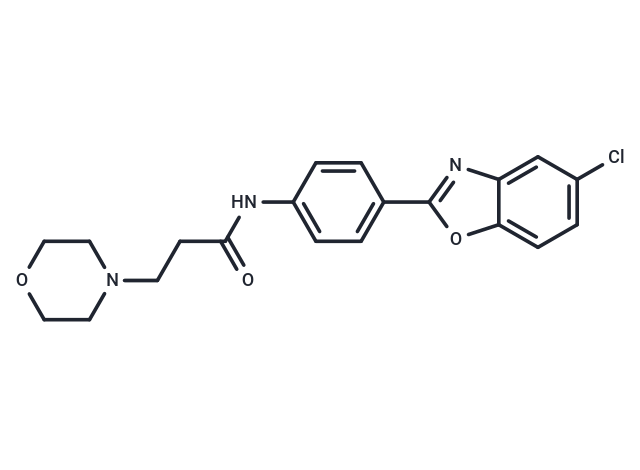
PARP-2-IN-3
CAS No. 2915650-86-9
PARP-2-IN-3( —— )
Catalog No. M36489 CAS No. 2915650-86-9
PARP-2-IN-3 is used as a potent PARP-2 inhibitor (IC50=0.07 μM) with anti-tumor activity that induces apoptosis and necrosis in cancer cells, and can be used for the study of breast cancer.CAS 128-52-56-8
Purity : >98% (HPLC)
 COA
Datasheet
HNMR
HPLC
MSDS
Handing Instructions
COA
Datasheet
HNMR
HPLC
MSDS
Handing Instructions
| Size | Price / USD | Stock | Quantity |
| 5MG | 922 | In Stock |


|
| 25MG | 1511 | In Stock |
|
| 50MG | 1841 | In Stock |
|
| 100MG | Get Quote | In Stock |
|
| 200MG | Get Quote | In Stock |
|
| 500MG | Get Quote | In Stock |
|
| 1G | Get Quote | In Stock |
|
Biological Information
-
Product NamePARP-2-IN-3
-
NoteResearch use only, not for human use.
-
Brief DescriptionPARP-2-IN-3 is used as a potent PARP-2 inhibitor (IC50=0.07 μM) with anti-tumor activity that induces apoptosis and necrosis in cancer cells, and can be used for the study of breast cancer.CAS 128-52-56-8
-
DescriptionPARP-2-IN-3 (Compound 12) is a potent PARP-2 inhibitor with an IC50 of 0.07 μM. PARP-2-IN-3 induces apoptosis and necrosis in cancer cells. PARP-2-IN-3 shows appropriate predicted pharmacokinetic parameters and oral bioavailability.
-
In VitroPARP-2-IN-3 (Compound 12) (24 h) shows cytotoxic activities with IC50s of 6.14±0.5 μM and 6.05±0.4 μM against MDA-MB-231 and MCF-7, respectively.PARP-2-IN-3 (6.05 μM; 24 h) arrests cell cycle at G2/M phase, and induces apoptosis and necrosis in MCF-7 cells.PARP-2-IN-3 fills the space inside the PARP-2 pocket in a manner similar to Olaparib (HY-10162).Cell Cytotoxicity Assay Cell Line:MDA-MB-231 and MCF-7 Concentration: Incubation Time:24 h Result:Displayed remarkable cytotoxic activities with IC50s of 6.14±0.5 μM and 6.05±0.4 μM against MDA-MB-231 and MCF-7, respectively.Cell Cycle Analysis Cell Line:MCF-7 Concentration:6.05 μM Incubation Time:24 h Result:The percentage of cells in pre-G1 phase increased from 1.85% to 33.47%, while in G2/M phase increased from 11.84% to 32.04%. The percentage of cells in S phase slightly decreased from 29.95% to 26.18% and in G0/G1 phase decreased from 58.21% to 41.78%.Apoptosis Analysis Cell Line:MCF-7 Concentration:6.05 μM Incubation Time:24 h Result:Induced an early apoptotic effect 22.52% and late apoptotic effect 3.72% in comparison to the untreated negative control MCF-7 cells which induced an early and late apoptotic effect 0.37% and 0.33%, respectively.
-
In Vivo——
-
Synonyms——
-
PathwayCell Cycle/DNA Damage
-
TargetPARP
-
RecptorPARP | Apoptosis
-
Research Area——
-
Indication——
Chemical Information
-
CAS Number2915650-86-9
-
Formula Weight385.84
-
Molecular FormulaC20H20ClN3O3
-
Purity>98% (HPLC)
-
Solubility——
-
SMILESO=C(NC=1C=CC(=CC1)C2=NC3=CC(Cl)=CC=C3O2)CCN4CCOCC4
-
Chemical Name——
Shipping & Storage Information
-
Storage(-20℃)
-
ShippingWith Ice Pack
-
Stability≥ 2 years
Reference
1. El-Ghobashy NM, et al. Synthesis, biological evaluation, and molecular modeling studies of new benzoxazole derivatives as PARP-2 inhibitors targeting breast cancer. Sci Rep. 2022 Sep 28;12(1):16246.?
molnova catalog



related products
-
AG-14361
AG14361 is a potent inhibitor of PARP1 with Ki of <5 nM. It is at least 1000-fold more potent than the benzamides.
-
Amelparib hydrochlor...
Amelparib hydrochloric hydrate (JPI-289, JPI289) is a novel potent, water soluble PARP-1 inhibitor with IC50 of 18.5 nM, inhibits cellular PAR formation with IC50 of 10.7 nM.
-
MK-4827 Racemate
MK-4827 Racemate is a selective PARP1 and PARP2 inhibitor with IC50s of 3.8 nM and 2.1 nM, respectively, over 330-fold selectivity for PARP3, V-PARP and Tank1.
