


 Cart
Cart
 sales@molnova.com


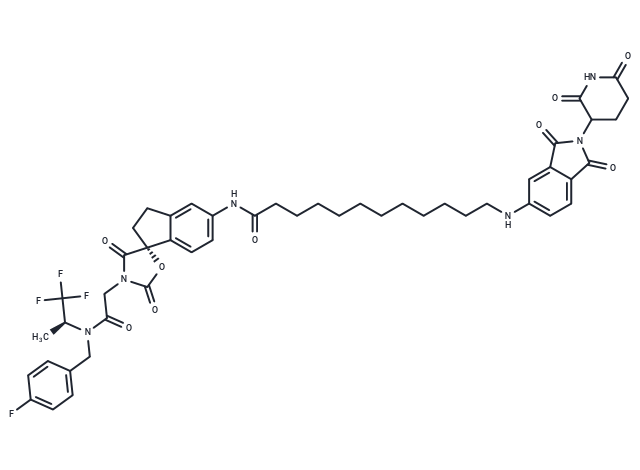
JQAD1
CAS No. 2417097-18-6
JQAD1( —— )
Catalog No. M35258 CAS No. 2417097-18-6
JQAD1 is a potent and selective histone acetyltransferase EP300 degrader (PROTAC ; DC50≤ 31.6 nM); comprises an EP300 inhibitor, A485, joined by a linker to a cereblon E3 ligase ligand.
Purity : >98% (HPLC)
 COA
Datasheet
HNMR
HPLC
MSDS
Handing Instructions
COA
Datasheet
HNMR
HPLC
MSDS
Handing Instructions
| Size | Price / USD | Stock | Quantity |
| 5MG | 312 | In Stock |


|
| 10MG | 473 | In Stock |
|
| 25MG | 771 | In Stock |
|
| 50MG | 1051 | In Stock |
|
| 100MG | 1414 | In Stock |
|
| 200MG | Get Quote | In Stock |
|
| 500MG | Get Quote | In Stock |
|
| 1G | Get Quote | In Stock |
|
Biological Information
-
Product NameJQAD1
-
NoteResearch use only, not for human use.
-
Brief DescriptionJQAD1 is a potent and selective histone acetyltransferase EP300 degrader (PROTAC ; DC50≤ 31.6 nM); comprises an EP300 inhibitor, A485, joined by a linker to a cereblon E3 ligase ligand.
-
DescriptionJQAD1 is a CRBN-dependent PROTAC that selectively targets EP300 for degradation. JQAD1 suppresses EP300 expression and the H3K27ac modification. JQAD1 induces apoptosis. JQAD1 can be used in research of cancer.
-
In VitroWestern Blot Analysis Cell Line:MYCN-amplified NB cells Concentration:0.1, 0.5, 1, 3, 5, and 10 μM Incubation Time:24 h Result:Demonstrated a dose-dependent decrease in EP300 expression along with a parallel loss of the H3K27ac modification. Induced selective loss of EP300 expression coincident with cleavage of PARP1, signaling the onset of apoptosis.Western Blot Analysis Cell Line:Kelly NB cells Concentration:1 μM Incubation Time:12, 24, and 36 hours Result:Increased the expression of cleaved caspase-3 and cleaved PARP1 in a dose-dependent manner.
-
In VivoAnimal Model:NSG mice with Kelly NB cell xenograftsDosage:40 mg/kg Administration:Intraperitoneal injection; daily, for 21 days Result:Suppressed tumor growth and prolonged survival.Animal Model:CD1 miceDosage:10 mg/kg Administration:Intraperitoneal injection (Pharmacokinetic Analysis) Result:Had a half-life of 13.3 (±3.37 SD) hours in murine serum, with a Cmax of 7 μmol/L.
-
Synonyms——
-
PathwayChromatin/Epigenetic
-
TargetEpigenetic Reader Domain
-
RecptorEpigenetic Reader Domain | PROTACs
-
Research Area——
-
Indication——
Chemical Information
-
CAS Number2417097-18-6
-
Formula Weight932.95
-
Molecular FormulaC48H52F4N6O9
-
Purity>98% (HPLC)
-
SolubilityIn Vitro:?DMSO : 100 mg/mL (107.19 mM; Ultrasonic )
-
SMILESO=C1[C@@]2(C=3C(CC2)=CC(NC(CCCCCCCCCCCNC=4C=C5C(=CC4)C(=O)N(C5=O)C6C(=O)NC(=O)CC6)=O)=CC3)OC(=O)N1CC(N(CC7=CC=C(F)C=C7)[C@H](C(F)(F)F)C)=O
-
Chemical Name——
Shipping & Storage Information
-
Storage(-20℃)
-
ShippingWith Ice Pack
-
Stability≥ 2 years
Reference
1. Durbin AD, et, al. EP300 Selectively Controls the Enhancer Landscape of MYCN-Amplified Neuroblastoma. Cancer Discov. 2022 Mar 1;12(3):730-751.?
molnova catalog



related products
-
653-47 hydrochloride
653-47 hydrochloride is a potentiator, significantly potentiates the cAMP-response element binding protein (CREB) inhibitory activity of 666-15.?
-
GSK778 hydrochloride
GSK778 hydrochloride hydrochloride is a potent and selective BD1 bromodomain inhibitor of the BET proteins, with IC50s of 75 nM (BRD2 BD1), 41 nM (BRD3 BD1), 41 nM (BRD4 BD1), and 143 nM (BRDT BD1), respectively.
-
dCBP-1
dCBP-1 is a chemical degrader of p300/CBP. dCBP-1 hijacks the E3 ubiquitin ligase CRBN for selective degradation of p300/CBP. Degradation of p300/CBP by dCBP-1 leads to effective multiple myeloma cell killing.
