


 Cart
Cart
 sales@molnova.com


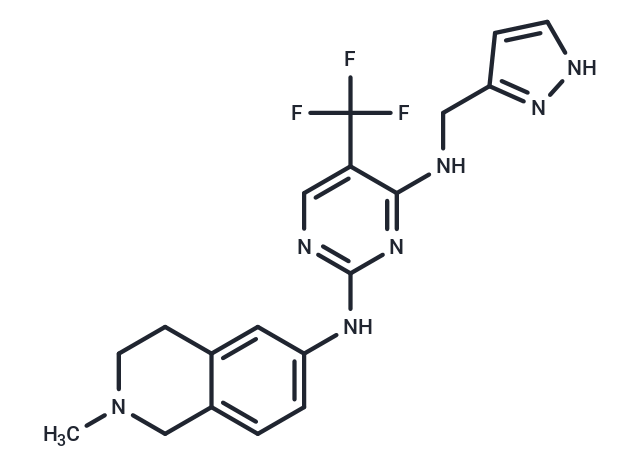
PCC0208017
CAS No. 2623158-64-3
PCC0208017( —— )
Catalog No. M35192 CAS No. 2623158-64-3
PCC0208017 is an inhibitor of MARK3 and MARK4 with IC50s of 1.8 and 2.01 nM. PCC0208017 disrupts microtubule dynamics and displays potent antitumor activity.
Purity : >98% (HPLC)
 COA
Datasheet
HNMR
HPLC
MSDS
Handing Instructions
COA
Datasheet
HNMR
HPLC
MSDS
Handing Instructions
| Size | Price / USD | Stock | Quantity |
| 1 mL x 10 mM in DMSO | 250 | In Stock |


|
| 5MG | 227 | In Stock |
|
| 10MG | 364 | In Stock |
|
| 25MG | 676 | In Stock |
|
| 50MG | 1004 | In Stock |
|
| 100MG | Get Quote | In Stock |
|
| 200MG | Get Quote | In Stock |
|
| 500MG | Get Quote | In Stock |
|
| 1G | Get Quote | In Stock |
|
Biological Information
-
Product NamePCC0208017
-
NoteResearch use only, not for human use.
-
Brief DescriptionPCC0208017 is an inhibitor of MARK3 and MARK4 with IC50s of 1.8 and 2.01 nM. PCC0208017 disrupts microtubule dynamics and displays potent antitumor activity.
-
DescriptionPCC0208017 is a microtubule affinity regulating kinases (MARK3/MARK4) inhibitor with IC50s of 1.8 and 2.01 nM, respectively. PCC0208017 has much lower inhibitory activity against MARK1 and MARK2, with IC50s of 31.4 and 33.7 nM, respectively. PCC0208017 suppresses glioma progression in vitro and in vivo. PCC0208017 disrupts microtubule dynamics and induces G2/M phase cell cycle arrest and cell apoptosis. PCC0208017 demonstrates robust antitumor activity in vivo and displays good BBB permeability.
-
In VitroPCC0208017 inhibits the activity of MARK3 and MARK4 and decreased the phosphorylation of Tau.PCC0208017 (1-5 μM; 24?hours) treatment results in decreased phosphorylation of Tau, the subtract of MARKs. PCC0208017 (3-21 μM; 24?hours) suppresses the proliferation of glioma cells.Cell Proliferation Assay Cell Line:The glioma cell lines GL261, U87-MG, U251 Concentration:0, 3, 6, 9, 12, 15, 18, 21 μM Incubation Time:24?hours Result:The IC50?values for GL261, U87-MG and U251 were calculated as 2.77, 4.02 and 4.45?μM, respectively.Cell Proliferation Assay Cell Line: Concentration:Glioma cell lines GL261 and U2511, 2, 5 μM Incubation Time:24?hours Result:Decreased the phosphorylation of Tau.
-
In VivoPCC0208017 demonstrates robust antitumor activity?in?vivo?and displays good BBB permeability. PCC0208017 (50 and 100?mg/kg; orally administrated) inhibits the growth of xenograft tumors derived from GL261?cells in a dose-dependent manner.? Inhibition rates are 56.15% and 70.32%, respectively. Co-treatment of PCC0208017 at dosage of 50?mg/kg significantly enhances the anti-tumor activity of Temozolomide (TMZ; 100?mg/kg), with an increase in tumor inhibition rates from 34.15% (TMZ only) to 83.5% (TMZ+PCC0208017).PCC0208017 (after a single oral administration at a dose of 50?mg/kg) could be detected in both plasma and brain following a single oral dose of 50?mg/kg. In plasma,?Cmax?is 1.36?μg/mL and?Tmax?is 0.833?h. In brain,?Cmax?is 0.14?μg/mL and?Tmax?is 0.833?h.Animal Model:C57BL/6 mice bearing murine glioma GL261?xenograft tumor Dosage: 50?mg/kg and 100?mg/kg (suspended in a 0.5% methylcellulose solution).Administration:Orally administrated every day at a volume of 10?mL/kg Result:Inhibited GL261?cells growth in xenograft mouse model.
-
Synonyms——
-
PathwayApoptosis
-
TargetApoptosis
-
RecptorApoptosis
-
Research Area——
-
Indication——
Chemical Information
-
CAS Number2623158-64-3
-
Formula Weight403.4
-
Molecular FormulaC19H20F3N7
-
Purity>98% (HPLC)
-
SolubilityIn Vitro:?DMSO : 125 mg/mL (309.87 mM; Ultrasonic )
-
SMILESCN1CCc2cc(Nc3ncc(c(NCc4cc[nH]n4)n3)C(F)(F)F)ccc2C1
-
Chemical Name——
Shipping & Storage Information
-
Storage(-20℃)
-
ShippingWith Ice Pack
-
Stability≥ 2 years
Reference
1. Fangfang Li, et al. PCC0208017, a novel small-molecule inhibitor of MARK3/MARK4, suppresses glioma progression?in vitro?and?in vivo. Acta Pharm Sin B.2020 Feb;10(2):289-300. ?
molnova catalog



related products
-
Supinoxin
Supinoxin is an orally active inhibitor of phosphorylated-p68 RNA helicase and a potent first-in-class anti-cancer agent.
-
Resolvin D1
Resolvin D1 (RvD1) is an endogenous pro-inflammatory mediator that blocks pro-inflammatory neutrophil migration by regulating actin polymerization.
-
Sandalore
Sandalore prolongs human hair growth by decreasing apoptosis and increasing the production of the anagen-prolonging growth factor IGF-1 in the outer root sheath. Sandalore is a selective agonist of olfactory receptor OR2AT4.
