


 Cart
Cart
 sales@molnova.com


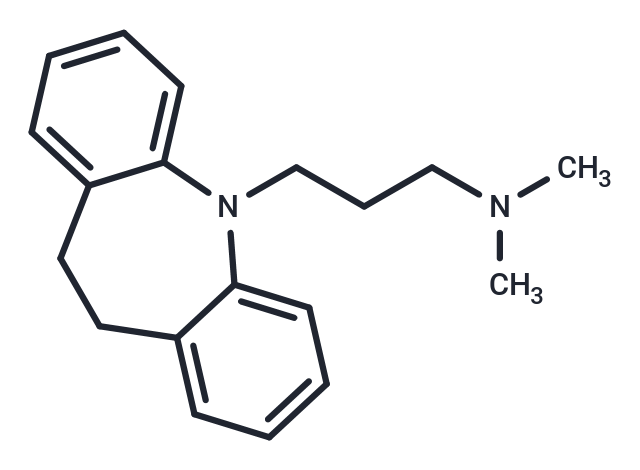
Imipramine
CAS No. 50-49-7
Imipramine( —— )
Catalog No. M33650 CAS No. 50-49-7
Imipramine (Dimipressin) is an orally active Fascin1 inhibitor with antidepressant and antitumor activity.
Purity : >98% (HPLC)
 COA
Datasheet
HNMR
HPLC
MSDS
Handing Instructions
COA
Datasheet
HNMR
HPLC
MSDS
Handing Instructions
| Size | Price / USD | Stock | Quantity |
| 5MG | 49 | In Stock |


|
| 10MG | 81 | In Stock |
|
| 25MG | 163 | In Stock |
|
| 50MG | 249 | In Stock |
|
| 100MG | 398 | In Stock |
|
| 200MG | Get Quote | In Stock |
|
| 500MG | 900 | In Stock |
|
| 1G | Get Quote | In Stock |
|
Biological Information
-
Product NameImipramine
-
NoteResearch use only, not for human use.
-
Brief DescriptionImipramine (Dimipressin) is an orally active Fascin1 inhibitor with antidepressant and antitumor activity.
-
DescriptionImipramine is an orally active tertiary amine tricyclic antidepressant. Imipramine is a Fascin1 inhibitor with antitumor activities. Imipramine also inhibits serotonin transporter with an IC50 value of 32 nM. Imipramine stimulates U-87MG glioma cells autophagy and induces HL-60 cell apoptosis. Imipramine shows neuroprotective and immunomodulatory effects.
-
In VitroImipramine (0.5-300 μM, 3 days) inhibits HCT-116 cell viability.Imipramine (20 μM) inhibits cell migration (7 h) and invasion (48 h).Imipramine (50 μM, 0-240 min) inhibites the PI3K/Akt/mTOR signaling pathway in U-87MG glioma cells.Imipramine (60 μM, 24 h) stimulates U-87MG glioma cells autophagy.Imipramine (80 μM, 24 h) induces HL-60 cell apoptosis.Cell Viability Assay Cell Line:DLD-1, HCT-116, and SW-480 Concentration: 0.5-300 μM Incubation Time:3 days Result:Inhibited cell viability and HCT-116 was more sensitive than DLD-1 and SW-480.Cell Migration Assay Cell Line:DLD-1, HCT-116, and SW-480 Concentration:20 μM Incubation Time:7?h Result:Produced a remarkable inhibition of migration in all assayed cell lines.Cell Invasion Assay Cell Line:HCT-116Concentration:20 μMIncubation Time:48?hResult:Inhibited cell invasion through Matrigel. Western Blot Analysis Cell Line:U-87MG Concentration:50 μM Incubation Time:0, 15, 30, 60, 120 and 240 min Result:Markedly inhibited the phosphorylation of both Akt (Ser473) and mTOR (Ser2481) in a time-dependent manner. Also dephosphorylated p70 S6K, a downstream target of mTOR.Cell Autophagy Assay Cell Line:U-87MG Concentration:60 μM Incubation Time:24 h Result:Stimulated the induction of autophagy through the redistribution of LC3 in U-87MG glioma cells.Apoptosis Analysis Cell Line:HL-60 Concentration:80 μM Incubation Time:24 h Result:Induced cell apoptosis.
-
In VivoImipramine (20 mg/kg, i.p. or 15 mg/kg, p.o.; daily for 24 days) attenuates neuroinflammatory signaling and reverses stress-induced social avoidance in mice.Animal Model:Male C57BL/6 mice (6–8 weeks old) subjected to RSD (repeated social defeat) and HCC (home cage control)Dosage:20 mg/kg or 15 mg/kg Administration:Intraperitoneal injection or oral administration, daily for 24 days Result:Reversed RSD-induced social avoidance behavior, significantly increasing the interaction time, significantly decreased stress-induced mRNA levels for IL-6 in brain microglia.
-
Synonyms——
-
PathwayApoptosis
-
TargetApoptosis
-
RecptorApoptosis
-
Research Area——
-
Indication——
Chemical Information
-
CAS Number50-49-7
-
Formula Weight280.41
-
Molecular FormulaC19H24N2
-
Purity>98% (HPLC)
-
Solubility——
-
SMILESC=1C=CC2=C(C1)N(C=3C=CC=CC3CC2)CCCN(C)C
-
Chemical Name——
Shipping & Storage Information
-
Storage(-20℃)
-
ShippingWith Ice Pack
-
Stability≥ 2 years
Reference
1. Alburquerque-González B, et al. New role of the antidepressant imipramine as a Fascin1 inhibitor in colorectal cancer cells. Exp Mol Med. 2020 Feb;52(2):281-292.?
molnova catalog



related products
-
3-Deoxyaconitine
3-?Deoxyaconitine is a derivative of Aconitine (A189875), which activates tetrodotoxin-sensitive Na+ channels, inducing presynaptic depolarization.
-
Gliotoxin
Gliotoxin, a Wnt signaling pathway inhibitor, induces growth inhibition and apoptosis in multiple colorectal cancer cell lines with mutations of the Wnt signaling pathway.
-
RSH-7
RSH-7 is a potent dual inhibitor of BTK and FLT3, with IC50s of 47 and 12 nM, respectively.RSH-7 has antiproliferative and antitumor activities, inducing apoptosis and inhibiting BTK and FLT3 signaling.
