


 Cart
Cart
 sales@molnova.com


Razoxane
CAS No. 21416-67-1
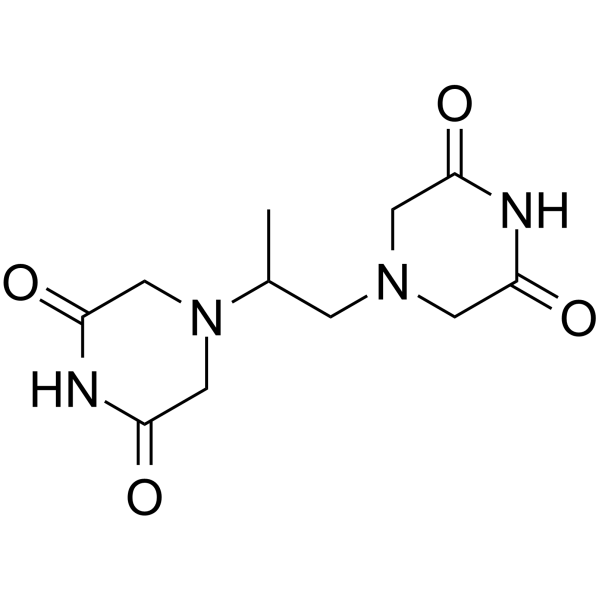
Razoxane( 4,4'-propylenebis(piperazine-2,6-dione) )
Catalog No. M27828 CAS No. 21416-67-1
Razoxane is used as an antimitotic agent with immunosuppressive properties.
Purity : >98% (HPLC)
 COA
Datasheet
HNMR
HPLC
MSDS
Handing Instructions
COA
Datasheet
HNMR
HPLC
MSDS
Handing Instructions
| Size | Price / USD | Stock | Quantity |
| 1 mL x 10 mM in DMSO | 93 | In Stock |


|
| 5MG | 85 | In Stock |
|
| 10MG | 136 | In Stock |
|
| 25MG | 255 | In Stock |
|
| 50MG | 398 | In Stock |
|
| 100MG | 616 | In Stock |
|
| 200MG | Get Quote | In Stock |
|
| 500MG | Get Quote | In Stock |
|
| 1G | Get Quote | In Stock |
|
Biological Information
-
Product NameRazoxane
-
NoteResearch use only, not for human use.
-
Brief DescriptionRazoxane is used as an antimitotic agent with immunosuppressive properties.
-
DescriptionRazoxane is used as an antimitotic agent with immunosuppressive properties.(In Vivo):This tumor model is characterized by osteoid formation and spontaneous metastasization to lungs, kidneys and lymph nodes. Razoxane given intraperitoneally (i.p.) from 2 days before to 14 days after tumor transplantation (30 mg/kg or 10 mg/kg per day) resulted in a dose-dependent prolongation of median survival time (83 or 48 days respectively, versus 38 days for the control group), but showed no influence on the growth of the primary tumor. Early treatment with razoxane (30 mg/kg i.p. from day -2 to +14) showed a greater inhibition of pulmonary metastases than later treatment (30 mg/kg i.p. from day +14 to +28 after transplantation). Whereas 59.9 per cent of the total sectional area of the lungs in the control animals was covered by osteosarcoma metastases, only 3.4 per cent and 26.1 per cent respectively was affected in the early and late razoxane treatment groups. Toxic side-effects of these treatment schedules were reversible diffuse alopecia, but no retardation of body weight gain.
-
In VitroRazoxane (30 mg/kg; i.p.) exhibits antimetastatic effects in a rat osteosarcoma model.
-
In VivoEarly treatment with Razoxane (30 mg/kg i.p. from day -2 to +14) shows a greater inhibition of pulmonary metastases than later treatment (30 mg/kg i.p. from day +14 to +28 after transplantation). Animal Model:Sprague-Dawley ratsDosage:30 mg/kg or 10 mg/kg per day Administration:Intraperitoneally (i.p.) from 2 days before to 14 days after tumor transplantation Result:Resulted in a dose-dependent prolongation of median survival time (83 or 48 days respectively, versus 38 days for the control group), but showed no influence on the growth of the primary tumor.
-
Synonyms4,4'-propylenebis(piperazine-2,6-dione)
-
PathwayCell Cycle/DNA Damage
-
TargetTopoisomerase
-
Recptor——
-
Research Area——
-
Indication——
Chemical Information
-
CAS Number21416-67-1
-
Formula Weight268.273
-
Molecular FormulaC11H16N4O4
-
Purity>98% (HPLC)
-
Solubility——
-
SMILESCC(CN1CC(=O)NC(=O)C1)N1CC(=O)NC(=O)C1
-
Chemical Name——
Shipping & Storage Information
-
Storage(-20℃)
-
ShippingWith Ice Pack
-
Stability≥ 2 years
Reference
1.KunchengQiu, et al. Protective effect of total glycosides from lily on H2O2-induced H9C2 cells mitochondrial damage and characterization of the chemical profiles by UHPLC-LTQ-Orbitrap-MSn. Journal of Functional Foods. Volume 71, August 2020, 104036
molnova catalog



related products
-
Pefloxacin Mesylate
Pefloxacin is a an antibacterial agent and prevents bacterial DNA replication by inhibiting DNA gyrase (topoisomerse).
-
Topixantrone 2HCl
Topixantrone 2HCl is a DNA topoisomerase inhibitor with antitumor activity for the study of gastric and prostate cancer.
-
SW-044248
SW-044248 is a novel selective inhibitor of Topoisomerase I; inhibits Top I differently from camptothecin.
