


 Cart
Cart
 sales@molnova.com


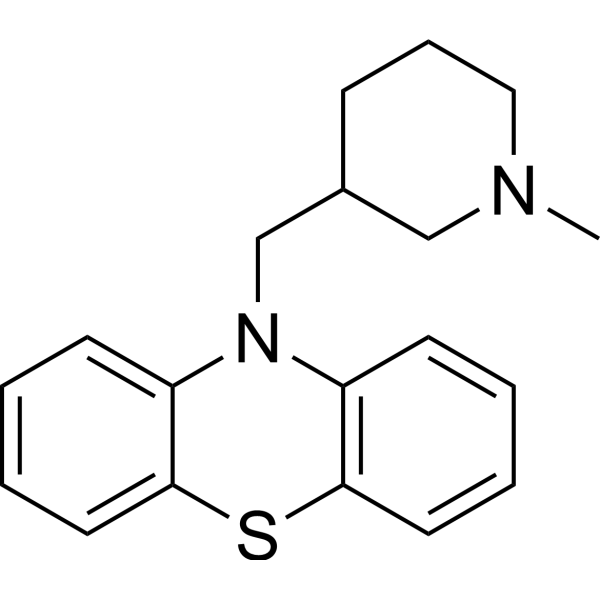
Mepazine
CAS No. 60-89-9
Mepazine( Pecazine )
Catalog No. M26752 CAS No. 60-89-9
Mepazine is a potent and selective inhibitor of MALT1. Mepazine inhibits GSTMALT1 full length and GSTMALT1 325-760 with IC50s of 0.83 μM and 0.42 μM.
Purity : >98% (HPLC)
 COA
Datasheet
HNMR
HPLC
MSDS
Handing Instructions
COA
Datasheet
HNMR
HPLC
MSDS
Handing Instructions
| Size | Price / USD | Stock | Quantity |
| 1 mL x 10 mM in DMSO | 29 | In Stock |


|
| 10MG | 31 | In Stock |
|
| 25MG | 52 | In Stock |
|
| 50MG | 79 | In Stock |
|
| 100MG | 110 | In Stock |
|
| 200MG | 174 | In Stock |
|
| 500MG | Get Quote | In Stock |
|
| 1G | Get Quote | In Stock |
|
Biological Information
-
Product NameMepazine
-
NoteResearch use only, not for human use.
-
Brief DescriptionMepazine is a potent and selective inhibitor of MALT1. Mepazine inhibits GSTMALT1 full length and GSTMALT1 325-760 with IC50s of 0.83 μM and 0.42 μM.
-
DescriptionMepazine is a potent and selective inhibitor of MALT1. Mepazine inhibits GSTMALT1 full length and GSTMALT1 325-760 with IC50s of 0.83 μM and 0.42 μM. Mepazine enhances apoptosis and affects the cell viability.(In Vitro):Mepazine (5, 10, and 20 μM) decreases cell viability in the ABC-DLBCL cells HBL1, OCI-Ly3, U2932, and TMD8, without significantly affecting GCB-DLBCL cells.(In Vivo):In female NSG mice with a murine DLBCL xenogeneic tumor model, Mepazine (16 mg/kg; i.p.) interferes with the growth and induces apoptosis of ABC-DLBCL cell line OCI-Ly10. Mepazine strongly impairs the expansion of OCI-Ly10 with daily administration.
-
In VitroMepazine (5-20 μM; 4 days) causes a decrease of cell viability in the activated B cell subtype of diffuse large B cell lymphoma (ABCDLBCL) cells, without significantly affecting GCB-DLBCL cells. Cell Viability Assay Cell Line:ABC-DLBCL cell lines (HBL1, OCI-Ly3, U2932, TMD8, OCI-Ly10) and GCB-DLBCL cell lines (BJAB, Su-DHL-6, Su-DHL-4)Concentration:5, 10, and 20 μM Incubation Time:4 days Result:Caused a decrease of cell viability in the ABC-DLBCL cells HBL1, OCI-Ly3, U2932, and TMD8, without significantly affecting GCB-DLBCL cells.
-
In VivoMepazine (16 mg/kg; intraperitoneal administration) interferes with growth and induces apoptosis of ABC-DLBCL cell line OCI-Ly10 in NOD/scid IL-2Rgnull (NSG) mice with a murine DLBCL xenogeneic tumor model. Daily administration of Mepazine strongly impairs the expansion of the ABC-DLBCL cell line OCI-Ly10. Animal Model:6- to 8-week-old female NOD.Cg-Prkdcscid Il2rgtm1Wjl/SzJ (NSG) mice with a murine DLBCL xenogeneic tumor modelDosage:400 μg per animal (25 g), corresponding to approximately 16 mg/kg. Administration:Intraperitoneal administration; started 1 or 12 days after transplantation and given continuously every 24 hr; daily application Result:Daily administration strongly impaired the expansion of the ABC-DLBCL cell line OCI-Ly10.
-
SynonymsPecazine
-
PathwayApoptosis
-
TargetApoptosis
-
RecptorAndrogen Receptor
-
Research Area——
-
Indication——
Chemical Information
-
CAS Number60-89-9
-
Formula Weight310.46
-
Molecular FormulaC19H22N2S
-
Purity>98% (HPLC)
-
SolubilityIn Vitro:?DMSO : 100 mg/mL (322.10 mM)
-
SMILESCN1CCCC(CN2c3ccccc3Sc3ccccc23)C1
-
Chemical Name——
Shipping & Storage Information
-
Storage(-20℃)
-
ShippingWith Ice Pack
-
Stability≥ 2 years
Reference
1.Toure BAKARY-BARRY, et al. Indole compounds as androgen receptor modulators.WO2022020342
molnova catalog



related products
-
Phenoxodiol
Phenoxodiol activates the mitochondrial caspase system, inhibits X-linked inhibitor of apoptosis(XIAP), disrupts FLICE inhibitory protein(FLIP) expression, and sensitizes the cancer cells to Fas-mediated apoptosis.
-
Ponicidin
Ponicidin is a diterpenoid derived from Rabdosia rubescens. Ponicidin exhibits immunoregulatory, anti-inflammatory, anti-viral, and anti-cancer activity.
-
Supinoxin
Supinoxin is an orally active inhibitor of phosphorylated-p68 RNA helicase and a potent first-in-class anti-cancer agent.
