


 Cart
Cart
 sales@molnova.com


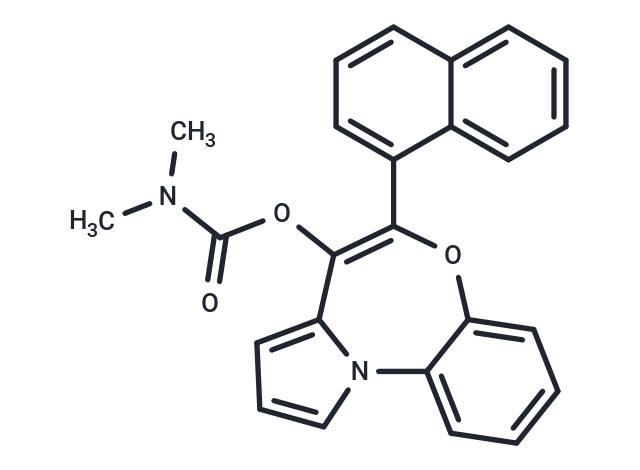
PBOX 6
CAS No. 290814-68-5
PBOX 6( —— )
Catalog No. M33452 CAS No. 290814-68-5
PBOX 6 is a pyrrolo-1,5-benzoxazepine (PBOX) compound exhibiting anticancer and antitumor activity by inhibiting breast cancer cell growth in vitro and selectively inducing apoptosis in leukemia cells through c-Jun NH2 terminal kinase-dependent phosphorylation and inactivation of Bcl-2 and Bcl-XL.
Purity : >98% (HPLC)
 COA
Datasheet
HNMR
HPLC
MSDS
Handing Instructions
COA
Datasheet
HNMR
HPLC
MSDS
Handing Instructions
| Size | Price / USD | Stock | Quantity |
| 1 mL x 10 mM in DMSO | 136 | In Stock |


|
| 5MG | 126 | In Stock |
|
| 10MG | 186 | In Stock |
|
| 25MG | 312 | In Stock |
|
| 50MG | 453 | In Stock |
|
| 100MG | 647 | In Stock |
|
| 200MG | Get Quote | In Stock |
|
| 500MG | Get Quote | In Stock |
|
| 1G | Get Quote | In Stock |
|
Biological Information
-
Product NamePBOX 6
-
NoteResearch use only, not for human use.
-
Brief DescriptionPBOX 6 is a pyrrolo-1,5-benzoxazepine (PBOX) compound exhibiting anticancer and antitumor activity by inhibiting breast cancer cell growth in vitro and selectively inducing apoptosis in leukemia cells through c-Jun NH2 terminal kinase-dependent phosphorylation and inactivation of Bcl-2 and Bcl-XL.
-
DescriptionPBOX 6 is a pyrrolo-1,5-benzoxazepine (PBOX) compound, acts as a microtubule-depolymerizing agent and an apoptotic agent.
-
In VitroPBOX 6 is a potent apoptotic PBOX, but does not elicit a general toxic effect in a rat R2C Leydig cell line. PBOX 6 (0-25 μM, 16 h) results in dose- and time-dependent induction of apoptosis, and also causes DNA fragmentation at 10 μM in HL-60 cells. PBOX 6 (10 μM) induces apoptosis through activation of caspase 3-like proteases in HL-60 cells. PBOX 6 (10 μM) induces apoptosis and exerts an accumulation of cytochromec in the cytosol, but this effect is not triggered by oxidative stress, and is independent of peripheral-type benzodiazepine receptor (PBR) and NF-κB. PBOX 6 (25 μM) induces apoptosis in MCF-7 cells through activation of caspase-7. PBOX 6 (10 μM) induces the redistribution of cypA from the nucleus to the cytosol of the cell in K562 cells. PBOX 6 (10 μM) induces nucleocytoplasmic redistribution of cypA and pin1 through a JNK-dependent manner, also dependent on upstream activation of a trypsin-like serine protease, and this effect correlates with G2/M arrest in K562 cells.
-
In Vivo——
-
Synonyms——
-
PathwayApoptosis
-
TargetApoptosis
-
RecptorApoptosis
-
Research Area——
-
Indication——
Chemical Information
-
CAS Number290814-68-5
-
Formula Weight396.44
-
Molecular FormulaC25H20N2O3
-
Purity>98% (HPLC)
-
SolubilityIn Vitro:?DMSO : 33.33 mg/mL (84.07 mM; Ultrasonic )
-
SMILESCN(C)C(=O)OC1=C(Oc2ccccc2-n2cccc12)c1cccc2ccccc12
-
Chemical Name——
Shipping & Storage Information
-
Storage(-20℃)
-
ShippingWith Ice Pack
-
Stability≥ 2 years
Reference
1. Zisterer DM, et al. Pyrrolo-1,5-benzoxazepines induce apoptosis in HL-60, Jurkat, and Hut-78 cells: a new class of apoptotic agents. J Pharmacol Exp Ther. 2000 Apr;293(1):48-59.?
molnova catalog



related products
-
Lonicerin
Lonicerin has antioxidant, anti-arthritic and antifungal activities, it can result in a combination therapy for the treatment of fungal arthritis due to C. albicans infection.
-
physalin F
Physalin F is a natural blocker of CaV2.3 (R-type) and CaV2.2 (N-type) voltage-gated calcium channels.It is a secosteroid with potent anti-inflammatory and immunomodulatory activities.
-
LYG-202
LYG-202 is a novel flavonoid with piperazine substitution and antitumor effects in vivo and in vitro.LYG-202 induced apoptosis in MCF-7, MDA-MB-231, and MDA-MB-435 cells, and increased intracellular ROS production.
