


 Cart
Cart
 sales@molnova.com


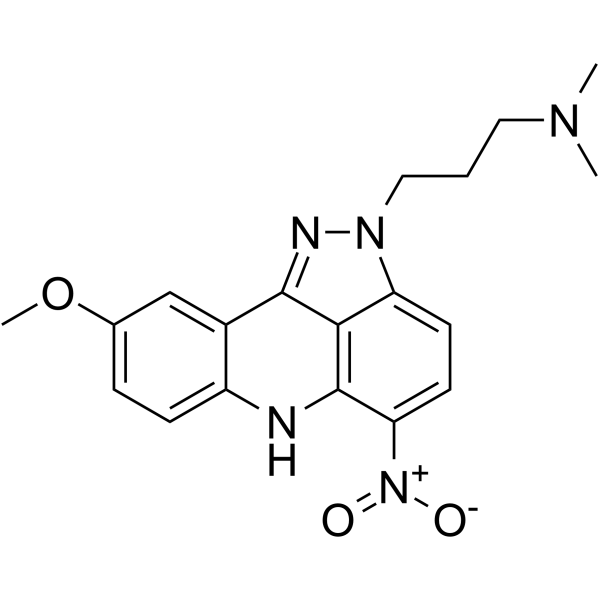
Pyrazoloacridine
CAS No. 99009-20-8
Pyrazoloacridine( PD 115934 | PD-115934 | PD 115,934 | NSC 366140 | NSC-366140 )
Catalog No. M27918 CAS No. 99009-20-8
Pyrazoloacridine is a nucleic acid binding agent that inhibits the activity of topo I and II with an IC50 of 1.25 μM in K562 cells. Pyrazoloacridine shows anti-cancer activity.
Purity : >98% (HPLC)
 COA
Datasheet
HNMR
HPLC
MSDS
Handing Instructions
COA
Datasheet
HNMR
HPLC
MSDS
Handing Instructions
| Size | Price / USD | Stock | Quantity |
| 1 mL x 10 mM in DMSO | 76 | In Stock |


|
| 5MG | 69 | In Stock |
|
| 10MG | 111 | In Stock |
|
| 25MG | 210 | In Stock |
|
| 50MG | 307 | In Stock |
|
| 100MG | 460 | In Stock |
|
| 200MG | Get Quote | In Stock |
|
| 500MG | Get Quote | In Stock |
|
| 1G | Get Quote | In Stock |
|
Biological Information
-
Product NamePyrazoloacridine
-
NoteResearch use only, not for human use.
-
Brief DescriptionPyrazoloacridine is a nucleic acid binding agent that inhibits the activity of topo I and II with an IC50 of 1.25 μM in K562 cells. Pyrazoloacridine shows anti-cancer activity.
-
DescriptionPyrazoloacridine is a nucleic acid binding agent that inhibits the activity of topo I and II with an IC50 of 1.25 μM in K562 cells. Pyrazoloacridine shows anti-cancer activity.(In Vitro):In oxic and hypoxic HCT-8 cells, Pyrazoloacridine exhibits IC50 values of 10.7 μM and 4.5 μM. Pyrazoloacridine causes delayed DNA fragmentation in MCF-7 cells and induces apoptosis in P53-deficient Hep 3B cells. Pyrazoloacridine exhibits activities against cisplatin- and paclitaxel-resistant ovarian cancer.
-
In VitroPyrazoloacridine (NSC 366140, PD 115934) exhibits IC50 values of 10.7 μM and 4.5 μM for oxic and hypoxic HCT-8 cells.Pyrazoloacridine (NSC 366140, 2-4 μM) abolishes the catalytic activity of both topo I and topo II in vitro.Pyrazoloacridine (NSC 366140) displays activity against cisplatin- and paclitaxel-resistant ovarian cancer.Pyrazoloacridine (NSC 366140) has been shown to cause delayed DNA fragmentation in MCF-7 breast cancer cells.Pyrazoloacridine (NSC 366140) induces apoptosis in P53-deficient Hep 3B human hepatoma cells.Cell Cytotoxicity Assay Cell Line:K562 Myeloid Leukemia Cells.Concentration:0-500 μM.Incubation Time:1 h or 24 h.Result:When K562 cells were incubated with PA for 1 h and then plated in soft agar, an IC50 of -50 μM was observed. In contrast, when cells were incubated for 24 h with PA, the IC50 was 1.25 μM.
-
In Vivo——
-
SynonymsPD 115934 | PD-115934 | PD 115,934 | NSC 366140 | NSC-366140
-
PathwayApoptosis
-
TargetApoptosis
-
RecptorAkt|PP2A|Apoptosis|CIP2A
-
Research Area——
-
Indication——
Chemical Information
-
CAS Number99009-20-8
-
Formula Weight367.409
-
Molecular FormulaC19H21N5O3
-
Purity>98% (HPLC)
-
SolubilityIn Vitro:?DMSO : 16.67 mg/mL (45.37 mM)
-
SMILESCOc1ccc2[nH]c3c(ccc4n(CCCN(C)C)nc(c34)c2c1)[N+]([O-])=O
-
Chemical Name——
Shipping & Storage Information
-
Storage(-20℃)
-
ShippingWith Ice Pack
-
Stability≥ 2 years
Reference
1.Chun-Yu Liu, et al. EGFR-independent Elk1/CIP2A signalling mediates apoptotic effect of an erlotinib derivative TD52 in triple-negative breast cancer cells. Eur J Cancer. 2017 Feb;72:112-123.
molnova catalog



related products
-
CNX-774
CNX-774 is a highly specific, irreversible, and orally active BTK inhibitor (IC50<1 nM).
-
(Rac)-Idroxioleic ac...
Minerval is a fatty acid amide hydrolase inhibitor with anti-tumor effect.
-
BTT-3033
BTT-3033 is an orally active and potent α2β1 (EC50: 130 nM) inhibitor with an affinity for the α2I domain, inhibiting platelet binding to collagen I and cell proliferation.
