


 Cart
Cart
 sales@molnova.com


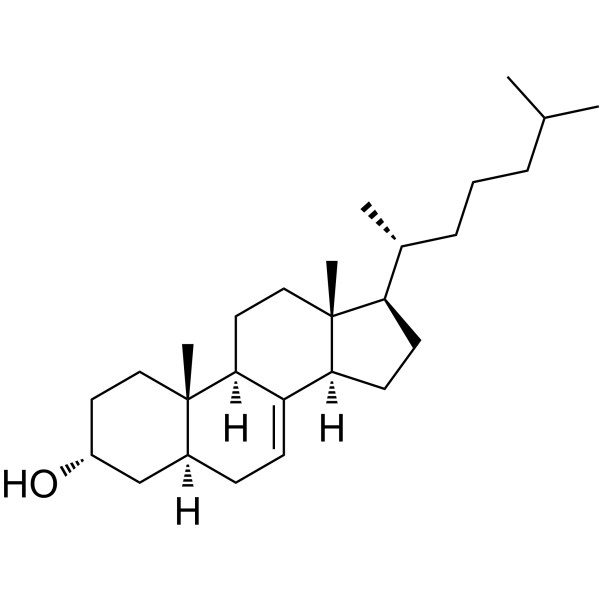
Lathosterol
CAS No. 80-99-9
Lathosterol( —— )
Catalog No. M26736 CAS No. 80-99-9
Lathosterol is a cholesterol-like endogenous metabolite. Serum Lathosterol concentration can be used as an indicator of whole-body cholesterol synthesis.
Purity : >98% (HPLC)
 COA
Datasheet
HNMR
HPLC
MSDS
Handing Instructions
COA
Datasheet
HNMR
HPLC
MSDS
Handing Instructions
| Size | Price / USD | Stock | Quantity |
| 10MG | 42 | In Stock |


|
| 25MG | 85 | In Stock |
|
| 50MG | 151 | In Stock |
|
| 100MG | 260 | In Stock |
|
| 200MG | Get Quote | In Stock |
|
| 500MG | Get Quote | In Stock |
|
| 1G | Get Quote | In Stock |
|
Biological Information
-
Product NameLathosterol
-
NoteResearch use only, not for human use.
-
Brief DescriptionLathosterol is a cholesterol-like endogenous metabolite. Serum Lathosterol concentration can be used as an indicator of whole-body cholesterol synthesis.
-
DescriptionLathosterol is a cholesterol-like endogenous metabolite. Serum Lathosterol concentration can be used as an indicator of whole-body cholesterol synthesis.
-
In Vitro——
-
In Vivo——
-
Synonyms——
-
PathwayProteasome/Ubiquitin
-
TargetEndogenous Metabolite
-
RecptorCDK9
-
Research Area——
-
Indication——
Chemical Information
-
CAS Number80-99-9
-
Formula Weight386.664
-
Molecular FormulaC27H46O
-
Purity>98% (HPLC)
-
SolubilityIn Vitro:?Ethanol : 33.33 mg/mL (86.20 )
-
SMILES[H][C@@]12CC[C@H]([C@H](C)CCCC(C)C)[C@@]1(C)CC[C@@]1([H])C2=CC[C@@]2([H])C[C@H](O)CC[C@]12C
-
Chemical Name——
Shipping & Storage Information
-
Storage(-20℃)
-
ShippingWith Ice Pack
-
Stability≥ 2 years
Reference
1.Chun Y, et al. Selective Kinase Inhibition Shows That Bur1 (Cdk9) Phosphorylates the Rpb1 Linker?In Vivo. Mol Cell Biol. 2019 Jul 16;39(15):e00602-18.
molnova catalog



related products
-
Vasopressin
Vasopressin (argipressin), a cyclic nine-peptide synthesized by hypothalamic neurons, is one of the hormones involved in peptide prohormone synthesis.
-
Oxaloacetic acid
Oxaloacetic acid also known as oxosuccinic acid or oxalacetic acid is a four-carbon dicarboxylic acid appearing as an intermediate of the citric acid cycle.
-
Creatine
Creatine is an amino acid that occurs in vertebrate tissues and in urine. In muscle tissue creatine generally occurs as phosphocreatine.
