


 Cart
Cart
 sales@molnova.com


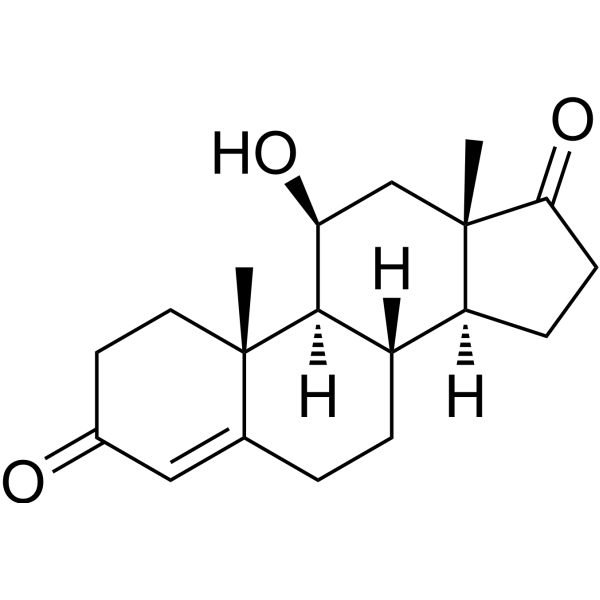
11-Beta-hydroxyandrostenedione
CAS No. 382-44-5
11-Beta-hydroxyandrostenedione( 4-Androsten-11β-ol-3,17-dione | NSC-17102 )
Catalog No. M26588 CAS No. 382-44-5
11-Beta-hydroxyandrostenedione is a steroid mainly found in the adrenal origin (11β-hydroxylase is present in adrenal tissue, but absent in ovarian tissue).
Purity : >98% (HPLC)
 COA
Datasheet
HNMR
HPLC
MSDS
Handing Instructions
COA
Datasheet
HNMR
HPLC
MSDS
Handing Instructions
| Size | Price / USD | Stock | Quantity |
| 1 mL x 10 mM in DMSO | 41 | In Stock |


|
| 5MG | 37 | In Stock |
|
| 10MG | 61 | In Stock |
|
| 25MG | 122 | In Stock |
|
| 50MG | 193 | In Stock |
|
| 100MG | 291 | In Stock |
|
| 200MG | Get Quote | In Stock |
|
| 500MG | 700 | In Stock |
|
| 1G | Get Quote | In Stock |
|
Biological Information
-
Product Name11-Beta-hydroxyandrostenedione
-
NoteResearch use only, not for human use.
-
Brief Description11-Beta-hydroxyandrostenedione is a steroid mainly found in the adrenal origin (11β-hydroxylase is present in adrenal tissue, but absent in ovarian tissue).
-
Description11-Beta-hydroxyandrostenedione is a steroid mainly found in the adrenal origin (11β-hydroxylase is present in adrenal tissue, but absent in ovarian tissue), which is a 11β-hydroxysteroid dehydrogenase isozymes inhibitor. Measuring plasma 11-Beta-hydroxyandrostenedione can distinguish the adrenal or ovarian origin of hyperandrogenism with 4-androstenedione increases.(In Vitro):21-deoxycortisol (21dF) and 21-deoxycortisone (21dE) are assayed within the LNCaP cell line to establish that this conversion is catalyzed by the lyase activity of CYP17A1. After the transfection of CYP17A1, 11-Beta-hydroxyandrostenedione (11OHA4)-pathway metabolites increase, 21dF, and 21dE are in fact metabolized to 11-Beta-hydroxyandrostenedione and 11-ketoprogesterone (11KP4) by CYP17A1, respectively .(In Vivo):In 21-hydroxylase deficiency, Cushing's syndrome, and hyperandrogenism of adrenal origin, the plasma concentration of 11-Beta-hydroxyandrostenedione (11beta-hydroxy-4-androstene-3,17-dione) is very high. In congenital 11-hydroxylase deficiency and adrenal insufficiency, the plasma concentration of 11-Beta-hydroxyandrostenedione (11beta-hydroxy-4-androstene-3,17-dione) is very low. Thus, when plasma 4-androstenedione is elevated, it is useful to measure the plasma 11-Beta-hydroxyandrostenedione level in order to determine the adrenal or ovarian origin of the hyperandrogenism .
-
In VitroIn order to establish that this conversion is catalysed by the lyase activity of CYP17A1, 21-deoxycortisol (21dF) and 21-deoxycortisone (21dE) is assayed within the LNCaP cell line. Upon the transfection of CYP17A1, 11-Beta-hydroxyandrostenedione (11OHA4)-pathway metabolites increase, 21dF and 21dE are in fact metabolised to 11-Beta-hydroxyandrostenedione and 11-ketoprogesterone (11KP4) by CYP17A1, respectively.
-
In VivoThe plasma concentration of 11-Beta-hydroxyandrostenedione (11beta-hydroxy-4-androstene-3,17-dione) is very high in 21-hydroxylase deficiency, Cushing's syndrome, and hyperandrogenism of adrenal origin, and very low in congenital 11-hydroxylase deficiency and adrenal insufficiency. Thus, when plasma 4-androstenedione is elevated, it is useful to measure the plasma 11-Beta-hydroxyandrostenedione level in order to determine the adrenal or ovarian origin of the hyperandrogenism.
-
Synonyms4-Androsten-11β-ol-3,17-dione | NSC-17102
-
PathwayProteasome/Ubiquitin
-
TargetEndogenous Metabolite
-
Recptorα1-adrenergic receptor
-
Research Area——
-
Indication——
Chemical Information
-
CAS Number382-44-5
-
Formula Weight302.414
-
Molecular FormulaC19H26O3
-
Purity>98% (HPLC)
-
SolubilityIn Vitro:?DMSO : 100 mg/mL (330.68 mM)
-
SMILESC[C@]12C[C@H](O)[C@H]3[C@@H](CCC4=CC(=O)CC[C@]34C)[C@@H]1CCC2=O
-
Chemical Name——
Shipping & Storage Information
-
Storage(-20℃)
-
ShippingWith Ice Pack
-
Stability≥ 2 years
Reference
1.Miura, Y. and K. Yoshinaga, Doxazosin: a newly developed, selective alpha 1-inhibitor in the management of patients with pheochromocytoma. Am Heart J, 1988. 116(6 Pt 2): p. 1785-9.
molnova catalog



related products
-
Aprocitentan
Aprocitentan is ETA and ETB antagonist .
-
Aniline
Aniline has been reported to be toxic to the spleen via iron overload and induction of oxidative stress via Heme Oxygenase 1 up-regulation.
-
2-Hydroxybutyric aci...
2-Hydroxybutyric acid (α-Hydroxybutyric acid) is a product of protein metabolism and serves as a biomarker for type 2 diabetes and pre-eclampsia.
