


 Cart
Cart
 sales@molnova.com


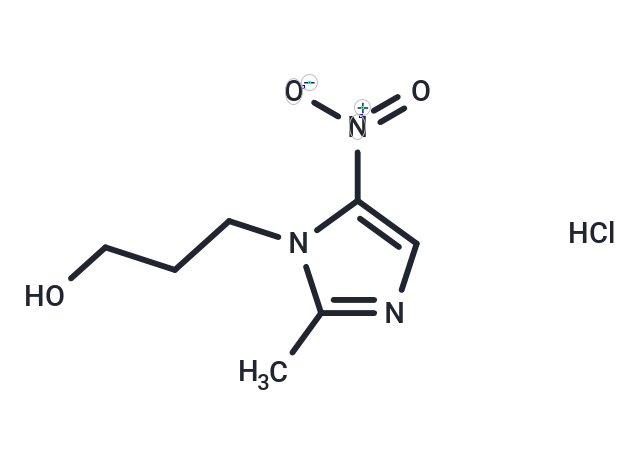
Ternidazole hydrochloride
CAS No. 70028-95-4
Ternidazole hydrochloride( —— )
Catalog No. M34954 CAS No. 70028-95-4
Ternidazole hydrochloride (Ternidazole HCl) is a 5-nitroimidazole antibiotic with antimicrobial antioxidant and antiprotozoal activity.
Purity : >98% (HPLC)
 COA
Datasheet
HNMR
HPLC
MSDS
Handing Instructions
COA
Datasheet
HNMR
HPLC
MSDS
Handing Instructions
| Size | Price / USD | Stock | Quantity |
| 1 mL x 10 mM in DMSO | 41 | In Stock |


|
| 2MG | 28 | In Stock |
|
| 100MG | Get Quote | In Stock |
|
| 200MG | Get Quote | In Stock |
|
| 500MG | Get Quote | In Stock |
|
| 1G | Get Quote | In Stock |
|
Biological Information
-
Product NameTernidazole hydrochloride
-
NoteResearch use only, not for human use.
-
Brief DescriptionTernidazole hydrochloride (Ternidazole HCl) is a 5-nitroimidazole antibiotic with antimicrobial antioxidant and antiprotozoal activity.
-
DescriptionTernidazole hydrochloride is a hydroxymetabolite of nitroimidazole, has antiprotozoic properties.
-
In Vitro——
-
In Vivo——
-
Synonyms——
-
PathwayProteasome/Ubiquitin
-
TargetEndogenous Metabolite
-
RecptorEndogenous Metabolite | Antioxidant | Antibacterial
-
Research Area——
-
Indication——
Chemical Information
-
CAS Number70028-95-4
-
Formula Weight221.64
-
Molecular FormulaC7H12ClN3O3
-
Purity>98% (HPLC)
-
SolubilityIn Vitro:?DMSO : 250 mg/mL (1127.96 mM; Ultrasonic )
-
SMILESO=[N+]([O-])C1=CN=C(C)N1CCCO.Cl
-
Chemical Name——
Shipping & Storage Information
-
Storage(-20℃)
-
ShippingWith Ice Pack
-
Stability≥ 2 years
Reference
1. Nathalie Mahé, et al. Solid-state studies of the triclinic (Z' = 2) antiprotozoal drug ternidazole. J Pharm Sci. 2011 Jun;100(6):2258-66.?
molnova catalog



related products
-
Darusentan
Darusentan is a potent inhibitor of endothelin signaling and function in both large and small arteries.
-
Coenzyme Q9
Coenzyme Q9 (CoQ9) is a normal constituent of human plasma.?CoQ9 in human plasma may originate as a product of incomplete CoQ10 biosynthesis or from the diet.
-
4-tert-Octylphenol
4-tert-Octylphenol, an endocrine-disrupting chemical with estrogenic properties, notably induces apoptosis in offspring mouse brain neuronal progenitor cells.
