


 Cart
Cart
 sales@molnova.com


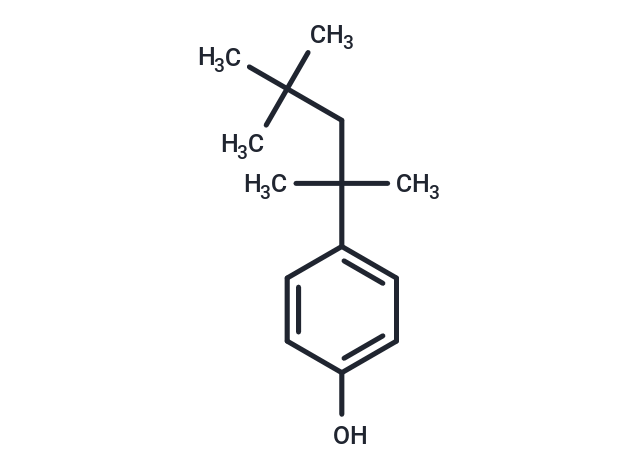
4-tert-Octylphenol
CAS No. 140-66-9
4-tert-Octylphenol( —— )
Catalog No. M35799 CAS No. 140-66-9
4-tert-Octylphenol, an endocrine-disrupting chemical with estrogenic properties, notably induces apoptosis in offspring mouse brain neuronal progenitor cells.
Purity : >98% (HPLC)
 COA
Datasheet
HNMR
HPLC
MSDS
Handing Instructions
COA
Datasheet
HNMR
HPLC
MSDS
Handing Instructions
| Size | Price / USD | Stock | Quantity |
| 1 mL x 10 mM in DMSO | 28 | In Stock |


|
| 100MG | Get Quote | In Stock |
|
| 200MG | 27 | In Stock |
|
| 500MG | 43 | In Stock |
|
| 1G | 61 | In Stock |
|
Biological Information
-
Product Name4-tert-Octylphenol
-
NoteResearch use only, not for human use.
-
Brief Description4-tert-Octylphenol, an endocrine-disrupting chemical with estrogenic properties, notably induces apoptosis in offspring mouse brain neuronal progenitor cells.
-
Description4-tert-Octylphenol, a endocrine-disrupting chemical, is an estrogenic agent. 4-tert-Octylphenol induces apoptosis in neuronal progenitor cells in offspring mouse brain. 4-tert-Octylphenol reduces bromodeoxyuridine (BrdU), mitotic marker Ki67, and phospho-histone H3 (p-Histone-H3), resulting in a reduction of neuronal progenitor proliferation. 4-tert-Octylphenol disrupts brain development and behavior in mice.
-
In Vitro——
-
In Vivo——
-
Synonyms——
-
PathwayProteasome/Ubiquitin
-
TargetEndogenous Metabolite
-
RecptorEndogenous Metabolite
-
Research Area——
-
Indication——
Chemical Information
-
CAS Number140-66-9
-
Formula Weight206.32
-
Molecular FormulaC14H22O
-
Purity>98% (HPLC)
-
SolubilityIn Vitro:?DMSO : 100 mg/mL (484.68 mM; Ultrasonic )
-
SMILESCC(C)(C)CC(C)(C)C1=CC=C(O)C=C1
-
Chemical Name——
Shipping & Storage Information
-
Storage(-20℃)
-
ShippingWith Ice Pack
-
Stability≥ 2 years
Reference
1. Dinh Nam Tran, et al. 4-tert-Octylphenol Exposure Disrupts Brain Development and Subsequent Motor, Cognition, Social, and Behavioral Functions. Oxidative Medicine and Cellular Longevity, 2020.
molnova catalog



related products
-
Estrone sulfate pota...
Estrone sulfate potassium is an estrogen ester and conjugate, a natural endogenous steroid.
-
Oxaloacetic acid
Oxaloacetic acid also known as oxosuccinic acid or oxalacetic acid is a four-carbon dicarboxylic acid appearing as an intermediate of the citric acid cycle.
-
5,6-Dihydroxyindole
5,6-Dihydroxyindole (Dopamine lutine) is a melanin precursor and has a broad-spectrum antibacterial, antiviral, antifungal, antiparasitic activity.
