


 Cart
Cart
 sales@molnova.com


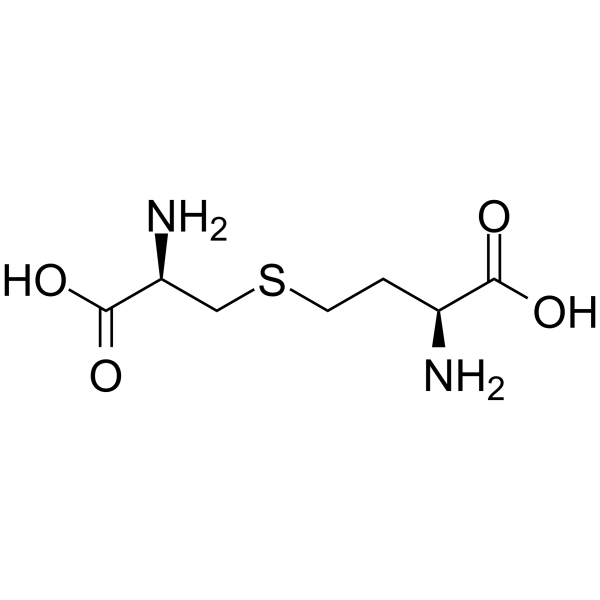
L-Cystathionine
CAS No. 56-88-2
L-Cystathionine( Cystathionine | L-(+)-Cystathionine | Cystathionine, L- | ZINC1532680 )
Catalog No. M26140 CAS No. 56-88-2
L-Cystathionine is a key nonprotein amino acid related to metabolic conditions of sulfur-containing amino acids.
Purity : >98% (HPLC)
 COA
Datasheet
HNMR
HPLC
MSDS
Handing Instructions
COA
Datasheet
HNMR
HPLC
MSDS
Handing Instructions
| Size | Price / USD | Stock | Quantity |
| 5MG | 93 | In Stock |


|
| 10MG | 135 | In Stock |
|
| 25MG | 224 | In Stock |
|
| 50MG | 324 | In Stock |
|
| 100MG | 482 | In Stock |
|
| 200MG | Get Quote | In Stock |
|
| 500MG | Get Quote | In Stock |
|
| 1G | Get Quote | In Stock |
|
Biological Information
-
Product NameL-Cystathionine
-
NoteResearch use only, not for human use.
-
Brief DescriptionL-Cystathionine is a key nonprotein amino acid related to metabolic conditions of sulfur-containing amino acids.
-
DescriptionL-Cystathionine is a key nonprotein amino acid related to metabolic conditions of sulfur-containing amino acids. L-Cystathionine can be used in studies about cardiovascular protection.(In Vitro):L-Cystathionine protects against homocysteine-induced mitochondria-dependent apoptosis of vascular endothelial cells. l-Cystathione reduces mitochondrial superoxide anion production and Bax expression and inhibits its translocation to mitochondria, increases mitochondrial membrane potential, inhibits the opening of mitochondrial permeability transition pores, inhibits cytochrome c leakage from mitochondria into the cytoplasm, and downregulates caspase-9 and caspase-3 activity .
-
In Vitro——
-
In Vivo——
-
SynonymsCystathionine | L-(+)-Cystathionine | Cystathionine, L- | ZINC1532680
-
PathwayApoptosis
-
TargetApoptosis
-
Recptor——
-
Research Area——
-
Indication——
Chemical Information
-
CAS Number56-88-2
-
Formula Weight222.26
-
Molecular FormulaC7H14N2O4S
-
Purity>98% (HPLC)
-
SolubilityIn Vitro:?1M HCl : 50 mg/mL (224.96 mM)
-
SMILESN[C@@H](CCSC[C@H](N)C(O)=O)C(O)=O
-
Chemical Name——
Shipping & Storage Information
-
Storage(-20℃)
-
ShippingWith Ice Pack
-
Stability≥ 2 years
Reference
1.YongWang, et al. Comparison of two different processes to synthesize biodiesel by waste cooking oil. Journal of Molecular Catalysis A: Chemical. Volume 252, Issues 1–2, 1 June 2006, Pages 107-112
molnova catalog



related products
-
Pipobroman
Pipobroman is an anti-cancer drug that probably acts as an alkylating agent.
-
Se-Aspirin
Se-Aspirin (Se-NSAID-8) has anticancer activity and gastroprotective effects, inhibits activation of proinflammatory and pro-survival NF-?B pathways, and inhibits the expression of anti-apoptotic targets downstream of NF-?B (e.g., Bcl-xL, Mcl-1, and survivin).
-
Sandacanol
Sandacanol(Sandranol) is a selective olfactory receptor (OR10H1) agonist. Sandacanol can induce cell cycle arrest and partial apoptosis in bladder cancer cells, and can reduce cell migration rate and proliferation rate.
