


 Cart
Cart
 sales@molnova.com


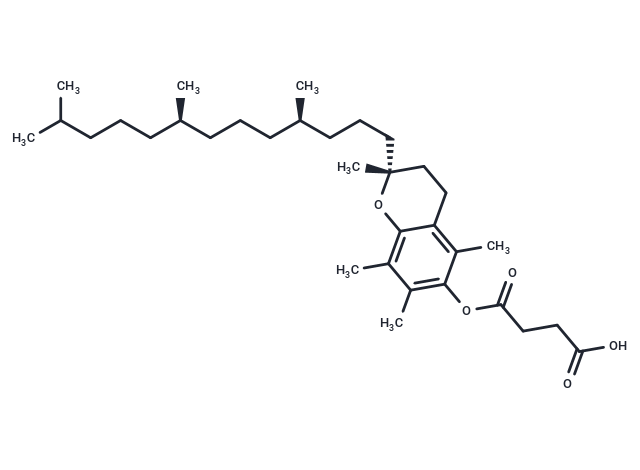
Vitamin E succinate
CAS No. 4345-03-3
Vitamin E succinate( —— )
Catalog No. M35841 CAS No. 4345-03-3
Vitamin E succinate (D-alpha-Tocopherol Succinate) is an antioxidant tocopherol that belongs to the vitamin E class of compounds Vitamin E succinate has antitumor activity, induces apoptosis, and is used as an adjuvant in the treatment of cancer and in the synthesis of INVITE, a biocoupling compound.
Purity : >98% (HPLC)
 COA
Datasheet
HNMR
HPLC
MSDS
Handing Instructions
COA
Datasheet
HNMR
HPLC
MSDS
Handing Instructions
| Size | Price / USD | Stock | Quantity |
| 50MG | 28 | In Stock |


|
| 100MG | 36 | In Stock |
|
| 200MG | Get Quote | In Stock |
|
| 500MG | 69 | In Stock |
|
| 1G | 102 | In Stock |
|
Biological Information
-
Product NameVitamin E succinate
-
NoteResearch use only, not for human use.
-
Brief DescriptionVitamin E succinate (D-alpha-Tocopherol Succinate) is an antioxidant tocopherol that belongs to the vitamin E class of compounds Vitamin E succinate has antitumor activity, induces apoptosis, and is used as an adjuvant in the treatment of cancer and in the synthesis of INVITE, a biocoupling compound.
-
DescriptionD-α-Tocopherol Succinate (Vitamin E succinate) is an antioxidant tocopherol and a salt form of vitamin E. D-α-Tocopherol Succinate inhibits Cisplatin (HY-17394)-induced cytotoxicity. D-α-Tocopherol Succinate can be used for the research of cancer.
-
In VitroD-α-Tocopherol Succinate (1-20 μM; 24 hours) shows cytotoxicity to HEI-OC1 cells.D-α-Tocopherol Succinate (10 μM; 48 hours) protects HEI-OC1 cells against cisplatin-induced ototoxicity and inhibits caspase-3 activity.D-α-Tocopherol Succinate (0-50 μM; 18 hours) shows cytotoxicity to TC-1 tumor cells.Cell Cytotoxicity Assay Cell Line:HEI-OC1 cell line Concentration:1-20 μM Incubation Time:24 hoursResult:Significantly induced cytotoxicity at a concentration of 20 μM and showed a higher cytotoxicity potency compared with 10 μM.Cell Viability Assay Cell Line:HEI-OC1 cell line Concentration:10 μM Incubation Time:48 hours Result:Increased cisplatin-induced cell population. Inhibited cisplatin-induced necrotic, ROS production and late apoptosis. Decreased cleaved PARP and inhibited the expression of caspase-3 which related to cisplatin-induced apoptosis.Cell Cytotoxicity Assay Cell Line:TC-1 tumor cells Concentration:0, 25 and 50 μM Incubation Time:18 hours Result:Dose-dependently showed cytotoxic and induced a higher percentage of necrotic TC-1 cells as opposed to apoptotic cells.
-
In VivoD-α-Tocopherol Succinate (1-2 mg/kg; i.p. three times at 2 day intervals from TC-1 tumor cells injection for 10 days to 14 days) shows antitumor effects to mice with TC-1 tumor.Animal Model:Six- to eight-week-old female C57BL/6 mice with TC-1 tumor cellsDosage:1 and 2 mg/kg Administration:Intraperitoneal injection; 1 and 2 mg/kg three times at 2 day intervals; from TC-1 tumor cells injection for 10 days to 14 days Result:Dreased the tumor volume, especially with a dose of 2 mg/kg.
-
Synonyms——
-
PathwayApoptosis
-
TargetApoptosis
-
RecptorApoptosis
-
Research Area——
-
Indication——
Chemical Information
-
CAS Number4345-03-3
-
Formula Weight530.78
-
Molecular FormulaC33H54O5
-
Purity>98% (HPLC)
-
SolubilityIn Vitro:?DMSO : 250 mg/mL (471.00 mM; Ultrasonic )
-
SMILESCC(C)CCC[C@@H](C)CCC[C@@H](C)CCC[C@]1(C)CCc2c(C)c(OC(=O)CCC(O)=O)c(C)c(C)c2O1
-
Chemical Name——
Shipping & Storage Information
-
Storage(-20℃)
-
ShippingWith Ice Pack
-
Stability≥ 2 years
Reference
1. Kim SK, et al. The effects of the antioxidant α-tocopherol succinate on cisplatin-induced ototoxicity in HEI-OC1 auditory cells. Int J Pediatr Otorhinolaryngol. 2016 Jul;86:9-14.?
molnova catalog



related products
-
Lanperisone HCl
Lanperisone HCl (NK 433) is a novel orally available centrally acting muscle relaxant with anticancer activity and inhibits mono- and polysynaptic reflex potentials.
-
ZNL 02-096
ZNL 02-096 (Pomalidomide-C3-adavosertib) is a rapid and selective degrader of Wee1 (IC50=3.58 nM).
-
Mepazine
Mepazine is a potent and selective inhibitor of MALT1. Mepazine inhibits GSTMALT1 full length and GSTMALT1 325-760 with IC50s of 0.83 μM and 0.42 μM.
