


 Cart
Cart
 sales@molnova.com


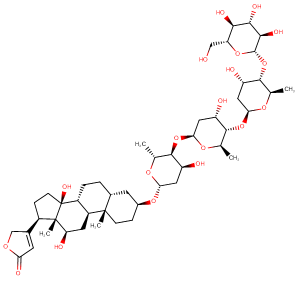
Deslanoside
CAS No. 17598-65-1
Deslanoside( Deacetyllanatoside C | Desacetyllanatoside C )
Catalog No. M21488 CAS No. 17598-65-1
Deslanoside is a rapidly acting cardiac glycoside used to treat congestive heart failure and supraventricular arrhythmias due to reentry mechanisms. Deslanoside inhibits the Na-K-ATPase membrane pump resulting in an increase in intracellular sodium and calcium concentrations.
Purity : >98% (HPLC)
 COA
Datasheet
HNMR
HPLC
MSDS
Handing Instructions
COA
Datasheet
HNMR
HPLC
MSDS
Handing Instructions
| Size | Price / USD | Stock | Quantity |
| 1 mL x 10 mM in DMSO | 256 | In Stock |


|
| 5MG | 155 | In Stock |
|
| 10MG | 246 | In Stock |
|
| 25MG | 417 | In Stock |
|
| 50MG | 586 | In Stock |
|
| 100MG | 834 | In Stock |
|
| 200MG | Get Quote | In Stock |
|
| 500MG | Get Quote | In Stock |
|
| 1G | Get Quote | In Stock |
|
Biological Information
-
Product NameDeslanoside
-
NoteResearch use only, not for human use.
-
Brief DescriptionDeslanoside is a rapidly acting cardiac glycoside used to treat congestive heart failure and supraventricular arrhythmias due to reentry mechanisms. Deslanoside inhibits the Na-K-ATPase membrane pump resulting in an increase in intracellular sodium and calcium concentrations.
-
DescriptionDeslanoside is a rapidly acting cardiac glycoside used to treat congestive heart failure and supraventricular arrhythmias due to reentry mechanisms. Deslanoside inhibits the Na-K-ATPase membrane pump resulting in an increase in intracellular sodium and calcium concentrations.
-
In Vitro——
-
In Vivo——
-
SynonymsDeacetyllanatoside C | Desacetyllanatoside C
-
PathwayEndocrinology/Hormones
-
TargetATPase
-
RecptorNa+/K+-ATPase
-
Research AreaCardiovascular Disease
-
IndicationCongestive cardiac insufficiency arrhythmias and heart failure.
Chemical Information
-
CAS Number17598-65-1
-
Formula Weight943.1
-
Molecular FormulaC47H74O19
-
Purity>98% (HPLC)
-
SolubilityIn Vitro:?DMSO : 100 mg/mL (106.04 mM)
-
SMILESC[C@@H]1[C@H]([C@H](C[C@@H](O1)O[C@H]2CC[C@]3([C@@H](C2)CC[C@@H]4[C@@H]3C[C@H]([C@]5([C@@]4(CC[C@@H]5C6=CC(=O)OC6)O)C)O)C)O)O[C@H]7C[C@@H]([C@@H]([C@H](O7)C)O[C@H]8C[C@@H]([C@@H]([C@H](O8)C)O[C@H]9[C@@H]([C@H]([C@@H]([C@H](O9)CO)O)O)O)O)O
-
Chemical Name4-((3S5R8R9S10S12R13S14S17R)-1214-dihydroxy-3-(((2R4S5S6R)-4-hydroxy-5-(((2S4S5S6R)-4-hydroxy-5-(((2S4S5S6R)-4-hydroxy-6-methyl-5-(((2S3R4S5S6R)-345-trihydroxy-6-(hydroxymethyl)tetrahydro-2H-pyran-2-yl)oxy)tetrahydro-2H-pyran-2-yl)oxy)-6-methyltetrahydro-2H-pyran-2-yl)oxy)-6-methyltetrahydro-2H-pyran-2-yl)oxy)-1013-dimethylhexadecahydro-1H-cyclopenta[a]phenanthren-17-yl)furan-2(5H)-one
Shipping & Storage Information
-
Storage(-20℃)
-
ShippingWith Ice Pack
-
Stability≥ 2 years
Reference
1.Hauptman PJ et al. Digitalis. Circulation. 1999 Mar 9;99(9):1265-70.
molnova catalog



related products
-
Digoxin
Digoxin is occasionally used in the treatment of various heart conditions namely atrial fibrillation atrial flutter and sometimes heart failure that cannot be controlled by other medication.
-
Bufalin
Bufalin is an active ingredient and one of the glycosides in the traditional Chinese medicine ChanSu.
-
Istaroxime hydrochlo...
Istaroxime hydrochloride (PST2744 hydrochloride) is a Na+/K+-ATPase inhibitor and sarcoplasmic/endoplasmic reticulum calcium ATPase 2 (SERCA 2) activator, a novel positive inotropic compound that can be used to study acute heart failure.
