


 Cart
Cart
 sales@molnova.com


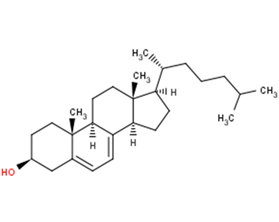
7-Dehydrocholesterol
CAS No. 434-16-2
7-Dehydrocholesterol( 7-DHC | Provitamin D3 )
Catalog No. M19772 CAS No. 434-16-2
7-Dehydrocholesterol down-regulates cholesterol biosynthesis in cultured Smith-Lemi-Opitz syndrome skin fibroblasts.
Purity : >98% (HPLC)
 COA
Datasheet
HNMR
HPLC
MSDS
Handing Instructions
COA
Datasheet
HNMR
HPLC
MSDS
Handing Instructions
| Size | Price / USD | Stock | Quantity |
| 1 mL x 10 mM in DMSO | 37 | In Stock |


|
| 50MG | 31 | In Stock |
|
| 100MG | 44 | In Stock |
|
| 200MG | Get Quote | In Stock |
|
| 500MG | 104 | In Stock |
|
| 1G | Get Quote | In Stock |
|
Biological Information
-
Product Name7-Dehydrocholesterol
-
NoteResearch use only, not for human use.
-
Brief Description7-Dehydrocholesterol down-regulates cholesterol biosynthesis in cultured Smith-Lemi-Opitz syndrome skin fibroblasts.
-
Description7-Dehydrocholesterol down-regulates cholesterol biosynthesis in cultured Smith-Lemi-Opitz syndrome skin fibroblasts.(In Vitro):7-Dehydrocholesterol is a biosynthetic precursor of cholesterol and vitamin D3. 7-Dehydrocholesterol is present in relatively high concentration in skin where it is converted to pre-vitamin D3 upon UV irradiation and where it is also exposed to exogenous radical sources and oxygen.
-
In Vitro7-Dehydrocholesterol is a biosynthetic precursor of cholesterol and vitamin D3. 7-Dehydrocholesterol is present in relatively high concentration in skin where it is converted to pre-vitamin D3 upon UV irradiation and where it is also exposed to exogenous radical sources and oxygen.
-
In Vivo——
-
Synonyms7-DHC | Provitamin D3
-
PathwayProteasome/Ubiquitin
-
TargetEndogenous Metabolite
-
RecptorHuman Endogenous Metabolite
-
Research Area——
-
Indication——
Chemical Information
-
CAS Number434-16-2
-
Formula Weight384.64
-
Molecular FormulaC27H44O
-
Purity>98% (HPLC)
-
SolubilityDMSO:10mM
-
SMILESCC(C)CCC[C@@H](C)[C@H]1CC[C@H]2C3=CC=C4C[C@@H](O)CC[C@]4(C)[C@H]3CC[C@]12C
-
Chemical Name——
Shipping & Storage Information
-
Storage(-20℃)
-
ShippingWith Ice Pack
-
Stability≥ 2 years
Reference
1.Lehmann B Genehr T Knuschke P et al. UVB-Induced Conversion of 7-Dehydrocholesterol to 1α25-Dihydroxyvitamin D3 in an In Vitro Human Skin Equivalent Model[J]. Journal of Investigative Dermatology 2001 117(5):1179.
molnova catalog



related products
-
4-Guanidinobutyric a...
4-Guanidinobutyric acid is an L-arginine metabolite that has been used in the intestinal transport tranport studies. It has been specifically use to human proton coupled amino acid transporters hPAT1.
-
Meconin
Meconin is a noscapine metabolite and a useful adjunct in detecting illicit opiate use.
-
D-chiro-Inositol
D-chiro-Inositol is an epimer of myo-inositol that is found in certain mammalian glycosylphosphatidylinositol protein anchors and inositol phosphoglycans possessing insulin-like bioactivity.
