


 Cart
Cart
 sales@molnova.com


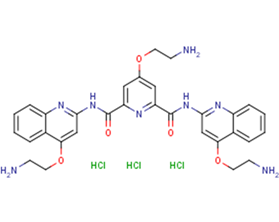
Pyridostatin Trihydrochloride
CAS No. ——
Pyridostatin Trihydrochloride( —— )
Catalog No. M19314 CAS No. ——
Pyridostatin hydrochloride is a G-quadruplexe stabilizer, with a Kd of 490 nM.
Purity : >98% (HPLC)
 COA
Datasheet
HNMR
HPLC
MSDS
Handing Instructions
COA
Datasheet
HNMR
HPLC
MSDS
Handing Instructions
| Size | Price / USD | Stock | Quantity |
| 5MG | 74 | Get Quote |


|
| 10MG | 111 | Get Quote |
|
| 25MG | 198 | Get Quote |
|
| 50MG | 299 | Get Quote |
|
| 100MG | Get Quote | Get Quote |
|
| 200MG | Get Quote | Get Quote |
|
| 500MG | Get Quote | Get Quote |
|
| 1G | Get Quote | Get Quote |
|
Biological Information
-
Product NamePyridostatin Trihydrochloride
-
NoteResearch use only, not for human use.
-
Brief DescriptionPyridostatin hydrochloride is a G-quadruplexe stabilizer, with a Kd of 490 nM.
-
DescriptionPyridostatin hydrochloride is a G-quadruplexe stabilizer, with a Kd of 490 nM.
-
In Vitro——
-
In Vivo——
-
Synonyms——
-
PathwayGPCR/G Protein
-
TargetCalcium Channel
-
RecptorG-quadruplexe
-
Research Area——
-
Indication——
Chemical Information
-
CAS Number——
-
Formula Weight706.02
-
Molecular FormulaC31H35Cl3N8O5
-
Purity>98% (HPLC)
-
Solubility——
-
SMILESCl.Cl.Cl.O=C(Nc1cc(OCCN)c2ccccc2n1)c3cc(OCCN)cc(n3)C(=O)Nc4cc(OCCN)c5ccccc5n4
-
Chemical Name——
Shipping & Storage Information
-
Storage(-20℃)
-
ShippingWith Ice Pack
-
Stability≥ 2 years
Reference
1.Koirala D,etal.A single-molecule platform for investigation of interactions between G-quadruplexes and small-molecule ligands.Nat Chem. 2011 Aug 28;3(10):782-7.
molnova catalog



related products
-
Gallopamil hydrochlo...
Gallopamil hydrochloride is an antagonist of phenylalkylamine calcium. Gallopamil hydrochloride can be used in antiarrhythmic and vasodilator studies.
-
Jamaicin
Jamaicin (AnCoA4), an isoflavone derived from the chickweed plant, is an inhibitor of the STIM1-Orai1 channel that blocks calcium influx, reduces its interaction with STIM1, and inhibits T-cell activation.
-
Efonidipine hydrochl...
Efonidipine (NZ-105) is a potent, dual T-type and L-type calcium channel blocker.
