


 Cart
Cart
 sales@molnova.com


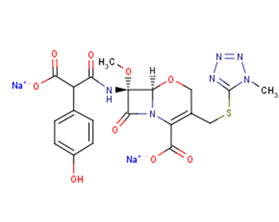
Moxalactam Disodium
CAS No. 64953-12-4
Moxalactam Disodium( Moxalactam Disodium | Latamoxef, Sodium Salt )
Catalog No. M18954 CAS No. 64953-12-4
Moxalactam sodium salt is an antibiotic compound more effective against Escherichia coli and Pseudomonas aeruginosathan cephalosporins.
Purity : >98% (HPLC)
 COA
Datasheet
HNMR
HPLC
MSDS
Handing Instructions
COA
Datasheet
HNMR
HPLC
MSDS
Handing Instructions
| Size | Price / USD | Stock | Quantity |
| 1 mL x 10 mM in DMSO | 28 | In Stock |


|
| 100MG | 27 | In Stock |
|
| 200MG | Get Quote | In Stock |
|
| 500MG | Get Quote | In Stock |
|
| 1G | Get Quote | In Stock |
|
Biological Information
-
Product NameMoxalactam Disodium
-
NoteResearch use only, not for human use.
-
Brief DescriptionMoxalactam sodium salt is an antibiotic compound more effective against Escherichia coli and Pseudomonas aeruginosathan cephalosporins.
-
DescriptionMoxalactam sodium salt is an antibiotic compound more effective against Escherichia coli and Pseudomonas aeruginosathan cephalosporins.(In Vitro):Moxalactam (Latamoxef) inhibits 90% of strains of Escherichia coli, Klebsiella species, Proteus species, Morganella morganii, Neisseria gonorrhoeae, Neisseria meningitidis, Haemophilus influenzae and Salmonella species, including strains which are resistant to Cephalothin (HY-B1275A) and Gentamicin (HY-A0276A) at concentrations of less than 1 μg/mL.Moxalactam exhibits moderate activity against P. aeruginosa and is usually active against other species of Pseudomonas, Acinetobacter species are usually resistant to Moxalactam.Moxalactam has marked stability in vitro against a variety of β-lactamases, including that produced by B. fragilis, inhibits production of β-lactamases and does not induce class I β-lactamase.(In Vivo):Moxalactam (Latamoxef) (0-7.4 mg/mouse; s.c.; once) is effective against bacterial infections in mice.
-
In VitroMoxalactam (Latamoxef) inhibits 90% of strains of Escherichia coli, Klebsiella species, Proteus species, Morganella morganii, Neisseria gonorrhoeae, Neisseria meningitidis, Haemophilus influenzae and Salmonella species, including strains which are resistant to Cephalothin (HY-B1275A) and Gentamicin (HY-A0276A) at concentrations of less than 1 μg/mL.Moxalactam exhibits moderate activity against P. aeruginosa and is usually active against other species of Pseudomonas, Acinetobacter species are usually resistant to Moxalactam.Moxalactam has marked stability in vitro against a variety of β-lactamases, including that produced by B. fragilis, inhibits production of β-lactamases and does not induce class I β-lactamase.
-
In VivoMoxalactam (Latamoxef) (0-7.4 mg/mouse; s.c.; once) is effective against bacterial infections in mice. Animal Model:Four-week-old male strain ICR mice, weighing 18-20 g, bacterial infection model Dosage:0-7.4 mg/mouse Administration:Subcutaneous injection, once Result:Showed protective activity with ED50s less than 7.4 mg/mouse against gram-positive and gram-negative bacteria infected mice.
-
SynonymsMoxalactam Disodium | Latamoxef, Sodium Salt
-
PathwayEndocrinology/Hormones
-
TargetAChR
-
RecptorAntibacterial
-
Research AreaInfection
-
Indication——
Chemical Information
-
CAS Number64953-12-4
-
Formula Weight564.44
-
Molecular FormulaC20H18N6Na2O9S
-
Purity>98% (HPLC)
-
SolubilityDMSO : ≥ 38 mg/mL; 67.32 mM
-
SMILES[H][C@]12OCC(CSC3=NN=NN3C)=C(N1C(=O)[C@]2(NC(=O)[C@H](C(=O)O[Na])C1=CC=C(O)C=C1)OC)C(=O)O[Na]
-
Chemical Namesodium (6R,7R)-7-(2-carboxylato-2-(4-hydroxyphenyl)acetamido)-7-methoxy-3-(((1-methyl-1H-tetrazol-5-yl)thio)methyl)-8-oxo-5-oxa-1-azabicyclo[4.2.0]oct-2-ene-2-carboxylate
Shipping & Storage Information
-
Storage(-20℃)
-
ShippingWith Ice Pack
-
Stability≥ 2 years
Reference
1. Carmine AA, et al. Drugs. 1983 Oct;26(4):279-333.
molnova catalog



related products
-
BMS-303141
BMS-303141 is a potent ATP-citrate lyase (ACL) inhibitor (IC50: 0.13 uM, human recombinant ACL).
-
Scopolamine HBr
Scopolamine hydrobromide is a competitive muscarinic acetylcholine receptor (mAChR) with an IC50 of 55.3 ± 4.3 nM.
-
Platycodin D
Platycodin D may stimulate TNF-α synthesis or inhibit degradation of TNF-α mRNA. Platycodin D (10/30 μM) suppresses prostaglandin E2 production in rat peritoneal macrophages stimulated by the protein kinase C activator 12-O-tetradecanoyl phorbol 13-acetate (TPA).
