


 Cart
Cart
 sales@molnova.com


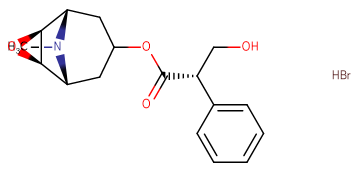
Scopolamine HBr
CAS No. 114-49-8
Scopolamine HBr( Hyoscine )
Catalog No. M10514 CAS No. 114-49-8
Scopolamine hydrobromide is a competitive muscarinic acetylcholine receptor (mAChR) with an IC50 of 55.3 ± 4.3 nM.
Purity : >98% (HPLC)
 COA
Datasheet
HNMR
HPLC
MSDS
Handing Instructions
COA
Datasheet
HNMR
HPLC
MSDS
Handing Instructions
| Size | Price / USD | Stock | Quantity |
| 100MG | Get Quote | In Stock |


|
| 200MG | Get Quote | In Stock |
|
| 500MG | Get Quote | In Stock |
|
| 1G | Get Quote | In Stock |
|
Biological Information
-
Product NameScopolamine HBr
-
NoteResearch use only, not for human use.
-
Brief DescriptionScopolamine hydrobromide is a competitive muscarinic acetylcholine receptor (mAChR) with an IC50 of 55.3 ± 4.3 nM.
-
DescriptionScopolamine hydrobromide is a competitive muscarinic acetylcholine receptor (mAChR) with an IC50 of 55.3 ± 4.3 nM.(In Vitro):Application of Scopolamine to oocytes expressing 5-HT3 receptors does not elicit a response when applied alone, but causes a concentration-dependent inhibition of the response during a co-application of 2 μM 5-HT. The pIC50 value for Scopolamine is 5.68±0.05 (IC50=2.09 μM, n=6) with a Hill Slope of 1.06 ± 0.05. This gave a Kb of 3.23 μM. The same concentration-dependent effect is also seen when Scopolamine is applied during the 5-HT application. To further test for a competitive binding at the 5-HT3 receptor, the competition of unlabelled Scopolamine is measured with [3H]granisetron, an established high-affinity competitive antagonist at these receptors. Scopolamine displays concentration-dependent competition with 0.6 nM [3H]granisetron (~Kd), yielding an average pKi of 5.17±0.24 (Ki=6.76 μM, n=3). (In Vivo):In the histopathology study, there is no significant change in the histology of the brain. However, it is observed that there is a reduction in density of cells in the hippocampus of the control mice pretreated with Scopolamine who received only distilled water. Scopolamine administration alone significantly increases the activity of Acetylcholinesterase enzyme (AchE) (7.98±0.065; P<0.001) when compared to the normal group (3.06±0.296). The animals treated with Scopolamine report a significant increase (34.61±4.85; P<0.01) in levels of malondialdehyde (MDA) as compared to the normal group (12.82±2.86). The Scopolamine-treated group shows significant decrease in reduced glutathione (GSH) level (P<0.001; 0.1504±0.03) as compared to the normal group (0.3906±0.02). The Scopolamine-treated rats show a significant increase in the concentration ofβ amyloid (Aβ1-42) (P<0.001; 146.2±1.74) as compared to the normal group (43.21±3.46).
-
In VitroApplication of Scopolamine to oocytes expressing 5-HT3 receptors does not elicit a response when applied alone, but causes a concentration-dependent inhibition of the response during a co-application of 2 μM 5-HT. The pIC50 value for Scopolamine is 5.68±0.05 (IC50=2.09 μM, n=6) with a Hill Slope of 1.06 ± 0.05. This gave a Kb of 3.23 μM. The same concentration-dependent effect is also seen when Scopolamine is applied during the 5-HT application. To further test for a competitive binding at the 5-HT3 receptor, the competition of unlabelled Scopolamine is measured with [3H]granisetron, an established high-affinity competitive antagonist at these receptors. Scopolamine displays concentration-dependent competition with 0.6 nM [3H]granisetron (~Kd), yielding an average pKi of 5.17±0.24 (Ki=6.76 μM, n=3).
-
In VivoIn the histopathology study, there is no significant change in the histology of the brain. However, it is observed that there is a reduction in density of cells in the hippocampus of the control mice pretreated with Scopolamine who received only distilled water. Scopolamine administration alone significantly increases the activity of Acetylcholinesterase enzyme (AchE) (7.98±0.065; P<0.001) when compared to the normal group (3.06±0.296). The animals treated with Scopolamine report a significant increase (34.61±4.85; P<0.01) in levels of malondialdehyde (MDA) as compared to the normal group (12.82±2.86). The Scopolamine-treated group shows significant decrease in reduced glutathione (GSH) level (P<0.001; 0.1504±0.03) as compared to the normal group (0.3906±0.02). The Scopolamine-treated rats show a significant increase in the concentration ofβ amyloid (Aβ1-42)(P<0.001; 146.2±1.74) as compared to the normal group (43.21±3.46).
-
SynonymsHyoscine
-
PathwayEndocrinology/Hormones
-
TargetAChR
-
RecptormAChR
-
Research AreaNeurological Disease
-
Indication——
Chemical Information
-
CAS Number114-49-8
-
Formula Weight384.26
-
Molecular FormulaC17H22BrNO4
-
Purity>98% (HPLC)
-
SolubilityWater: 76 mg/mL (197.78 mM); DMSO: 76 mg/mL (197.78 mM)
-
SMILESCN1[C@@H]2CC(C[C@H]1[C@H]3[C@@H]2O3)OC(=O)[C@H](CO)C4=CC=CC=C4.Br
-
Chemical Name——
Shipping & Storage Information
-
Storage(-20℃)
-
ShippingWith Ice Pack
-
Stability≥ 2 years
Reference
1.Murasaki O, et al. J Pharmacol Exp Ther. 2003 Dec;307(3):995-1000.
molnova catalog



related products
-
Cevimeline hydrochlo...
Cevimeline hydrochloride hemihydrate, a novel muscarinic receptor agonist.
-
GW 441756
GW 441756 is a specific Tropomyosin-related kinase A (TrkA) inhibitor with an IC50 value of 2 nM.
-
Theophylline monohyd...
A methylxanthine derivative from tea with diuretic, smooth muscle relaxant, bronchial dilation, cardiac and central nervous system stimulant activities.
