


 Cart
Cart
 sales@molnova.com


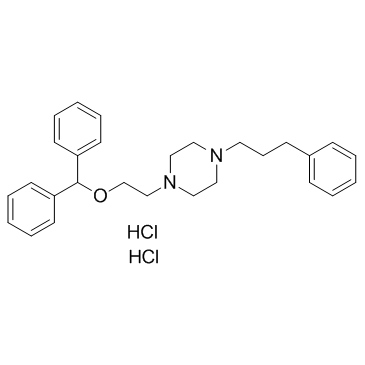
GBR-12935
CAS No. 67469-81-2
GBR-12935( —— )
Catalog No. M15577 CAS No. 67469-81-2
GBR 12935 induced increase in the extracellular levels of dopamine to basal levels.
Purity : >98% (HPLC)
 COA
Datasheet
HNMR
HPLC
MSDS
Handing Instructions
COA
Datasheet
HNMR
HPLC
MSDS
Handing Instructions
| Size | Price / USD | Stock | Quantity |
| 5MG | 32 | In Stock |


|
| 10MG | 48 | In Stock |
|
| 25MG | 79 | In Stock |
|
| 50MG | 100 | In Stock |
|
| 100MG | 176 | In Stock |
|
| 200MG | 263 | In Stock |
|
| 500MG | Get Quote | In Stock |
|
| 1G | Get Quote | In Stock |
|
Biological Information
-
Product NameGBR-12935
-
NoteResearch use only, not for human use.
-
Brief DescriptionGBR 12935 induced increase in the extracellular levels of dopamine to basal levels.
-
DescriptionGBR 12935 induced increase in the extracellular levels of dopamine to basal levels.
-
In VitroGBR 12909 (10-100 nM) also shows a high affinity for CYP2D6 with the Kd value of 42.2 nM, lower than the affinity for dopamine transporter. The binding effect can be reduced by Quinidine (HY-B1751) and Quinine (HY-D0143), which are the specific and potent inhibitors of CYPZD enzymatic activities.GBR 12935 dihydrochloride (10 nM; 2 min) increases the extracellular levels of dopamine to approximately 400% of basal during the application in the nucleus accumbens.GBR 12935 dihydrochloride (100 μM; 60 min) increases extracellular levels of dopamine compared with levels for artificial cerebrospinal fluid (ACSF) by local perfusion for 60 min. GBR 12935 dihydrochloride (1-9 nM) dose-dependently inhibits active uptake of [3H]dopamine in homogenates of the nucleus accumbens.Co-perfusion of 100 μM GBR 12935 dihydrochloride with either 100 μM Sulpiride (HY-B1019) or Raclopride (HY-103414) produces a significant reduction in the GBR 12935 dihydrochloride induced increase in the extracellular levels of dopamine to basal levels.
-
In VivoGBR 12935 dihydrochloride (1-32 mg/kg; repeat injection; 7 d) elevates locomotion activity to a greater extent in C57BL/6J mice than DBA/2J mice, and (10 mg/kg; injection; 7 d) results few mice sensitized to cocaine-induced stereotypy with repeated injections. Animal Model:Adult male DBA/2J and C57BL/6J mice (22-30 g)Dosage:1.0, 3.2, 10, 32 mg/kg Administration:Repeat injection; for 7 days Result:Elevated locomotion activity to a greater extent in C57BL/6J mice than DBA/2J mice.No stereotypy was induced by an eighth day challenge of 10 mg/kg GBR 12935 dihydrochloride in mice pretreated with seven dally injections of either 32 mg/kg cocaine or saline.
-
Synonyms——
-
PathwayGPCR/G Protein
-
TargetDopamine Receptor
-
RecptorDopamine
-
Research AreaNeurological Disease
-
Indication——
Chemical Information
-
CAS Number67469-81-2
-
Formula Weight487.5
-
Molecular FormulaC28H36Cl2N2O
-
Purity>98% (HPLC)
-
SolubilitySoluble in DMSO
-
SMILESCl.Cl.C(CN1CCN(CCOC(C2=CC=CC=C2)C2=CC=CC=C2)CC1)CC1=CC=CC=C1
-
Chemical Name——
Shipping & Storage Information
-
Storage(-20℃)
-
ShippingWith Ice Pack
-
Stability≥ 2 years
Reference
1.Norlén M, et al. Eur J Pharmacol. 1999 Feb 5;366(2-3):329-32.
molnova catalog



related products
-
GR 103691
GR 103691 is a potent, selective dopamine D3 receptor antagonist (Ki: 0.4 nM).?
-
Octopamine hydrochlo...
Octopamine (OA), a biogenic monoamine structurally related to noradrenaline.
-
Flupenthixol dihydro...
Flupenthixol is a strong dopamine receptor antagonist.
