


 Cart
Cart
 sales@molnova.com


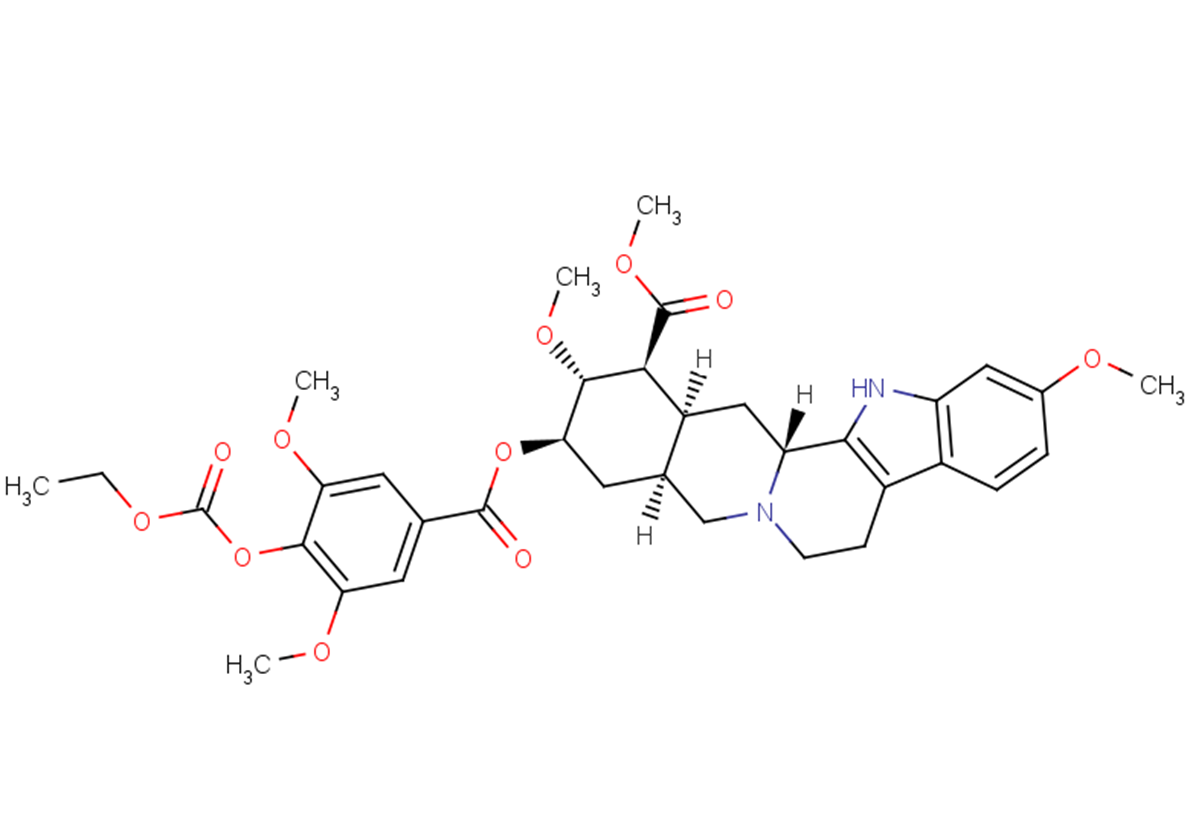
Syrosingopine
CAS No. 84-36-6
Syrosingopine( —— )
Catalog No. M22915 CAS No. 84-36-6
Syrosingopine has selective depleting effect on brain amines is potentiated by combined treatment with disulfiram or fusaric acid, a dopamine beta-hydroxylase inhibitor.
Purity : >98% (HPLC)
 COA
Datasheet
HNMR
HPLC
MSDS
Handing Instructions
COA
Datasheet
HNMR
HPLC
MSDS
Handing Instructions
| Size | Price / USD | Stock | Quantity |
| 1 mL x 10 mM in DMSO | 202 | In Stock |


|
| 5MG | 138 | In Stock |
|
| 10MG | 212 | In Stock |
|
| 25MG | 362 | In Stock |
|
| 50MG | 532 | In Stock |
|
| 100MG | 734 | In Stock |
|
| 200MG | Get Quote | In Stock |
|
| 500MG | Get Quote | In Stock |
|
| 1G | Get Quote | In Stock |
|
Biological Information
-
Product NameSyrosingopine
-
NoteResearch use only, not for human use.
-
Brief DescriptionSyrosingopine has selective depleting effect on brain amines is potentiated by combined treatment with disulfiram or fusaric acid, a dopamine beta-hydroxylase inhibitor.
-
DescriptionSyrosingopine has selective depleting effect on brain amines is potentiated by combined treatment with disulfiram or fusaric acid, a dopamine beta-hydroxylase inhibitor.The anticancer activity of the widely used diabetic drug metformin is strongly potentiated by Syrosingopine. Synthetic lethality elicited by combining the two drugs is synergistic and specific to transformed cells. This effect is unrelated to Syrosingopine s known role as an inhibitor of the vesicular monoamine transporters. Syrosingopine binds to the glycolytic enzyme α±-enolase in vitro, and the expression of the γ-enolase isoform correlates with nonresponsiveness to the drug combination. Syrosingopine sensitized cancer cells to metformin and its more potent derivative phenformin far below the individual toxic threshold of each compound.
-
In VitroCell Viability Assay Cell Line:HeLa, MCT1-KO, MCT4-KO HAP1, HAP1 MCT1-KO Concentration:10 μM Incubation Time:1, 2, 3, 4 hours Result:Caused intracellular lactate accumulation and acidification.Slowed lactate efflux by inhibiting MCT4 and MCT1. Induced synthetic lethality by inhibiting transport of lactate when combined with metformin.
-
In VivoAnimal Model:Spontaneously hypertensive rats (SHR) (2 to 17-month-age).Dosage:5 mg/kg Administration:Subcutaneous injection; once (16 hours before undertaking the study of blood pressure).Result:Showed anti-hypertensive activity by depleting peripheral stores of norepinephrine.
-
Synonyms——
-
PathwayGPCR/G Protein
-
TargetDopamine Receptor
-
Recptordopamine
-
Research Area——
-
Indication——
Chemical Information
-
CAS Number84-36-6
-
Formula Weight666.71
-
Molecular FormulaC35H42N2O11
-
Purity>98% (HPLC)
-
SolubilityDMSO:62.5 mg/mL (93.74 mM; Need ultrasonic)
-
SMILES[H][C@@]12C(NC3=C4C=CC(OC)=C3)=C4CCN1C[C@]5(C[C@@H](OC(C6=CC(OC)=C(OC(OCC)=O)C(OC)=C6)=O)[C@H](OC)[C@@H](C(OC)=O)[C@]5(C2)[H])[H]
-
Chemical Name——
Shipping & Storage Information
-
Storage(-20℃)
-
ShippingWith Ice Pack
-
Stability≥ 2 years
Reference
1. Syrosingopine sensitizes cancer cells to killing by metforminSci. Adv.,2016 Dec; 2(12): e1601756.
molnova catalog



related products
-
Fluphenazine decanoa...
Fluphenazine decanoate is dopamine D2 receptor blockeand is a long-acting phenothiazine neuroleptic that used to treat schizophrenia.
-
Pramipexole dihydroc...
A partial/full agonist of dopamine receptor with Ki of 3.9/2.2/0.5/5.1 nM for D2S/D2L/D3/D4, respeectively.
-
Bendazol
Bendazol always be used as the drug of hypertension, cerebral Angiospasm.
