


 Cart
Cart
 sales@molnova.com


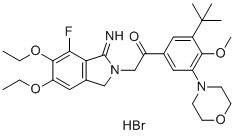
Atopaxar hydrobromide
CAS No. 474550-69-1
Atopaxar hydrobromide( E5555 hydrobromide )
Catalog No. M14576 CAS No. 474550-69-1
A potent, reversible PAR-1 antagonist with IC50 of 19 nM; shows potent inhibitory effects on human platelet aggregation induced by thrombin and TRAP with IC50 of 64 nM and 31 nM, respectively.
Purity : >98% (HPLC)
 COA
Datasheet
HNMR
HPLC
MSDS
Handing Instructions
COA
Datasheet
HNMR
HPLC
MSDS
Handing Instructions
| Size | Price / USD | Stock | Quantity |
| 2MG | 359 | In Stock |


|
| 5MG | 607 | In Stock |
|
| 10MG | 846 | In Stock |
|
| 25MG | 1302 | In Stock |
|
| 50MG | 1655 | In Stock |
|
| 100MG | Get Quote | In Stock |
|
| 200MG | Get Quote | In Stock |
|
| 500MG | Get Quote | In Stock |
|
| 1G | Get Quote | In Stock |
|
Biological Information
-
Product NameAtopaxar hydrobromide
-
NoteResearch use only, not for human use.
-
Brief DescriptionA potent, reversible PAR-1 antagonist with IC50 of 19 nM; shows potent inhibitory effects on human platelet aggregation induced by thrombin and TRAP with IC50 of 64 nM and 31 nM, respectively.
-
DescriptionA potent, reversible PAR-1 antagonist with IC50 of 19 nM; shows potent inhibitory effects on human platelet aggregation induced by thrombin and TRAP with IC50 of 64 nM and 31 nM, respectively, with no effect on platelet aggregation induced by either ADP or collagen; inhibits arterial thrombosis without affecting bleeding time in photochemically-induced thrombosis model guinea pigs.Thrombosis Phase 2 Clinical.
-
In VitroAtopaxar hydrobromide (0.0001-10 μM; 1h) inhibits haTRAP (high-affinity thrombin receptor activating peptide) binding to PAR-1 on human platelet membranes in a concentration-dependent manner, with an IC50 of 0.019 μM.Atopaxar hydrobromide shows potent inhibitory effects on human platelet aggregation induced by thrombin and TRAP with IC50s of 0.064 and 0.031 μM, respectively, but has no effect on platelet aggregation induced by either ADP or collagen.Atopaxar hydrobromide shows potent and selective inhibitory effects on guinea pig platelet aggregation induced by thrombin and TRAP with IC50s of 0.13 and 0.097 μM, respectively.
-
In VivoAtopaxar (30-100 mg/kg; p.o.) hydrobromide causes a dose-dependent prolongation of the time to occlusion of the femoral artery in photochemically-induced thrombosis (PIT) guinea pigs model. Atopaxar hydrobromide does not prolong bleeding time in guinea pigs at the highest tested dosage of 1000 mg/kg. Animal Model:Guinea pigs, PIT model Dosage:Oral administration Administration:10 mg/kg, 30 mg/kg, 100 mg/kg Result:Prolonged the time to occlusion by 1.8-fold and 2.4-fold at 30 mg/kg and 100 mg/kg, respectively, compared with controls.
-
SynonymsE5555 hydrobromide
-
PathwayGPCR/G Protein
-
TargetPAR
-
RecptorPAR-1
-
Research AreaCardiovascular Disease
-
IndicationThrombosis
Chemical Information
-
CAS Number474550-69-1
-
Formula Weight608.54
-
Molecular FormulaC29H38FN3O5.HBr
-
Purity>98% (HPLC)
-
SolubilityDMSO: 10 mM ( < 1 mg/ml refers to the product slightly soluble or insoluble )
-
SMILESCOC1=C(N2CCOCC2)C=C(C(CN(CC3=C4C(F)=C(OCC)C(OCC)=C3)C4=N)=O)C=C1C(C)(C)C.[H]Br
-
Chemical Name2-(5,6-Diethoxy-7-fluoro-1,3-dihydro-1-imino-2H-isoindol-2-yl)-1-[3-(1,1-dimethylethyl)-4-methoxy-5-(4-morpholinyl)phenyl]ethanone hydrobromide
Shipping & Storage Information
-
Storage(-20℃)
-
ShippingWith Ice Pack
-
Stability≥ 2 years
Reference
1. Serebruany VL, et al. Thromb Haemost. 2009 Jul;102(1):111-9.
2. Angiolillo DJ, et al. Eur Heart J. 2010 Jan;31(1):17-28.
3. Kogushi M, et al. Eur J Pharmacol. 2011 Apr 25;657(1-3):131-7.
molnova catalog



related products
-
I-191
I-191 is a potent antagonist of protease-activated receptor 2 (PAR2)?inhibits multiple signaling functions in human cancer cells.?
-
AY 77
AY 77 (Unk-Cha-Chg-NH2) is a potent and selective PAR2 agonist. AY 77 showed selectivity for Ca2+ and ERK1/2 signaling (ec50 value of Ca2+ release was 40 nM and ec50 value of ERK1/2 phosphorylation was 2 μM).
-
BMS-986120
BMS-986120 (BMS986120)?is a potent, selective, orally bioavailable, and reversible PAR4 antagonist with Kd of 0.098 nM for human PAR4.
