


 Cart
Cart
 sales@molnova.com


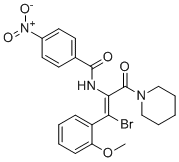
AT-130
CAS No. 211364-06-6
AT-130( AT130 )
Catalog No. M13358 CAS No. 211364-06-6
AT-130 is a potent inhibitor of HBV capsid assembly, inhibits wild-type HBV replication with IC50 of 2.4 uM.
Purity : >98% (HPLC)
 COA
Datasheet
HNMR
HPLC
MSDS
Handing Instructions
COA
Datasheet
HNMR
HPLC
MSDS
Handing Instructions
| Size | Price / USD | Stock | Quantity |
| 1 mL x 10 mM in DMSO | 85 | In Stock |


|
| 5MG | 79 | In Stock |
|
| 10MG | 126 | In Stock |
|
| 25MG | 226 | In Stock |
|
| 50MG | 331 | In Stock |
|
| 100MG | 498 | In Stock |
|
| 200MG | 684 | In Stock |
|
| 500MG | Get Quote | In Stock |
|
| 1G | Get Quote | In Stock |
|
Biological Information
-
Product NameAT-130
-
NoteResearch use only, not for human use.
-
Brief DescriptionAT-130 is a potent inhibitor of HBV capsid assembly, inhibits wild-type HBV replication with IC50 of 2.4 uM.
-
DescriptionAT-130 is a potent inhibitor of HBV capsid assembly, inhibits wild-type HBV replication with IC50 of 2.4 uM; inhibits replication of wild-type and lamivudine-resistant strains of hepatitis B virus in vitro with same sensitivity (rtL180M, rtM204I, and rtL180M + rtM204V); blocks HBV replication at the level of viral RNA packaging, interferes with capsid morphogenesis, shows activity against the main lamivudine- and adefovir-resistant mutants.
-
In VitroAT-130 inhibits Wt HBV (IC50=2.4 μM), rtL180M HBV (IC50=9.8 μM), rtM204I HBV (IC50=35.6 μM). AT-130 (0.1, 1, 5, 10, 100 μM; for 7 days) causes dose-dependent inhibition of wt HBV replication in HepG2 cells transduced with HBV baculovirus. AT-130 at a concentration of 2.5 μM, reduces encapsidated HBV DNA by 50% (IC50) and at 18.5 μM by 90% (IC90). AT-130 has no toxic to either HepG2 or Huh-7 cells at concentrations of up to 250 μM. AT-130 (0.005, 0.05, 0.5, 5, 50 μM) does not inhibit HBV DNA synthesis by blocking the HBV endogenous DNA polymerase reaction directly in Huh 7 or HepG2 cells. AT-130 inhibits HBV DNA replication in hepatoma cells but has no effect on viral DNA polymerase activity or core protein translation. AT-130 (2.5, 18.5 μM) has no effect on total HBV RNA production but does reduce encapsidated RNA. AT-130 does not affect core protein or nucleocapsid production and the activity of the protein expression vector.
-
In Vivo——
-
SynonymsAT130
-
PathwayMicrobiology/Virology
-
TargetHBV
-
RecptorHBV
-
Research Area——
-
Indication——
Chemical Information
-
CAS Number211364-06-6
-
Formula Weight488.338
-
Molecular FormulaC22H22BrN3O5
-
Purity>98% (HPLC)
-
SolubilityIn Vitro:?DMSO : 25 mg/mL (51.19 mM)
-
SMILESO=C(N/C(C(N1CCCCC1)=O)=C(Br)\C2=CC=CC=C2OC)C3=CC=C([N+]([O-])=O)C=C3
-
Chemical Name(E)-N-(1-bromo-1-(2-methoxyphenyl)-3-oxo-3-(piperidin-1-yl)prop-1-en-2-yl)-4-nitrobenzamide
Shipping & Storage Information
-
Storage(-20℃)
-
ShippingWith Ice Pack
-
Stability≥ 2 years
Reference
1. Delaney WE 4th, et al. Antimicrob Agents Chemother. 2002 Sep;46(9):3057-60.
2. Feld JJ, et al. Antiviral Res. 2007 Nov;76(2):168-77.
3. Billioud G, et al. Antiviral Res. 2011 Nov;92(2):271-6.
molnova catalog



related products
-
GLP-26
GLP-26 is a novel potent HBV capsid modulator that reduces secreted HBeAg in HepNTCPDL cells transfected with HBV wild type with EC50 of 0.7 uM.
-
NTCP binder peptide ...
NTCP binder peptide WD1 is a macrocyclic peptide, pan-genotypic inhibitor of HBV cellular entry via targeting the cell-surface receptor for HBV.
-
HBV-IN-37
HBV-IN-37 is an HBV inhibitor with an EC50 value of 10 μM and can be used for hepatitis B disease-related research.
