


 Cart
Cart
 sales@molnova.com


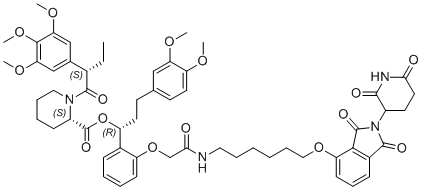
FKBP12 PROTAC dTAG-13
CAS No. 2064175-41-1
FKBP12 PROTAC dTAG-13( dTAG-13 )
Catalog No. M13209 CAS No. 2064175-41-1
FKBP12 PROTAC dTAG-13 (dTAG-13) is an in vivo-active heterobifunctional adation tag (dTAG) small molecule that engage FKBP12F36V and CRBN.
Purity : >98% (HPLC)
 COA
Datasheet
HNMR
HPLC
MSDS
Handing Instructions
COA
Datasheet
HNMR
HPLC
MSDS
Handing Instructions
| Size | Price / USD | Stock | Quantity |
| 5MG | 155 | In Stock |


|
| 10MG | 227 | In Stock |
|
| 25MG | 373 | In Stock |
|
| 50MG | 556 | In Stock |
|
| 100MG | Get Quote | In Stock |
|
| 200MG | Get Quote | In Stock |
|
| 500MG | Get Quote | In Stock |
|
| 1G | Get Quote | In Stock |
|
Biological Information
-
Product NameFKBP12 PROTAC dTAG-13
-
NoteResearch use only, not for human use.
-
Brief DescriptionFKBP12 PROTAC dTAG-13 (dTAG-13) is an in vivo-active heterobifunctional adation tag (dTAG) small molecule that engage FKBP12F36V and CRBN.
-
DescriptionFKBP12 PROTAC dTAG-13 (dTAG-13) is an in vivo-active heterobifunctional adation tag (dTAG) small molecule that engage FKBP12F36V and CRBN, selectively degrade FKBP12F36V in a CRBN-dependent manner in cells; causes rapid degradation of nuclear and cytoplasmic FKBP12F36V fusion chimeras, and an unexpected superior antiproliferative effect of pan-BET bromodomain degradation over selective BRD4 degradation, characterize immediate effects of KRASG12V loss on proteomic signaling, and demonstrate rapid degradation in vivo.
-
In VitroTAG-13 (1-1000 nM; 4 hours; 293FTWT cells) treatment potently reduces FKBP12F36V-Nluc levels in 293FTWT cell, indicating the requirement of CRBN for the observed effects.Treatment of MV4;11 cells expressing BRD4(short)-FKBP12F36V with dTAG-13 leads to robust degradation of BRD4. dTAG-13 treatment leads to rapid degradation of BRD4 within one hou. dTAG-13 treatment leads to rapid and potent degradation of the BRD4 fusion chimera in the heterozygous and homozygous knock-in clones, with no effect on endogenous FKBP12WT. Western Blot Analysis Cell Line:293FTWT cells Concentration:1 nM, 10 nM, 100 nM, 1000 nM Incubation Time:4 hours Result:Potently reduced FKBP12F36V-Nluc levels in 293FTWT cell.
-
In VivoFollowing bone marrow engraftment of MV4;11 cells expressing luc-FKBP12F36V in mice, the bioluminescent signal after vehicle or dTAG-13 administration is monitored. A significant, rapid, and durable effect on bioluminescent signal is observed four hours after dTAG-13 administration, indicating effective degradation of luc-FKBP12F36V. Twenty-eight hours following the final treatment, the recovery of cellular bioluminescence to levels comparable between vehicle and dTAG-13 treatment groups is observed.
-
SynonymsdTAG-13
-
PathwayPROTACs
-
TargetPROTAC
-
RecptorPROTAC
-
Research Area——
-
Indication——
Chemical Information
-
CAS Number2064175-41-1
-
Formula Weight1049.184
-
Molecular FormulaC57H68N4O15
-
Purity>98% (HPLC)
-
SolubilityIn Vitro:?DMSO : ≥ 100 mg/mL (95.31 mM)
-
SMILESCCC(C1=CC(=C(C(=C1)OC)OC)OC)C(=O)N2CCCCC2C(=O)OC(CCC3=CC(=C(C=C3)OC)OC)C4=CC=CC=C4OCC(=O)NCCCCCCOC5=CC=CC6=C5C(=O)N(C6=O)C7CCC(=O)NC7=O
-
Chemical Name(1R)-3-(3,4-dimethoxyphenyl)-1-(2-(2-((6-((2-(2,6-dioxopiperidin-3-yl)-1,3-dioxoisoindolin-4-yl)oxy)hexyl)amino)-2-oxoethoxy)phenyl)propyl (2S)-1-((S)-2-(3,4,5-trimethoxyphenyl)butanoyl)piperidine-2-carboxylate
Shipping & Storage Information
-
Storage(-20℃)
-
ShippingWith Ice Pack
-
Stability≥ 2 years
Reference
1. Nabet B, et al. Nat Chem Biol. 2018 May;14(5):431-441.
molnova catalog



related products
-
NH2-PEG6-Boc
NH2-PEG6-Boc is a PEG-based PROTAC linker that can be used in the synthesis of PROTACs. NH2-PEG6-Boc is also a non-cleavable 6 unit PEG ADC linker used in the synthesis of antibody-drug conjugates (ADCs).
-
5-Ethynyl-2-deoxyuri...
5-Ethynyl-2'-deoxyuridine (EdU) is a nucleoside analog of thymidine used to monitor de novo DNA synthesis through click chemistry and serves as an alkyl chain-based PROTAC linker for synthesizing PROTACs.
-
m-PEG11-Br
m-PEG11-Br is a PEG-based PROTAC linker that can be used in the synthesis of PROTACs.
