


 Cart
Cart
 sales@molnova.com


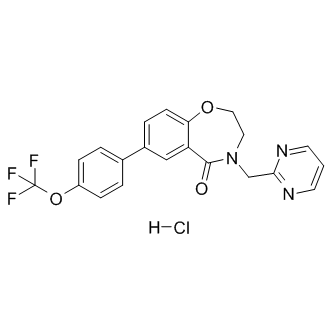
Eleclazine hydrochloride
CAS No. 1448754-43-5
Eleclazine hydrochloride( GS-6615 hydrochloride )
Catalog No. M11926 CAS No. 1448754-43-5
A novel, potent, and selective inhibitor of Late sodium current (late INa) for treatment of long QT-3 syndrome (LQT-3).
Purity : >98% (HPLC)
 COA
Datasheet
HNMR
HPLC
MSDS
Handing Instructions
COA
Datasheet
HNMR
HPLC
MSDS
Handing Instructions
| Size | Price / USD | Stock | Quantity |
| 1 mL x 10 mM in DMSO | 124 | In Stock |


|
| 5MG | 112 | In Stock |
|
| 10MG | 169 | In Stock |
|
| 25MG | 282 | In Stock |
|
| 50MG | 416 | In Stock |
|
| 100MG | 551 | In Stock |
|
| 200MG | 728 | In Stock |
|
| 500MG | Get Quote | In Stock |
|
| 1G | Get Quote | In Stock |
|
Biological Information
-
Product NameEleclazine hydrochloride
-
NoteResearch use only, not for human use.
-
Brief DescriptionA novel, potent, and selective inhibitor of Late sodium current (late INa) for treatment of long QT-3 syndrome (LQT-3).
-
DescriptionA novel, potent, and selective inhibitor of Late sodium current (late INa) for treatment of long QT-3 syndrome (LQT-3), hypertrophic cardiomyopathy (HCM), and ventricular tachycardia–ventricular fibrillation (VT–VF); 42 times more potent than Ranolazine in reducing ischemic burden in vivo (EC50=190 nM).Heart Arrhythmia Phase 3 Clinical(In Vitro):Eleclazine inhibits sodium current in hiPSC-derived cardiomyocytes with an IC50 of 2.5 μM.(In Vivo):Eleclazine (0.3 and 0.9 mg/kg; IV; infused over 15 minutes) reduces the incidence of epinephrine-induced ventricular premature beats and couplets, and shortens ventricular QT and atrial PTa intervals.
-
In VitroEleclazine inhibits sodium current in hiPSC-derived cardiomyocytes with an IC50 of 2.5 μM.
-
In VivoEleclazine (0.3 and 0.9 mg/kg; IV; infused over 15 minutes) reduces the incidence of epinephrine-induced ventricular premature beats and couplets, and shortens ventricular QT and atrial PTa intervals. Animal Model:Male Yorkshire pigs (35.20 ± 0.46 kg; injected with epinephrine via a jugular vein)Dosage:0.3 and 0.9 mg/kg Administration:IV; infused over 15 minutes Result:Reduced the incidence of epinephrine-induced ventricular premature beats and couplets by 51% (from 31.3 ± 1.91 to 15.2 ± 5.08 episodes; P = 0.038) and the incidence of 3- to 7-beat ventricular tachycardia (VT) by 56% (from 10.8 ± 3.45 to 4.7 ± 3.12 episodes; P = 0.004).Shortened ventricular QT and atrial PTa intervals by 7%, and reduced atrial repolarization alternans and heterogeneity without attenuation of the inotropic response to catecholamine.
-
SynonymsGS-6615 hydrochloride
-
PathwayMembrane Transporter/Ion Channel
-
TargetSodium Channel
-
RecptorSodium Channel
-
Research AreaCardiovascular Disease
-
IndicationHeart Arrhythmia
Chemical Information
-
CAS Number1448754-43-5
-
Formula Weight451.8262
-
Molecular FormulaC21H17ClF3N3O3
-
Purity>98% (HPLC)
-
Solubility10 mM in DMSO
-
SMILESO=C1N(CC2=NC=CC=N2)CCOC3=CC=C(C4=CC=C(OC(F)(F)F)C=C4)C=C13.[H]Cl
-
Chemical Name1,4-Benzoxazepin-5(2H)-one, 3,4-dihydro-4-(2-pyrimidinylmethyl)-7-[4-(trifluoromethoxy)phenyl]-, hydrochloride (1:1)
Shipping & Storage Information
-
Storage(-20℃)
-
ShippingWith Ice Pack
-
Stability≥ 2 years
Reference
1. Zablocki JA, et al. J. Med. Chem., 2016, 59 (19), pp 9005–90172. Fuller H, et al. Heart Rhythm. 2016 Aug;13(8):1679-86.
3. Bacic D, et al. Heart Rhythm. 2017 Mar;14(3):448-454.
molnova catalog



related products
-
PF-05150122
PF-05150122 is a potent, state-dependent, subtype selective Nav1.7 inhibitor with IC50 of 21 nM.
-
Flecainide
A class Ic antiarrhythmic agent used to prevent and treat tachyarrhythmias, works by blocking the Nav1.5 sodium channel in the heart.
-
XEN-402
XEN-402 (Funapide;TV-45070) is a potent and selective, orally available sodium channel Nav1.7 and Nav1.8 blocker for treatment of pain.
