


 Cart
Cart
 sales@molnova.com


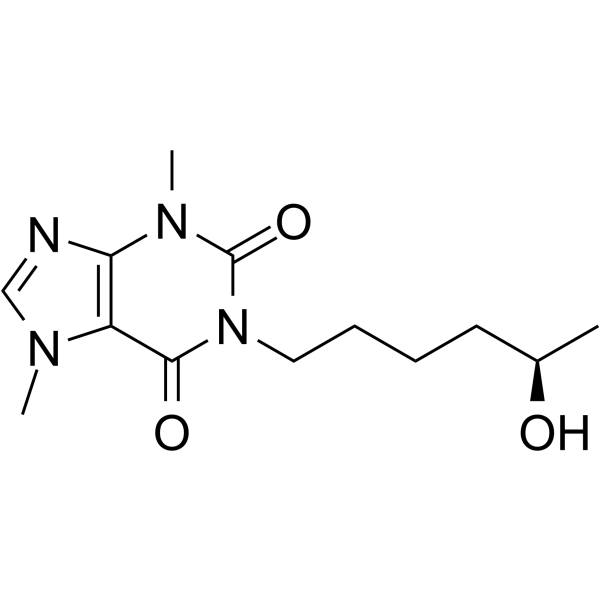
(R)-Lisofylline
CAS No. 100324-81-0
(R)-Lisofylline( —— )
Catalog No. M27451 CAS No. 100324-81-0
(R)-Lisofylline is an inhibitor of lysophosphatidic acid acyltransferase (IC50 = 0.6 μM).
Purity : >98% (HPLC)
 COA
Datasheet
HNMR
HPLC
MSDS
Handing Instructions
COA
Datasheet
HNMR
HPLC
MSDS
Handing Instructions
| Size | Price / USD | Stock | Quantity |
| 5MG | 518 | Get Quote |


|
| 100MG | Get Quote | Get Quote |
|
| 200MG | Get Quote | Get Quote |
|
| 500MG | Get Quote | Get Quote |
|
| 1G | Get Quote | Get Quote |
|
Biological Information
-
Product Name(R)-Lisofylline
-
NoteResearch use only, not for human use.
-
Brief Description(R)-Lisofylline is an inhibitor of lysophosphatidic acid acyltransferase (IC50 = 0.6 μM).
-
Description(R)-Lisofylline is an inhibitor of lysophosphatidic acid acyltransferase (IC50 = 0.6 μM). (R)-Lisofylline interrupts IL-12 signaling-mediated STAT4 activation and can be used in studies about the treatment of type 1 diabetes and autoimmune disorders.(In Vitro):(R)-Lisofylline blocks IL-12-driven T cell proliferation and Th1 differentiation yet has no effect on IL-12 secretion.(In Vivo):In NOD mice, (R)-Lisofylline prevents β cell dysfunction by inhibition of STAT4 phosphorylation and ameliorates experimental allergic encephalomyelitis. (R)-Lisofylline reduces the impairment of insulin secretion induced by IL-1β in cultured rat islet cells, suppresses IFN-γ production, the onset of diabetes, and macrophage infiltration into islets. (R)-Lisofylline improves insulin response and lowers glucose levels in Streptozotocin-treated rats after the oral glucose tolerance test. In rats given IL-1 intratracheally (R)-Lisofylline pretreatment reduces lung leak but does not decrease neutrophil accumulation in lungs. (R)-Lisofylline improves survival in mice injected with a lethal dose of LPS and ameliorates sepsis-induced lung injury in minipigs.
-
In Vitro(R)-Lisofylline blocks IL-12-driven Th1 differentiation and T cell proliferation in vitro, yet has no effect on IL-12 secretion from APCs ex vivo or in vitro.
-
In Vivo(R)-Lisofylline reduces the impairment of insulin secretion induced by IL-1β in cultured rat islet cells, suppresses IFN-γ production, the onset of diabetes, and macrophage infiltration into islets from NOD mice, as well as Lisofylline improves insulin response and lowers glucose levels in Streptozotocin-treated rats after the oral glucose tolerance test.(R)-Lisofylline prevents β cell dysfunction in NOD mice by inhibition of STAT4 phosphorylation which interrupts IL-12 signaling. (R)-Lisofylline ameliorates experimental allergic encephalomyelitis in mice. (R)-Lisofylline also improves survival in mice injected with a lethal dose of LPS and ameliorates sepsis-induced lung injury in minipigs. In rats given IL-1 intratracheally (R)-Lisofylline pretreatment reduces lung leak but does not decrease neutrophil accumulation in lungs. (R)-Lisofylline also suppresses release of TNF-α in vivo in mice and ex vivo in human blood stimulated with endotoxin derived from Salmonella or Escherichia coli.
-
Synonyms——
-
PathwayJAK/STAT Signaling
-
TargetSTAT
-
RecptorCereblon|PEGs
-
Research Area——
-
Indication——
Chemical Information
-
CAS Number100324-81-0
-
Formula Weight280.32
-
Molecular FormulaC13H20N4O3
-
Purity>98% (HPLC)
-
SolubilityIn Vitro:?DMSO : 100 mg/mL (356.74 mM)
-
SMILESO=C1C2=C(N(C)C(=O)N1CCCC[C@@H](C)O)N=CN2C
-
Chemical Name——
Shipping & Storage Information
-
Storage(-20℃)
-
ShippingWith Ice Pack
-
Stability≥ 2 years
Reference
1.Li Y, et al. Discovery of MD-224 as a First-in-Class, Highly Potent, and Efficacious Proteolysis Targeting Chimera Murine Double Minute 2 Degrader Capable of Achieving Complete and Durable Tumor Regression. J Med Chem. 2019 Jan 24;62(2):448-466.
molnova catalog



related products
-
HODHBt
HODHBt is a STAT5-SUMO protein-protein interaction inhibitor.
-
SH-4-54
A potent, BBB permeable, nonphosphorylated STAT3 inhibitor that strongly binds to STAT3 protein with Kd of 300 nM.
-
PG-S3-001
PG-S3-001 is a small molecule STAT3 inhibitor that binds to STAT3 protein potently with Kd of 324 nM by surface plasmon resonance.
