


 Cart
Cart
 sales@molnova.com


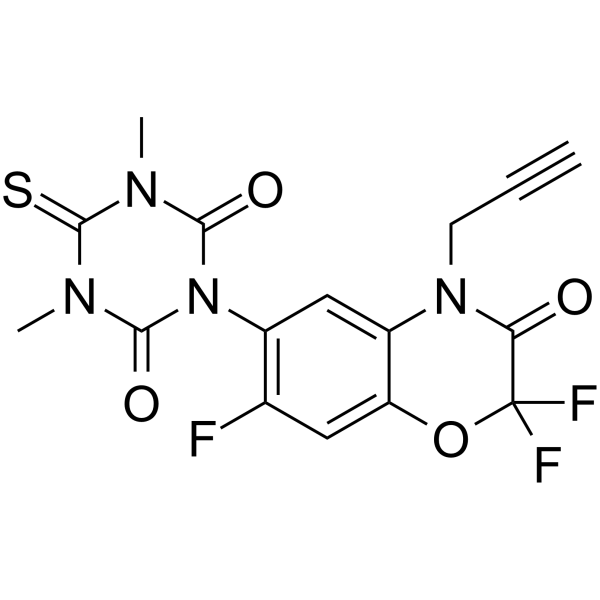
Trifludimoxazin
CAS No. 1258836-72-4
Trifludimoxazin( —— )
Catalog No. M28195 CAS No. 1258836-72-4
Trifludimoxazin is an inhibitor of protoporphyrinogen oxidase and can be used as a herbicide.
Purity : >98% (HPLC)
 COA
Datasheet
HNMR
HPLC
MSDS
Handing Instructions
COA
Datasheet
HNMR
HPLC
MSDS
Handing Instructions
| Size | Price / USD | Stock | Quantity |
| 5MG | 59 | Get Quote |


|
| 10MG | 95 | Get Quote |
|
| 25MG | 158 | Get Quote |
|
| 50MG | 230 | Get Quote |
|
| 100MG | Get Quote | Get Quote |
|
| 200MG | Get Quote | Get Quote |
|
| 500MG | Get Quote | Get Quote |
|
| 1G | Get Quote | Get Quote |
|
Biological Information
-
Product NameTrifludimoxazin
-
NoteResearch use only, not for human use.
-
Brief DescriptionTrifludimoxazin is an inhibitor of protoporphyrinogen oxidase and can be used as a herbicide.
-
DescriptionTrifludimoxazin is an inhibitor of protoporphyrinogen oxidase and can be used as a herbicide.
-
In Vitro——
-
In Vivo——
-
Synonyms——
-
PathwayOthers
-
TargetOther Targets
-
RecptorGasdermin D
-
Research Area——
-
Indication——
Chemical Information
-
CAS Number1258836-72-4
-
Formula Weight412.34
-
Molecular FormulaC16H11F3N4O4S
-
Purity>98% (HPLC)
-
SolubilityIn Vitro:?DMSO : 100 mg/mL (242.52 mM)
-
SMILESCN1C(=O)N(C(=O)N(C)C1=S)C1=CC2=C(OC(F)(F)C(=O)N2CC#C)C=C1F
-
Chemical Name——
Shipping & Storage Information
-
Storage(-20℃)
-
ShippingWith Ice Pack
-
Stability≥ 2 years
Reference
1.Spel L, et al. Gasdermin D opens the way for NETs. Nat Rev Rheumatol. 2018 Dec;14(12):690-692.
molnova catalog



related products
-
GNE-1858
GNE-1858 is an ATP-competitive hematopoietic progenitor kinase-1 (HPK1) inhibitor (IC50s of 1.9 nM, 1.9 nM, and 4.5 nM for wild-type and the active mimetic mutants HPK1-TSEE and HPK1-SA).
-
5,6-Epoxyergosterol
5,6-Epoxyergosterol is derived from the endophytic fungus Phyllosticta capitalensis.
-
DSP-4 hydrochloride
DSP-4 hydrochloride (Neurotoxin DSP 4 hydrochloride) can be used for the temporary selective degradation of the central and peripheral noradrenergic neurons, mainly those from the locus coeruleus (LC).
