


 Cart
Cart
 sales@molnova.com


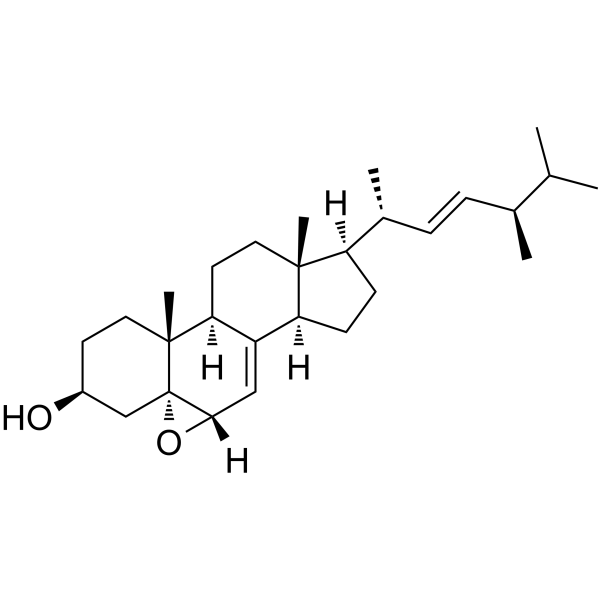
5,6-Epoxyergosterol
CAS No. 23637-31-2
5,6-Epoxyergosterol( —— )
Catalog No. M29503 CAS No. 23637-31-2
5,6-Epoxyergosterol is derived from the endophytic fungus Phyllosticta capitalensis.
Purity : >98% (HPLC)
 COA
Datasheet
HNMR
HPLC
MSDS
Handing Instructions
COA
Datasheet
HNMR
HPLC
MSDS
Handing Instructions
| Size | Price / USD | Stock | Quantity |
| 2MG | 166 | In Stock |


|
| 5MG | 256 | In Stock |
|
| 10MG | 375 | In Stock |
|
| 25MG | 562 | In Stock |
|
| 100MG | Get Quote | In Stock |
|
| 200MG | Get Quote | In Stock |
|
| 500MG | Get Quote | In Stock |
|
| 1G | Get Quote | In Stock |
|
Biological Information
-
Product Name5,6-Epoxyergosterol
-
NoteResearch use only, not for human use.
-
Brief Description5,6-Epoxyergosterol is derived from the endophytic fungus Phyllosticta capitalensis.
-
Description5,6-Epoxyergosterol is derived from the endophytic fungus Phyllosticta capitalensis.
-
In Vitro——
-
In Vivo——
-
Synonyms——
-
PathwayOthers
-
TargetOther Targets
-
Recptor——
-
Research Area——
-
Indication——
Chemical Information
-
CAS Number23637-31-2
-
Formula Weight412.65
-
Molecular FormulaC28H44O2
-
Purity>98% (HPLC)
-
Solubility——
-
SMILESC[C@]12[C@@]3([C@@](O3)(C=C4[C@@]1(CC[C@@]5(C)[C@]4(CC[C@@]5([C@@H](/C=C/[C@@H](C(C)C)C)C)[H])[H])[H])[H])C[C@@H](O)CC2
-
Chemical Name——
Shipping & Storage Information
-
Storage(-20℃)
-
ShippingWith Ice Pack
-
Stability≥ 2 years
Reference
molnova catalog



related products
-
MIF-IN-2
MIF-IN-2 is a heterocyclic macrophage migration inhibitory factor (MIF) inhibitor with anticancer activity for the study of cancer and autoimmune disorders.CAS ??13460-73-86-5
-
Amphotericin B
Amphotericin B is a Lipid-based Polyene Antifungal and Polyene Antifungal. The chemical classification of amphotericin b is Polyenes.
-
[Gln22] - 25359 - Am...
[Gln22] - 25359 - Amyloid (6 - 40)
