


 Cart
Cart
 sales@molnova.com


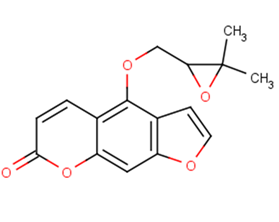
Oxypeucedanin
CAS No. 737-52-0
Oxypeucedanin( —— )
Catalog No. M19055 CAS No. 737-52-0
Oxypeucedanin has novel anticancer effect, mediated via induction of G2-M cell cycle arrest and apoptosis in human prostate carcinoma DU145 cells.
Purity : >98% (HPLC)
 COA
Datasheet
HNMR
HPLC
MSDS
Handing Instructions
COA
Datasheet
HNMR
HPLC
MSDS
Handing Instructions
| Size | Price / USD | Stock | Quantity |
| 5MG | 149 | In Stock |


|
| 10MG | 255 | In Stock |
|
| 25MG | 431 | In Stock |
|
| 50MG | 619 | In Stock |
|
| 100MG | 861 | In Stock |
|
| 200MG | Get Quote | In Stock |
|
| 500MG | Get Quote | In Stock |
|
| 1G | Get Quote | In Stock |
|
Biological Information
-
Product NameOxypeucedanin
-
NoteResearch use only, not for human use.
-
Brief DescriptionOxypeucedanin has novel anticancer effect, mediated via induction of G2-M cell cycle arrest and apoptosis in human prostate carcinoma DU145 cells.
-
DescriptionOxypeucedanin has novel anticancer effect, mediated via induction of G2-M cell cycle arrest and apoptosis in human prostate carcinoma DU145 cells. Oxypeucedanin is a kind of open-channel blocker of the hKv1.5 channel and it prolongs the APD; therefore, it is an excellent candidate as an antiarrhythmic drug for atrial fibrillation.
-
In Vitro——
-
In Vivo——
-
Synonyms——
-
PathwayApoptosis
-
TargetApoptosis
-
RecptorOthers
-
Research AreaCancer
-
Indication——
Chemical Information
-
CAS Number737-52-0
-
Formula Weight286.28
-
Molecular FormulaC16H14O5
-
Purity>98% (HPLC)
-
SolubilityIn Vitro:?DMSO : 50 mg/mL (174.65 mM)
-
SMILESCC1(C(O1)COC2=C3C=CC(=O)OC3=CC4=C2C=CO4)C
-
Chemical Name——
Shipping & Storage Information
-
Storage(-20℃)
-
ShippingWith Ice Pack
-
Stability≥ 2 years
Reference
molnova catalog



related products
-
Phenformin
Phenformin (BRN 1977317) is a biguanide compound with anticancer and anti-glycemic activity, inhibits skin tumor growth and promotes keratinocyte differentiation and apoptosis.
-
DB1976
DB1976 is a selenophene analog of DB270 and a highly potent, cell-permeable, fully efficacious transcription factor PU.1 inhibitor.
-
3-Deoxyaconitine
3-?Deoxyaconitine is a derivative of Aconitine (A189875), which activates tetrodotoxin-sensitive Na+ channels, inducing presynaptic depolarization.
