


 Cart
Cart
 sales@molnova.com


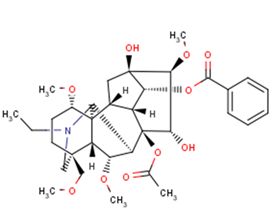
3-Deoxyaconitine
CAS No. 3175-95-9
3-Deoxyaconitine( —— )
Catalog No. M18418 CAS No. 3175-95-9
3- Deoxyaconitine is a derivative of Aconitine (A189875), which activates tetrodotoxin-sensitive Na+ channels, inducing presynaptic depolarization.
Purity : >98% (HPLC)
 COA
Datasheet
HNMR
HPLC
MSDS
Handing Instructions
COA
Datasheet
HNMR
HPLC
MSDS
Handing Instructions
| Size | Price / USD | Stock | Quantity |
| 1 mL x 10 mM in DMSO | 103 | In Stock |


|
| 5MG | 73 | In Stock |
|
| 10MG | 107 | In Stock |
|
| 25MG | 180 | In Stock |
|
| 50MG | 263 | In Stock |
|
| 100MG | Get Quote | In Stock |
|
| 200MG | Get Quote | In Stock |
|
| 500MG | Get Quote | In Stock |
|
| 1G | Get Quote | In Stock |
|
Biological Information
-
Product Name3-Deoxyaconitine
-
NoteResearch use only, not for human use.
-
Brief Description3- Deoxyaconitine is a derivative of Aconitine (A189875), which activates tetrodotoxin-sensitive Na+ channels, inducing presynaptic depolarization.
-
Description3- Deoxyaconitine is a derivative of Aconitine (A189875), which activates tetrodotoxin-sensitive Na+ channels, inducing presynaptic depolarization, thus blocking the nerve action potential which, in turn, blocks the release of neurotransmitters and decreases the end plate potential at the neuromuscular junction.
-
In Vitro——
-
In Vivo——
-
Synonyms——
-
PathwayApoptosis
-
TargetApoptosis
-
RecptorOthers
-
Research Area——
-
Indication——
Chemical Information
-
CAS Number3175-95-9
-
Formula Weight629.74
-
Molecular FormulaC34H47NO10
-
Purity>98% (HPLC)
-
SolubilityIn Vitro:?DMSO : 50 mg/mL (79.40 mM)
-
SMILESCCN1CC2(CCC(C34C2C(C(C31)C5(C6C4CC(C6OC(=O)C7=CC=CC=C7)(C(C5O)OC)O)OC(=O)C)OC)OC)COC
-
Chemical Name——
Shipping & Storage Information
-
Storage(-20℃)
-
ShippingWith Ice Pack
-
Stability≥ 2 years
Reference
1.Derbre, S., et al.: Anal. Bioanal. Chem., 398, 1747 (2010), Li, M., et al.: J. Pharm. Biomed. Anal., 53, 1063 (2010)
molnova catalog



related products
-
Soyasapogenol B
Soyasapogenol B has anti-cancer, hypocholesterolemic, anticomplementary, hepatoprotective effects, it inhibits proliferation of cultured Hep-G2.
-
EAD1 TFA(1644388-26-...
EAD1 HCL is a potent autophagy inhibitor with antiproliferative activity in lung and pancreatic cancer cells. EAD1 HCL also induces apoptosis
-
(±)-Indoxacarb
(±)-Indoxacarb is a pyrazoline insecticide with insecticidal activity and cytotoxicity, blocks sodium channels in insect neurons, and can induce apoptosis.
