


 Cart
Cart
 sales@molnova.com


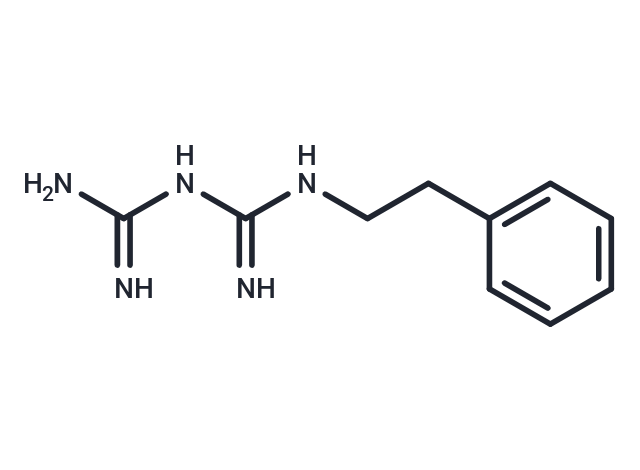
Phenformin
CAS No. 114-86-3
Phenformin( —— )
Catalog No. M33658 CAS No. 114-86-3
Phenformin (BRN 1977317) is a biguanide compound with anticancer and anti-glycemic activity, inhibits skin tumor growth and promotes keratinocyte differentiation and apoptosis.
Purity : >98% (HPLC)
 COA
Datasheet
HNMR
HPLC
MSDS
Handing Instructions
COA
Datasheet
HNMR
HPLC
MSDS
Handing Instructions
| Size | Price / USD | Stock | Quantity |
| 5MG | 40 | In Stock |


|
| 10MG | 65 | In Stock |
|
| 25MG | 121 | In Stock |
|
| 50MG | 175 | In Stock |
|
| 100MG | 256 | In Stock |
|
| 200MG | 369 | In Stock |
|
| 500MG | Get Quote | In Stock |
|
| 1G | Get Quote | In Stock |
|
Biological Information
-
Product NamePhenformin
-
NoteResearch use only, not for human use.
-
Brief DescriptionPhenformin (BRN 1977317) is a biguanide compound with anticancer and anti-glycemic activity, inhibits skin tumor growth and promotes keratinocyte differentiation and apoptosis.
-
DescriptionPhenformin (1-phenethylbiguanide) is an orally active antidiabetic and anticancer agent. Phenformin has an incidence of associated lactic acidosis. Phenformin acts through acting AMPK activation and blocking mTOR pathway. Phenformin is also a substrate of P-glycoprotein (P-gp), and an OXPHOS inhibitor. Phenformin induces cancer cell apoptosis.
-
In Vitro——
-
In Vivo——
-
Synonyms——
-
PathwayApoptosis
-
TargetApoptosis
-
RecptorApoptosis
-
Research Area——
-
Indication——
Chemical Information
-
CAS Number114-86-3
-
Formula Weight205.26
-
Molecular FormulaC10H15N5
-
Purity>98% (HPLC)
-
Solubility——
-
SMILESNC(=N)NC(=N)NCCc1ccccc1
-
Chemical Name——
Shipping & Storage Information
-
Storage(-20℃)
-
ShippingWith Ice Pack
-
Stability≥ 2 years
Reference
1. García Rubi?o ME, et al. Phenformin as an Anticancer Agent: Challenges and Prospects. Int J Mol Sci. 2019 Jul 5;20(13):3316.?
molnova catalog



related products
-
1-beta-D-Arabinofura...
1-beta-D-Arabinofuranosylthymine (Thymine 1-β-D-arabinofuranoside) is a purine nucleoside analog. Purine nucleoside analogs have a broad spectrum of antitumor activity, targeting inert lymphoid malignancies and inducing apoptosis.
-
Bromelain
Bromelain is an anti-inflammatory drug derived from pineapple stem.
-
Se-Aspirin
Se-Aspirin (Se-NSAID-8) has anticancer activity and gastroprotective effects, inhibits activation of proinflammatory and pro-survival NF-?B pathways, and inhibits the expression of anti-apoptotic targets downstream of NF-?B (e.g., Bcl-xL, Mcl-1, and survivin).
