


 Cart
Cart
 sales@molnova.com


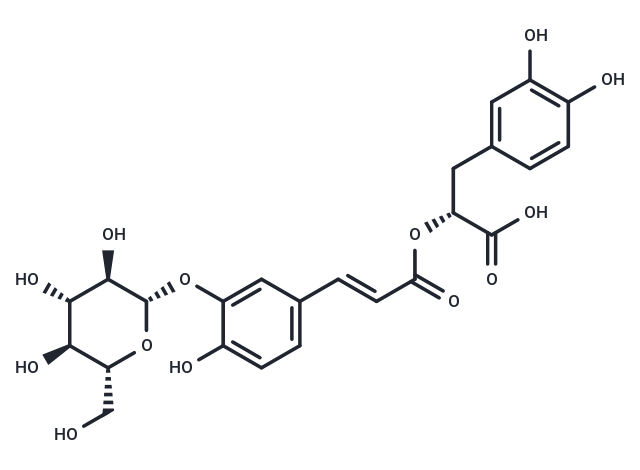
Salviaflaside
CAS No. 178895-25-5
Salviaflaside( —— )
Catalog No. M37726 CAS No. 178895-25-5
Salviaflaside is the main bioactive component of Prunella vulgaris and has antioxidant activity.
Purity : >98% (HPLC)
 COA
Datasheet
HNMR
HPLC
MSDS
Handing Instructions
COA
Datasheet
HNMR
HPLC
MSDS
Handing Instructions
| Size | Price / USD | Stock | Quantity |
| 1 mL x 10 mM in DMSO | 282 | In Stock |


|
| 5MG | 227 | In Stock |
|
| 10MG | 339 | In Stock |
|
| 25MG | 561 | In Stock |
|
| 50MG | 799 | In Stock |
|
| 100MG | 1097 | In Stock |
|
| 200MG | Get Quote | In Stock |
|
| 500MG | Get Quote | In Stock |
|
| 1G | Get Quote | In Stock |
|
Biological Information
-
Product NameSalviaflaside
-
NoteResearch use only, not for human use.
-
Brief DescriptionSalviaflaside is the main bioactive component of Prunella vulgaris and has antioxidant activity.
-
DescriptionSalviaflaside is a main bioactive component of Spica Prunellae.
-
In Vitro——
-
In Vivo——
-
Synonyms——
-
PathwayOthers
-
TargetAntioxidant
-
RecptorAntioxidant
-
Research Area——
-
Indication——
Chemical Information
-
CAS Number178895-25-5
-
Formula Weight522.46
-
Molecular FormulaC24H26O13
-
Purity>98% (HPLC)
-
SolubilityIn Vitro:?DMSO : 100 mg/mL (191.40 mM; Ultrasonic )
-
SMILESO([C@@H]1O[C@H](CO)[C@@H](O)[C@H](O)[C@H]1O)C2=CC(/C=C/C(O[C@H](CC3=CC(O)=C(O)C=C3)C(O)=O)=O)=CC=C2O
-
Chemical Name——
Shipping & Storage Information
-
Storage(-20℃)
-
ShippingWith Ice Pack
-
Stability≥ 2 years
Reference
1. Chen Y, et al. Effects of UV-B Radiation on the Content of Bioactive Components and the Antioxidant Activity of Prunella vulgaris L. Spica during Development. Molecules. 2018 Apr 24;23(5).?
molnova catalog



related products
-
Purpurin 18
Purpurin 18 is an interesting dihydroporphyrin for generating photosensitizers. It has antioxidant activity.
-
Ethyl pyruvate
Ethyl pyruvate is a simple aliphatic ester of pyruvic acid and has been shown to have robust neuroprotective effects via its anti-inflammatory anti-oxidative and anti-apoptotic functions.
-
Isovitexin(b)
Isovitexin an active component of many traditional Chinese medicines shows various activities such as anti-oxidant anti-inflammatory anti-alzheimer disease (AD) effects and so on.
