


 Cart
Cart
 sales@molnova.com


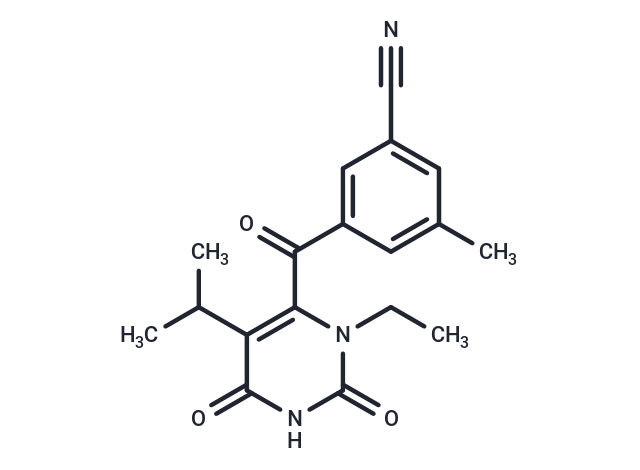
KM-023
CAS No. 1097628-00-6
KM-023( —— )
Catalog No. M35996 CAS No. 1097628-00-6
KM-023 is a new second-generation non-nucleoside reverse transcriptase inhibitor for the study of human immunodeficiency virus (HIV) type 1 infection.
Purity : >98% (HPLC)
 COA
Datasheet
HNMR
HPLC
MSDS
Handing Instructions
COA
Datasheet
HNMR
HPLC
MSDS
Handing Instructions
| Size | Price / USD | Stock | Quantity |
| 1 mL x 10 mM in DMSO | 358 | In Stock |


|
| 5MG | 361 | In Stock |
|
| 10MG | 542 | In Stock |
|
| 25MG | 870 | In Stock |
|
| 50MG | 1163 | In Stock |
|
| 100MG | 1562 | In Stock |
|
| 200MG | Get Quote | In Stock |
|
| 500MG | 3134 | In Stock |
|
| 1G | Get Quote | In Stock |
|
Biological Information
-
Product NameKM-023
-
NoteResearch use only, not for human use.
-
Brief DescriptionKM-023 is a new second-generation non-nucleoside reverse transcriptase inhibitor for the study of human immunodeficiency virus (HIV) type 1 infection.
-
DescriptionKM-023 is a new second-generation non-nucleoside reverse transcriptase inhibitor for the study of human immunodeficiency virus (HIV) type 1 infection.
-
In Vitro——
-
In Vivo——
-
Synonyms——
-
PathwayMicrobiology/Virology
-
TargetHIV
-
RecptorHIV Protease
-
Research Area——
-
Indication——
Chemical Information
-
CAS Number1097628-00-6
-
Formula Weight325.36
-
Molecular FormulaC18H19N3O3
-
Purity>98% (HPLC)
-
Solubility——
-
SMILESC(=O)(C1=C(C(C)C)C(=O)NC(=O)N1CC)C2=CC(C#N)=CC(C)=C2
-
Chemical Name——
Shipping & Storage Information
-
Storage(-20℃)
-
ShippingWith Ice Pack
-
Stability≥ 2 years
Reference
molnova catalog



related products
-
GSK-2838232
GSK-2838232 is a novel HIV maturation inhibitor being developed for the treatment of HIV in combination with other antiretroviral therapy.
-
Emivirine
Emivirine (MKC-442) is a potent and selective nonnucleoside reverse transcriptase inhibitor for human immunodeficiency virus type 1.
-
NSC-34931
A anti-HIV-1 compound that interferes with HIV-I integrase binding to viral DNA.
