


 Cart
Cart
 sales@molnova.com


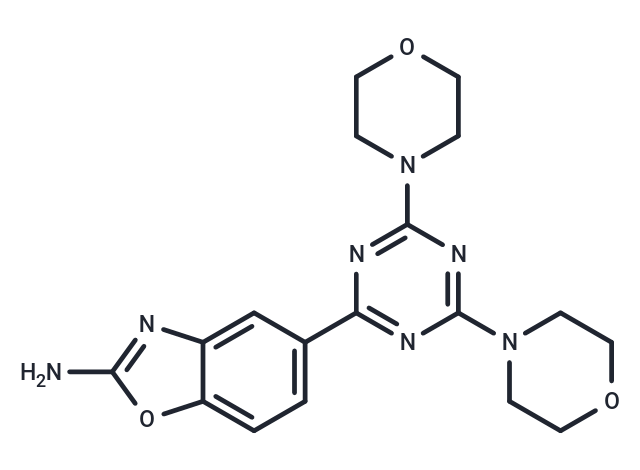
PI3Kα-IN-9
CAS No. 2715287-67-3
PI3Kα-IN-9( —— )
Catalog No. M35579 CAS No. 2715287-67-3
PI3Kα-IN-9 is an orally available, selective and potent PI3Kα inhibitor with antiproliferative activity, inhibits PI3Kα, PI3Kγ, PI3Kδ, and PI3Kβ, induces apoptosis, and can be used in the study of cancer.
Purity : >98% (HPLC)
 COA
Datasheet
HNMR
HPLC
MSDS
Handing Instructions
COA
Datasheet
HNMR
HPLC
MSDS
Handing Instructions
| Size | Price / USD | Stock | Quantity |
| 5MG | 117 | In Stock |


|
| 10MG | 188 | In Stock |
|
| 25MG | 432 | In Stock |
|
| 50MG | 641 | In Stock |
|
| 100MG | 1014 | In Stock |
|
| 200MG | Get Quote | In Stock |
|
| 500MG | Get Quote | In Stock |
|
| 1G | Get Quote | In Stock |
|
Biological Information
-
Product NamePI3Kα-IN-9
-
NoteResearch use only, not for human use.
-
Brief DescriptionPI3Kα-IN-9 is an orally available, selective and potent PI3Kα inhibitor with antiproliferative activity, inhibits PI3Kα, PI3Kγ, PI3Kδ, and PI3Kβ, induces apoptosis, and can be used in the study of cancer.
-
DescriptionPI3Kα-IN-9 (compound 27) is a selective, long-acting and oral active PI3Kα inhibitor with IC50 values of 4.4, 128, 146 and 153 nM for PI3Kα, PI3Kγ, PI3Kδ and PI3Kβ, respectively. PI3Kα-IN-9 has antiproliferative activity and induces apoptosis. PI3Kα-IN-9 can be used for cancer research.
-
In VitroPI3Kα-IN-9 (compound 27) (0-8 μM; 72 hours; cancer cell lines) has antiproliferative activity and induces apoptosis.PI3Kα-IN-9 (compound 27) (0-8 μM; MGC-803 cells) down-regulates the expression of PI3Kα protein, the proteins of PI3K downstream, p-AKT and p-P70S6 K.Cell Viability Assay Cell Line:MGC-803 (gastric cancer), SKOV-3 (ovarian cancer), PC-3(prostate cancer), MCF-7 (breast cancer), MDA-MB-231 (triple-negative breast cancer), HepG2 (liver cancer), RPMI8226 (multiple myeloma), K562 (chronic myeloid leukemia), U251 (glioma) and MOLT-4 (acute lymphoblastic leukemia) cell lines Concentration:0-2 μM Incubation Time:72 hours Result:Inhibited the growth of a variety of cancer cells with IC50 values ranging from 0.43 to 1.33 μM.Apoptosis Analysis Cell Line:MGC-803 cells Concentration:0, 2, 4 and 8 μM Incubation Time:36 hours Result:Increased the percentage of apoptotic cells from 12.07 to 61.69% in a dose-dependent manner.
-
In VivoPI3Kα-IN-9 (compound 27) (1-10 mg/kg; p.o. and i.v.; for 24 hours; male Sprague-Dawley rat) has favorable stability (T1/2>10 h) and high bioavailability (130%).PI3Kα-IN-9 (compound 27) (30 mg/kg; p.o.; daily, for 3 weeks; male BALB/c nude mice) has antitumor activity and low cytotoxicity.Animal Model:Male Sprague-Dawley ratDosage:1 and 10 mg/kg Administration:Oral administration and intravenous injection.Animal Model:Male BALB/c nude mice Dosage:30 mg/kg Administration:Oral administration; daily, for 3 weeks Result:Inhibited tumor growth with a tumor growth inhibition (TGI) rate of 41.5%.
-
Synonyms——
-
PathwayApoptosis
-
TargetApoptosis
-
RecptorApoptosis | PI3K
-
Research Area——
-
Indication——
Chemical Information
-
CAS Number2715287-67-3
-
Formula Weight383.4
-
Molecular FormulaC18H21N7O3
-
Purity>98% (HPLC)
-
SolubilityIn Vitro:?DMSO : 100 mg/mL (260.82 mM; Ultrasonic (<80°C)
-
SMILESN1=C(N=C(N=C1N2CCOCC2)N3CCOCC3)C4=CC=C5OC(=NC5=C4)N
-
Chemical Name——
Shipping & Storage Information
-
Storage(-20℃)
-
ShippingWith Ice Pack
-
Stability≥ 2 years
Reference
1. Hou Y, et, al. Discovery of Novel Phosphoinositide-3-Kinase α Inhibitors with High Selectivity, Excellent Bioavailability, and Long-Acting Efficacy for Gastric Cancer. J Med Chem. 2022 Jul 14.?
molnova catalog



related products
-
Ac-Pro-Gly-Pro-OH
Ac-Pro-Gly-Pro-OH is an acetyl-modified tripeptide compound that acts as a CXCR2 agonist, exhibiting bactericidal and anti-inflammatory activities.
-
NM-3
NM-3 is an orally available anti-angiogenic inhibitor with anti-tumour activity.NM-3 is used as a radiation modulator in vitro and in vivo.
-
Sodium Oxamate
Sodium Oxamate is an LDH inhibitor.?Sodium oxamate (SO) induces G2/M cell cycle arrest via downregulation of the CDK1/cyclin B1 pathway and promotes apoptosis through enhancement of mitochondrial ROS generation.
