


 Cart
Cart
 sales@molnova.com


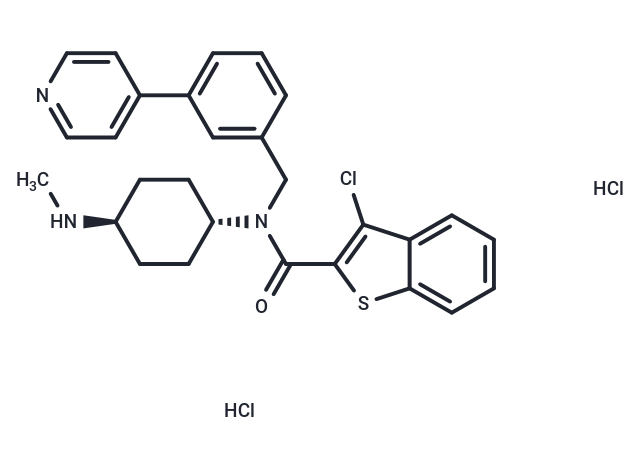
SAG dihydrochloride
CAS No. 2702366-44-5
SAG dihydrochloride( —— )
Catalog No. M35211 CAS No. 2702366-44-5
SAG dihydrochloride, a powerful agonist of the Smoothened (Smo) receptor (EC 50 = 3 nM; Kd = 59 nM), effectively activates the Hedgehog signaling pathway.
Purity : >98% (HPLC)
 COA
Datasheet
HNMR
HPLC
MSDS
Handing Instructions
COA
Datasheet
HNMR
HPLC
MSDS
Handing Instructions
| Size | Price / USD | Stock | Quantity |
| 1 mL x 10 mM in DMSO | 216 | In Stock |


|
| 5MG | 87 | In Stock |
|
| 10MG | 140 | In Stock |
|
| 25MG | 236 | In Stock |
|
| 50MG | 350 | In Stock |
|
| 100MG | 524 | In Stock |
|
| 200MG | Get Quote | In Stock |
|
| 500MG | Get Quote | In Stock |
|
| 1G | Get Quote | In Stock |
|
Biological Information
-
Product NameSAG dihydrochloride
-
NoteResearch use only, not for human use.
-
Brief DescriptionSAG dihydrochloride, a powerful agonist of the Smoothened (Smo) receptor (EC 50 = 3 nM; Kd = 59 nM), effectively activates the Hedgehog signaling pathway.
-
DescriptionSAG dihydrochloride is a potent Smoothened (Smo) receptor agonist (EC50=3 nM; Kd=59 nM). SAG dihydrochloride activates the Hedgehog signaling pathway and counteracts Cyclopamine (HY-17024) inhibition of Smo.
-
In VitroSAG (0.1 nM-100 μM; 30 h) induces firefly luciferase expression in Shh-LIGHT2 cells with an EC50 of 3 nM and then inhibits expression at higher concentrations.SAG (1-1000 nM; 1 h) competes for the binding of BODIPY-cyclopamine to Smo-expressing Cos-1 cells, yielding an apparent dissociation constant (Kd) of 59 nM for the SAG/Smo complex.SAG (100 nM) inhibits the inhibitory effect of ShhN-induced pathway activation by Robotnikinin.SAG (250 nM; 48 h) significantly increases SMO mRNA and protein expression in MDAMB231 cells.SAG (250 nM; 24 and 48 h) increases CAXII mRNA expression in MDAMB231 cells at 24h in normoxic and hypoxic conditions in MDAMB231 cells.SAG (250 nM; 24 h) increases MDAMB231 cells migration.
-
In VivoSAG (1.0 mM) induces more osteogenesis mainly at the defect borders and a significant increase in BV/TV at the eight week timepoint in CD-1 mice.SAG (15-20 mg/kg; i.p.) induces pre-axial polydactyly prevalently in a dose-dependent manner in mice.Animal Model:Pregnant C57BL/6J mice Dosage:15, 17, 20 mg/kg Administration:A single i.p.Result:Effective in ca. 80% of the embryos and increased Gli1 and Gli2 mRNA expression in the limb bud, with Gli1 mRNA being the most upregulated at the dose of 20 mg/kg.
-
Synonyms——
-
PathwayGPCR/G Protein
-
TargetHedgehog (Hh)
-
RecptorHedgehog/Smoothened
-
Research Area——
-
Indication——
Chemical Information
-
CAS Number2702366-44-5
-
Formula Weight562.98
-
Molecular FormulaC28H30Cl3N3OS
-
Purity>98% (HPLC)
-
SolubilityIn Vitro:?H2O : 100 mg/mL (177.63 mM; Ultrasonic)DMSO : 33.33 mg/mL (59.20 mM; Ultrasonic )
-
SMILESO=C(C1=C(C2=CC=CC=C2S1)Cl)N([C@@H]3CC[C@H](CC3)NC)CC4=CC(C5=CC=NC=C5)=CC=C4.Cl.Cl
-
Chemical Name——
Shipping & Storage Information
-
Storage(-20℃)
-
ShippingWith Ice Pack
-
Stability≥ 2 years
Reference
1. Chen JK, et al. Small molecule modulation of Smoothened activity. Proc Natl Acad Sci U S A. 2002 Oct 29;99(22):14071-6.?
molnova catalog



related products
-
Robotnikinin
Robotnikinin is asmall molecule that binds the extracellular Sonic Hedgehog (Shh) protein (Kd=3.1 uM) and blocks Shh-signaling in cell lines.
-
Cyclopamine
A natural steroidal alkaloid that inhibits hedgehog (Hh) signaling with IC50 of 46 nM.
-
Cyclopamine tartrate
Cyclopamine tartrate is a natural steroidal alkaloid that inhibits hedgehog (Hh) signaling with IC50 of 46 nM.
