


 Cart
Cart
 sales@molnova.com


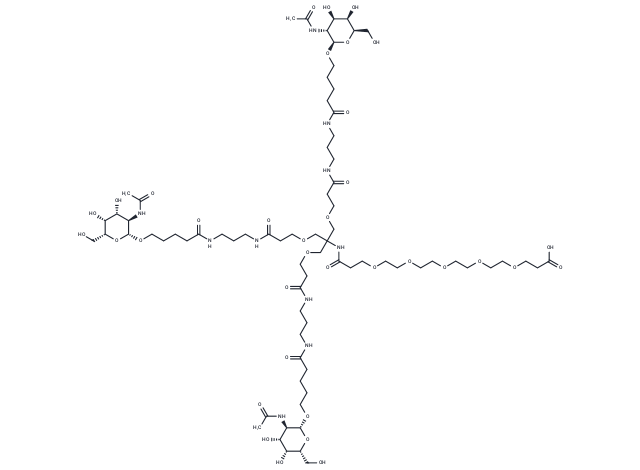
tri-GalNAc-COOH
CAS No. 1953146-81-0
tri-GalNAc-COOH( —— )
Catalog No. M35114 CAS No. 1953146-81-0
Tri-GalNAc-COOH is a ligand for the asialoglycoprotein receptor (ASGPR) and is commonly used in lysosomal targeting chimera (LYTAC) investigations.
Purity : >98% (HPLC)
 COA
Datasheet
HNMR
HPLC
MSDS
Handing Instructions
COA
Datasheet
HNMR
HPLC
MSDS
Handing Instructions
| Size | Price / USD | Stock | Quantity |
| 1 mL x 10 mM in DMSO | 1159 | In Stock |


|
| 5MG | 607 | In Stock |
|
| 10MG | 846 | In Stock |
|
| 25MG | 1302 | In Stock |
|
| 50MG | 1702 | In Stock |
|
| 100MG | 2316 | In Stock |
|
| 200MG | Get Quote | In Stock |
|
| 500MG | 4631 | In Stock |
|
| 1G | Get Quote | In Stock |
|
Biological Information
-
Product Nametri-GalNAc-COOH
-
NoteResearch use only, not for human use.
-
Brief DescriptionTri-GalNAc-COOH is a ligand for the asialoglycoprotein receptor (ASGPR) and is commonly used in lysosomal targeting chimera (LYTAC) investigations.
-
Descriptiontri-GalNAc-COOH is an asialoglycoprotein receptor (ASGPR) ligand that can be used for LYsosome TArgeting Chimera (LYTAC) research.
-
In Vitrotri-GalNAc-COOH is a biotin-free ASGPR ligand, which failes to deliver NA-650 to HepG2, Huh7, or A549 cells.
-
In Vivo——
-
Synonyms——
-
PathwayOthers
-
TargetOther Targets
-
RecptorLYTACs
-
Research Area——
-
Indication——
Chemical Information
-
CAS Number1953146-81-0
-
Formula Weight1735.91
-
Molecular FormulaC75H134N10O35
-
Purity>98% (HPLC)
-
SolubilityIn Vitro:?DMSO : 250 mg/mL (144.02 mM; Ultrasonic )
-
SMILESCC(=O)N[C@@H]1[C@@H](O)[C@@H](O)[C@@H](CO)O[C@H]1OCCCCC(=O)NCCCNC(=O)CCOCC(COCCC(=O)NCCCNC(=O)CCCCO[C@@H]1O[C@H](CO)[C@H](O)[C@H](O)[C@H]1NC(C)=O)(COCCC(=O)NCCCNC(=O)CCCCO[C@@H]1O[C@H](CO)[C@H](O)[C@H](O)[C@H]1NC(C)=O)NC(=O)CCOCCOCCOCCOCCOCCC(O)=O
-
Chemical Name——
Shipping & Storage Information
-
Storage(-20℃)
-
ShippingWith Ice Pack
-
Stability≥ 2 years
Reference
1. Yaxian Zhou, et al. Development of Triantennary N-Acetylgalactosamine Conjugates as Degraders for Extracellular Proteins. ACS Cent Sci. 2021 Mar 24;7(3):499-506.?
molnova catalog



related products
-
Biotin-Kinase Domain...
Biotin-Kinase Domain of Insulin Receptor (2)
-
β-Endorphin, equine ...
β-Endorphin, equine (TFA) is an endogenous opioid peptide, which binds at high affinity to both μ/δ opioid receptors.
-
Methyl behenate
Methyl behenate is a natural compound is an ester form of docosanoic acid .
