


 Cart
Cart
 sales@molnova.com


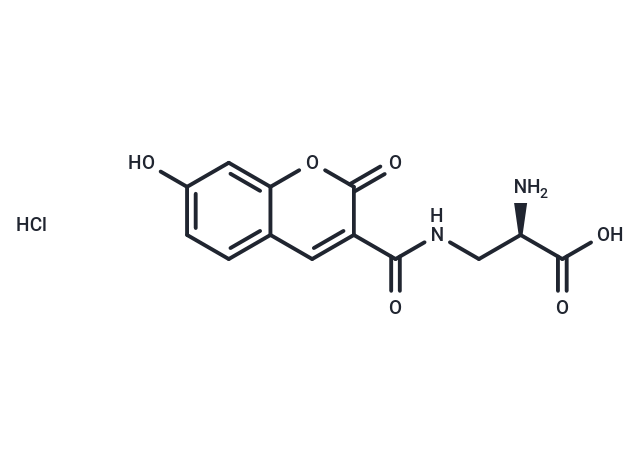
HADA Hydrochloride
CAS No. 2253733-10-5
HADA Hydrochloride( —— )
Catalog No. M34616 CAS No. 2253733-10-5
HADA Hydrochloride (HCC-Amino-D-alanine hydrochloride) is a blue (λem~450 nm) fluorescent D-amino acid (FDAA).
Purity : >98% (HPLC)
 COA
Datasheet
HNMR
HPLC
MSDS
Handing Instructions
COA
Datasheet
HNMR
HPLC
MSDS
Handing Instructions
| Size | Price / USD | Stock | Quantity |
| 1 mL x 10 mM in DMSO | 167 | In Stock |


|
| 2MG | 91 | In Stock |
|
| 5MG | 150 | In Stock |
|
| 10MG | 236 | In Stock |
|
| 25MG | 377 | In Stock |
|
| 50MG | 529 | In Stock |
|
| 100MG | 731 | In Stock |
|
| 200MG | 1014 | In Stock |
|
| 500MG | Get Quote | In Stock |
|
| 1G | Get Quote | In Stock |
|
Biological Information
-
Product NameHADA Hydrochloride
-
NoteResearch use only, not for human use.
-
Brief DescriptionHADA Hydrochloride (HCC-Amino-D-alanine hydrochloride) is a blue (λem~450 nm) fluorescent D-amino acid (FDAA).
-
DescriptionHADA hydrochloride (HCC-Amino-D-alanine hydrochloride) is a blue (λem~450 nm) fluorescent D-amino acid (FDAA). FDAAs are efficiently incorporated into the peptidoglycans (PGs) of diverse bacterial species at the sites of PG biosynthesis, allowing specific and covalent probing of bacterial growth with minimal perturbation.
-
In Vitro——
-
In Vivo——
-
Synonyms——
-
PathwayAutophagy
-
TargetAutophagy
-
RecptorAutophagy
-
Research Area——
-
Indication——
Chemical Information
-
CAS Number2253733-10-5
-
Formula Weight328.71
-
Molecular FormulaC13H13ClN2O6
-
Purity>98% (HPLC)
-
SolubilityIn Vitro:?DMSO : 125 mg/mL (380.27 mM; Ultrasonic )
-
SMILESCl.N[C@H](CNC(=O)c1cc2ccc(O)cc2oc1=O)C(O)=O
-
Chemical Name——
Shipping & Storage Information
-
Storage(-20℃)
-
ShippingWith Ice Pack
-
Stability≥ 2 years
Reference
1. Erkin Kuru, et al. Synthesis of fluorescent D-amino acids and their use for probing peptidoglycan synthesis and bacterial growth in situ. Nat Protoc. 2015 Jan;10(1):33-52.?
molnova catalog



related products
-
Sulfathiazole
Sulfathiazole is an organosulfur compound that has been used as a short-acting sulfa drug.
-
LY2183240
LY2183240 inhibits fatty acid amide hydrolase (FAAH) activity (IC50 = 12.4 nM). LY2183240 is a novel and highly effective blocker of anandamide uptake (IC50 = 270 pM).
-
UNC669
UNC669 is an effective and specific MBT (malignant brain tumor) inhibitor with IC50 of 4.2/3.1 uM for L3MBTL1/3.
