


 Cart
Cart
 sales@molnova.com


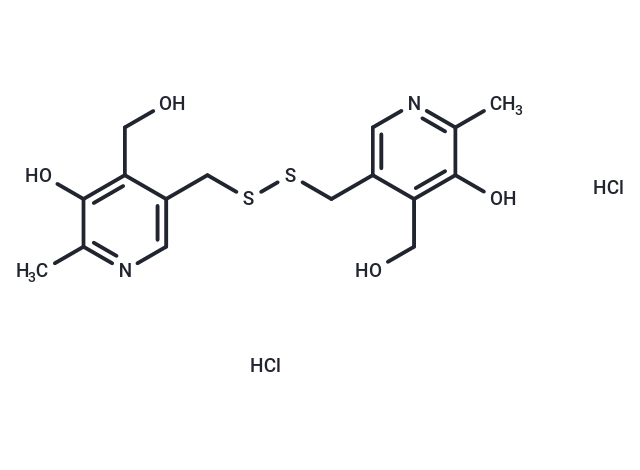
Pyrithioxin dihydrochloride
CAS No. 10049-83-9
Pyrithioxin dihydrochloride( —— )
Catalog No. M33686 CAS No. 10049-83-9
Pyrithioxin dihydrochloride (Pyrithioxine HCl) has anti-nociceptive and anti-allodynic effects, can promote the metabolism of glucose and amino acids in the brain, improve systemic assimilation, and can be used to study neurological diseases such as atherosclerosis.
Purity : >98% (HPLC)
 COA
Datasheet
HNMR
HPLC
MSDS
Handing Instructions
COA
Datasheet
HNMR
HPLC
MSDS
Handing Instructions
| Size | Price / USD | Stock | Quantity |
| 50MG | 30 | In Stock |


|
| 100MG | 45 | In Stock |
|
| 200MG | Get Quote | In Stock |
|
| 500MG | Get Quote | In Stock |
|
| 1G | Get Quote | In Stock |
|
Biological Information
-
Product NamePyrithioxin dihydrochloride
-
NoteResearch use only, not for human use.
-
Brief DescriptionPyrithioxin dihydrochloride (Pyrithioxine HCl) has anti-nociceptive and anti-allodynic effects, can promote the metabolism of glucose and amino acids in the brain, improve systemic assimilation, and can be used to study neurological diseases such as atherosclerosis.
-
DescriptionPyrithioxin dihydrochloride is a neurodynamic compound, combined with a short period of hyperventilation (HV) was applied in cerebral infarct patients with Hemiplegia.
-
In Vitro——
-
In Vivo——
-
Synonyms——
-
PathwayProteasome/Ubiquitin
-
TargetEndogenous Metabolite
-
RecptorEndogenous Metabolite
-
Research Area——
-
Indication——
Chemical Information
-
CAS Number10049-83-9
-
Formula Weight441.39
-
Molecular FormulaC16H22Cl2N2O4S2
-
Purity>98% (HPLC)
-
SolubilityIn Vitro:?DMSO : 66.67 mg/mL (151.05 mM; Ultrasonic )H2O : 50 mg/mL (113.28 mM; Ultrasonic)
-
SMILESOC1=C(CO)C(CSSCC2=CN=C(C)C(O)=C2CO)=CN=C1C.Cl.Cl
-
Chemical Name——
Shipping & Storage Information
-
Storage(-20℃)
-
ShippingWith Ice Pack
-
Stability≥ 2 years
Reference
1. Stoica E, et al. Facilitation through hyperventilation of therapeutic effect of pyrithioxin in cerebral infarct patients. Eur Neurol. 1975;13(4):285-303.?
molnova catalog



related products
-
Diphenyl disulfide
Diphenyl disulfide (Phenyl disulfide) shows anticancer activity in breast cancer cell lines.Diphenyl disulfide induces and enhances apoptosis in breast cancer cells through Bax protein hydrolysis activation and concomitant autophagy.
-
(3-Carboxypropyl)tri...
(3-Carboxypropyl)trimethylammonium chloride is a synthetic carnitine related compound used as a transporter substrate in the cloning and sequencing of human carnitine transporter 2 (CT2).
-
Uvaol
Uvaol is present in olives and virgin olive oil with anti-inflammatory, anti-proliferative, and vasorelaxant activities.
