


 Cart
Cart
 sales@molnova.com


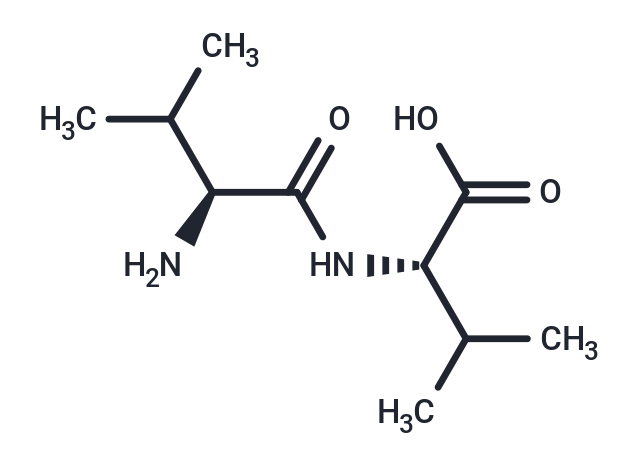
Valylvaline
CAS No. 3918-94-3
Valylvaline( —— )
Catalog No. M33679 CAS No. 3918-94-3
Valylvaline (Val-val) is a dipeptide compound that can be used for protein synthesis.
Purity : >98% (HPLC)
 COA
Datasheet
HNMR
HPLC
MSDS
Handing Instructions
COA
Datasheet
HNMR
HPLC
MSDS
Handing Instructions
| Size | Price / USD | Stock | Quantity |
| 1 mL x 10 mM in DMSO | 37 | In Stock |


|
| 25MG | 29 | In Stock |
|
| 100MG | Get Quote | In Stock |
|
| 200MG | Get Quote | In Stock |
|
| 500MG | Get Quote | In Stock |
|
| 1G | Get Quote | In Stock |
|
Biological Information
-
Product NameValylvaline
-
NoteResearch use only, not for human use.
-
Brief DescriptionValylvaline (Val-val) is a dipeptide compound that can be used for protein synthesis.
-
DescriptionH-VAL-VAL-OH is a dipeptide of the amino acid valine, an essential amino acid.
-
In Vitro——
-
In Vivo——
-
Synonyms——
-
PathwayOthers
-
TargetOther Targets
-
RecptorOthers
-
Research Area——
-
Indication——
Chemical Information
-
CAS Number3918-94-3
-
Formula Weight216.28
-
Molecular FormulaC10H20N2O3
-
Purity>98% (HPLC)
-
SolubilityIn Vitro:?DMSO : 9.52 mg/mL (44.02 mM; ultrasonic and adjust pH to 4 with 1M HCl; )H2O : < 0.1 mg/mL (insoluble)
-
SMILES[C@H](NC([C@H](C(C)C)N)=O)(C(C)C)C(O)=O
-
Chemical Name——
Shipping & Storage Information
-
Storage(-20℃)
-
ShippingWith Ice Pack
-
Stability≥ 2 years
Reference
1. Pierfrancesco Bravo, et al. Solution and solid-phase synthesis of trifluoromethyl peptides and mimetics. Journal of Fluorine Chemistry Volume 112, Issue 1, 28 November 2001, Pages 153-162.
molnova catalog



related products
-
Chikusetsusaponin IV
Chikusetsusaponin IV might relieve cutaneous symptoms caused by excessive apoptotic cell death in the skin through the Fas/FasL pathway.
-
3-Bromopyruvic acid
3-Bromopyruvic acid is a hexokinase II inhibitor with Ki of 2.4 mM for glycolysis/hexokinase inhibition. It is inhibitor of tumour cell energy metabolism and chemopotentiator of platinum drugs.
-
Anidoxime HCl
Anidoxime HCl (USVP-E142) is a novel orally available compound with anti-analgesic activity.
