


 Cart
Cart
 sales@molnova.com


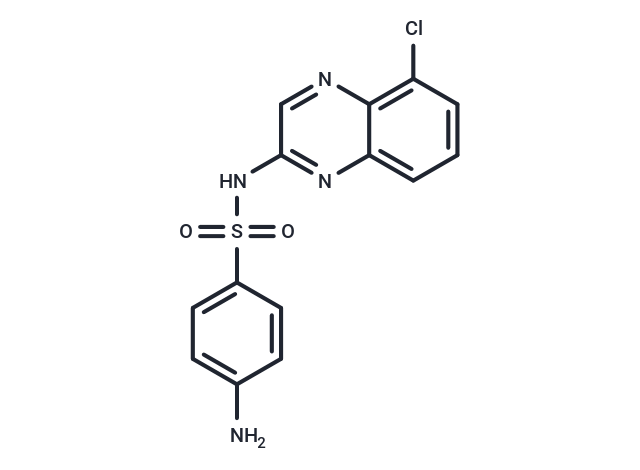
Chloroquinoxaline sulfonamide
CAS No. 97919-22-7
Chloroquinoxaline sulfonamide( —— )
Catalog No. M33316 CAS No. 97919-22-7
Chloroquinoxaline sulfonamide (Chloroquinoxaline) is a topoisomerase II alpha/beta toxin with antitumor activity and immunosuppressive properties that inhibits the proliferation of B16 melanoma cells in mice, and can be used to study metastatic colorectal cancer.
Purity : >98% (HPLC)
 COA
Datasheet
HNMR
HPLC
MSDS
Handing Instructions
COA
Datasheet
HNMR
HPLC
MSDS
Handing Instructions
| Size | Price / USD | Stock | Quantity |
| 1 mL x 10 mM in DMSO | 131 | In Stock |


|
| 5MG | 122 | In Stock |
|
| 10MG | 178 | In Stock |
|
| 25MG | 296 | In Stock |
|
| 50MG | 431 | In Stock |
|
| 100MG | 631 | In Stock |
|
| 200MG | Get Quote | In Stock |
|
| 500MG | 1330 | In Stock |
|
| 1G | Get Quote | In Stock |
|
Biological Information
-
Product NameChloroquinoxaline sulfonamide
-
NoteResearch use only, not for human use.
-
Brief DescriptionChloroquinoxaline sulfonamide (Chloroquinoxaline) is a topoisomerase II alpha/beta toxin with antitumor activity and immunosuppressive properties that inhibits the proliferation of B16 melanoma cells in mice, and can be used to study metastatic colorectal cancer.
-
DescriptionChloroquinoxaline sulfonamide (Chloroquinoxaline), a structural analogue of sulfaquinoxaline, is a topoisomerase II alpha/beta poison. Chloroquinoxaline sulfonamide is used to control coccidiosis in poultry, rabbit, sheep, and cattle. Antitumor activity.
-
In VitroThe Chloroquinoxaline sulfonamide IC50?for CV-1cells, obtained using an MTT cytotoxicity assay, was 1.8 mM. Chloroquinoxaline sulfonamide causes dose-dependent protein-DNA cross-links to CV-1 monkey kidney cell chromosomal DNA when drug treatment was terminated by lysis with GuHCl. Chloroquinoxaline sulfonamide-induced protein-DNA cross-links in CV-1 cells. Chloroquinoxaline sulfonamide-induced topoisomerase II-DNA cross-links.Chloroquinoxaline sulfonamide (Chloroquinoxaline), a chlorinated derivative of sulfaquinoxaline, inhibits proliferation of murine B16 melanoma cells, but only when relatively high drug concentrations (1 mM) are used.Cell Proliferation Assay Cell Line:B16 murine melanoma cells Concentration:10 μM, 100 μM, 1 mM Incubation Time:24, 48, 72 hours Result:Inhibited proliferation of murine B16 melanoma cells, but only when relatively high drug concentrations (1 mM) were used.
-
In Vivo——
-
Synonyms——
-
PathwayCell Cycle/DNA Damage
-
TargetTopoisomerase
-
RecptorTopoisomerase
-
Research Area——
-
Indication——
Chemical Information
-
CAS Number97919-22-7
-
Formula Weight334.78
-
Molecular FormulaC14H11ClN4O2S
-
Purity>98% (HPLC)
-
SolubilityIn Vitro:?DMSO : 125 mg/mL (373.38 mM; Ultrasonic )
-
SMILESNc1ccc(cc1)S(=O)(=O)Nc1cnc2c(Cl)cccc2n1
-
Chemical Name——
Shipping & Storage Information
-
Storage(-20℃)
-
ShippingWith Ice Pack
-
Stability≥ 2 years
Reference
1. Gao H, et al. Chloroquinoxaline sulfonamide (NSC 339004) is a topoisomerase IIalpha/beta poison. Cancer?Res.?2000 Nov 1;60(21):5937-40.?
molnova catalog



related products
-
UAMC 00039 dihydroch...
UAMC00039 dihydrochloride is a potent, reversible and competitive dipeptidyl peptidase II inhibitor with an IC50 of 0.48 nM.
-
Chimmitecan
Chimmitecan ((S)-9-Allyl-10-hydroxycamptothecin) is a potent topoisomerase I inhibitor with exceptional in vitro and in vivo activity.
-
Tubulin inhibitor 35
Tubulin inhibitor 35 (Tubulin IN 35) is a potent dual inhibitor of topoisomerase I and microtubule protein polymerization with antitumor activity, inhibits migration and invasion of MGC-803 and RKO cell lines, interrupts the cell cycle and induces apoptosis.
