


 Cart
Cart
 sales@molnova.com


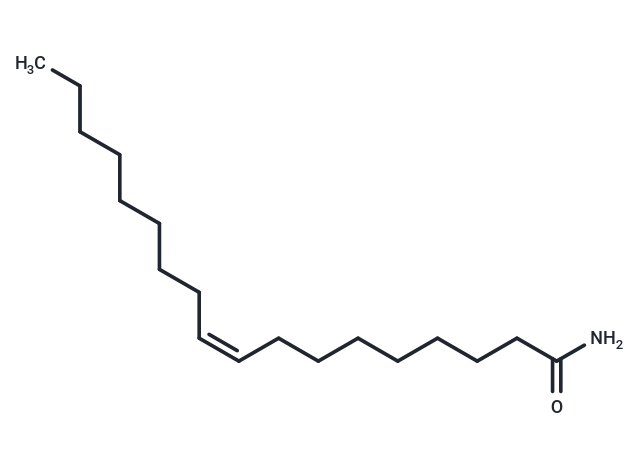
Oleamide
CAS No. 301-02-0
Oleamide( —— )
Catalog No. M33226 CAS No. 301-02-0
Oleamide (Oleic acid amide) is an endogenous fatty acid amide and can be used in the synthesis of de novo in the mammalian nervous system.
Purity : >98% (HPLC)
 COA
Datasheet
HNMR
HPLC
MSDS
Handing Instructions
COA
Datasheet
HNMR
HPLC
MSDS
Handing Instructions
| Size | Price / USD | Stock | Quantity |
| 50MG | 47 | In Stock |


|
| 100MG | Get Quote | In Stock |
|
| 200MG | Get Quote | In Stock |
|
| 500MG | Get Quote | In Stock |
|
| 1G | Get Quote | In Stock |
|
Biological Information
-
Product NameOleamide
-
NoteResearch use only, not for human use.
-
Brief DescriptionOleamide (Oleic acid amide) is an endogenous fatty acid amide and can be used in the synthesis of de novo in the mammalian nervous system.
-
DescriptionOleamide is an endogenous fatty acid amide which can be synthesized de novo in the mammalian nervous system, and has been detected in human plasma.
-
In VitroOleamide accumulates in the cerebrospinal fluid (CSF) of rats after six hours of sleep deprivation and induces sleep in naive rats and mice. Inhibition of the primary catabolic enzyme of oleamide (fatty acid amide hydrolase) by trifluoromethyl-octadecenone reduces sleep latency and increases total sleep time when given centrally to rats and peripherally to mice.
-
In Vivo——
-
Synonyms——
-
PathwayProteasome/Ubiquitin
-
TargetEndogenous Metabolite
-
RecptorEndogenous Metabolite
-
Research Area——
-
Indication——
Chemical Information
-
CAS Number301-02-0
-
Formula Weight281.48
-
Molecular FormulaC18H35NO
-
Purity>98% (HPLC)
-
SolubilityIn Vitro:?DMSO : 100 mg/mL (355.27 mM; Ultrasonic (<60°C); )Ethanol : ≥ 100 mg/mL (355.27 mM)
-
SMILESCCCCCCCC\C=C/CCCCCCCC(N)=O
-
Chemical Name——
Shipping & Storage Information
-
Storage(-20℃)
-
ShippingWith Ice Pack
-
Stability≥ 2 years
Reference



-
Atranorin
Atranorin shows significant antinociceptive and antiinflammatory activities, it has a relevant redox-active action, acting as a pro-oxidant or antioxidant agent depending on the radical.
-
N-Acetyl-L-alanine
N-Acetyl-L-alanine is a substrate for Guanine nucleotide-binding protein G(I)/G(S)/G(O) gamma-2 subunit Myelin basic protein GTP-binding nuclear protein Ran Tropomyosin alpha 4 chain HIV-1 Rev binding protein 2 Xaa-Pro dipeptidase Thymosin beta-10 Actin-like protein 3 Alanine aminotransferase Serine/threonine protein phosphatase PP1-beta catalytic subunit 10 kDa heat shock protein (mitochondrial) Calmodulin and Beta-1-syntrophin.
-
Cinnamic acid (b)
Cinnamic acid has potential use in cancer interventionThe concentration causing a 50% reduction of cell proliferation (IC50) ranged from 1 to 4.5 mM in glioblastoma melanoma prostate and lung carcinoma cells.
