


 Cart
Cart
 sales@molnova.com


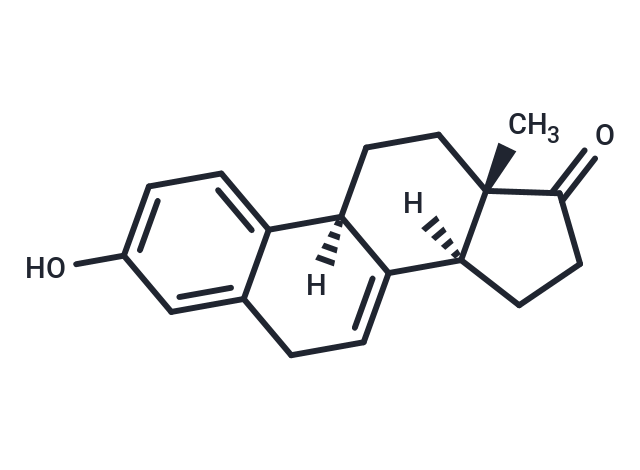
Equilin
CAS No. 474-86-2
Equilin( —— )
Catalog No. M33216 CAS No. 474-86-2
Equilin (7-Dehydroestrone) is a neurotrophic estrogenic steroid with vasodilatory activity that increases monocyte-endothelial adhesion through NF-κB signalling.
Purity : >98% (HPLC)
 COA
Datasheet
HNMR
HPLC
MSDS
Handing Instructions
COA
Datasheet
HNMR
HPLC
MSDS
Handing Instructions
| Size | Price / USD | Stock | Quantity |
| 1 mL x 10 mM in DMSO | 105 | Get Quote |


|
| 5MG | 59 | Get Quote |
|
| 10MG | 97 | Get Quote |
|
| 100MG | Get Quote | Get Quote |
|
| 200MG | Get Quote | Get Quote |
|
| 500MG | Get Quote | Get Quote |
|
| 1G | Get Quote | Get Quote |
|
Biological Information
-
Product NameEquilin
-
NoteResearch use only, not for human use.
-
Brief DescriptionEquilin (7-Dehydroestrone) is a neurotrophic estrogenic steroid with vasodilatory activity that increases monocyte-endothelial adhesion through NF-κB signalling.
-
DescriptionEquilin (7-Dehydroestrone) is an important member of the large group of oestrogenic substances and is chemically related to menformon (oestrone). Equilin increases the growth of cortical neurons via an NMDA receptor-dependent mechanism.
-
In Vitro——
-
In Vivo——
-
Synonyms——
-
PathwayGPCR/G Protein
-
TargetCalcium Channel
-
RecptorCalcium Channel
-
Research Area——
-
Indication——
Chemical Information
-
CAS Number474-86-2
-
Formula Weight268.35
-
Molecular FormulaC18H20O2
-
Purity>98% (HPLC)
-
SolubilityIn Vitro:?DMSO : 100 mg/mL (372.65 mM; Ultrasonic )
-
SMILES[H][C@@]12CCC(=O)[C@@]1(C)CC[C@@]1([H])C2=CCc2cc(O)ccc12
-
Chemical Name——
Shipping & Storage Information
-
Storage(-20℃)
-
ShippingWith Ice Pack
-
Stability≥ 2 years
Reference
1. David K, et al. Some biological properties of equilin. Biochem J. 1935;29(2):371-377.?
molnova catalog



related products
-
Pinaverium bromide
Pinaverium bromide is an calcium channel blocker with Antispasmodic and effectively relieves pain diarrhea and intestinal discomfort.
-
Praeruptorin A (c)
(-)-Praeruptorin A is a nature product that could be isolated from the roots of Peucedanum praeruptorum Dunn. (-)-Praeruptorin A relaxes ileum and tracheal smooth muscles by activating NO/cGMP signaling pathway. (-)-Praeruptorin A has dramatically therapeutic effects on hypertension mainly through acting as a Ca2+-influx blocker.
-
Zonisamide
Zonisamide is a sulfonamide anticonvulsant approved for use as an adjunctive therapy in adults with partial-onset seizures.
