


 Cart
Cart
 sales@molnova.com


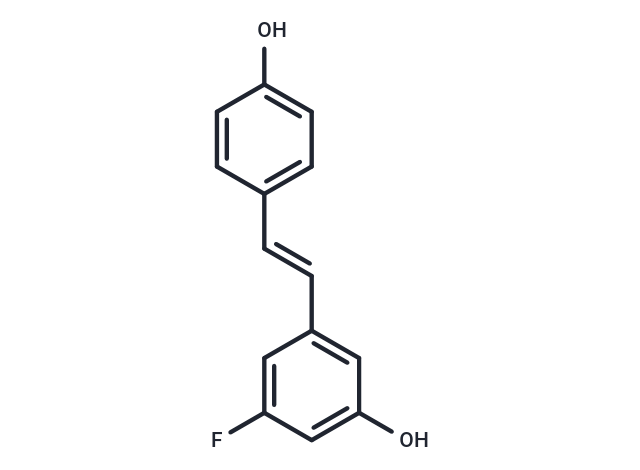
Resveratrol analog 1
CAS No. 861446-16-4
Resveratrol analog 1( —— )
Catalog No. M33102 CAS No. 861446-16-4
Resveratrol analog 1, an analog of Resveratrol, is a natural polyphenolic phytoalexin with antioxidant, anti-inflammatory, cardioprotective, and anti-cancer properties.
Purity : >98% (HPLC)
 COA
Datasheet
HNMR
HPLC
MSDS
Handing Instructions
COA
Datasheet
HNMR
HPLC
MSDS
Handing Instructions
| Size | Price / USD | Stock | Quantity |
| 2MG | 59 | In Stock |


|
| 100MG | Get Quote | In Stock |
|
| 200MG | Get Quote | In Stock |
|
| 500MG | Get Quote | In Stock |
|
| 1G | Get Quote | In Stock |
|
Biological Information
-
Product NameResveratrol analog 1
-
NoteResearch use only, not for human use.
-
Brief DescriptionResveratrol analog 1, an analog of Resveratrol, is a natural polyphenolic phytoalexin with antioxidant, anti-inflammatory, cardioprotective, and anti-cancer properties.
-
DescriptionResveratrol analog 1 is an analog of Resveratrol (HY-16561), compound 48. Resveratrol is a natural polyphenolic phytoalexin that possesses anti-oxidant, anti-inflammatory, cardioprotective, and anti-cancer properties.
-
In Vitro——
-
In Vivo——
-
Synonyms——
-
PathwayAutophagy
-
TargetAutophagy
-
RecptorAutophagy | Mitophagy | Sirtuin | IκB/IKK
-
Research Area——
-
Indication——
Chemical Information
-
CAS Number861446-16-4
-
Formula Weight230.23
-
Molecular FormulaC14H11FO2
-
Purity>98% (HPLC)
-
SolubilityIn Vitro:?DMSO : 100 mg/mL (434.35 mM; Ultrasonic )
-
SMILESOc1ccc(\C=C\c2cc(O)cc(F)c2)cc1
-
Chemical Name——
Shipping & Storage Information
-
Storage(-20℃)
-
ShippingWith Ice Pack
-
Stability≥ 2 years
Reference
1. Liu, Jing, "Synthesis of Resveratrol and Its Analogs, Phase-Transfer Catalyzed Asymmetric Glycolate Aldol Reaction, and Total Synthesis of 8,9-Methylamido-Geldanamycin" (2007). All Theses and Dissertations. 1415.
molnova catalog



related products
-
UNC669
UNC669 is an effective and specific MBT (malignant brain tumor) inhibitor with IC50 of 4.2/3.1 uM for L3MBTL1/3.
-
CLK1-IN-3
Clk1-in-3 is a + selective and highly potent sexual Clk1 inhibitor with an IC50 of 5 nM and 300 pairs higher affinity than Dyrk1A.
-
Tin-protoporphyrin I...
Tin-protoporphyrin IX dichloride (SnPPIX dichloride) is an HO-1) inhibitor with antiviral activity that inhibits dengue and yellow fever viruses.
