


 Cart
 sales@molnova.com


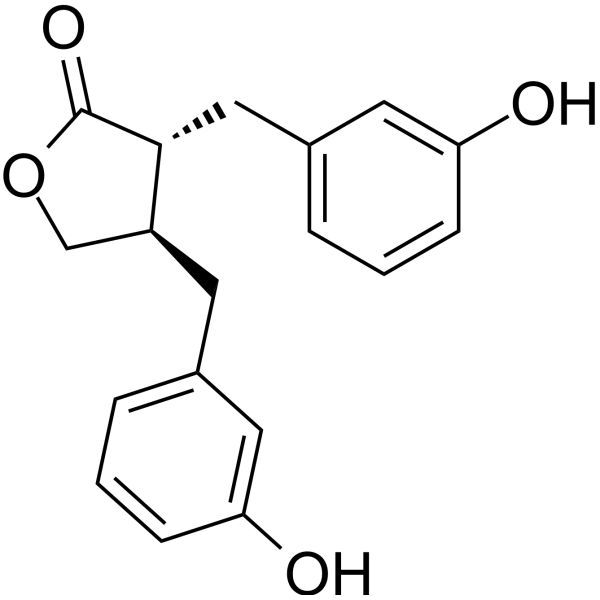
Enterolactone
CAS No. 78473-71-9
Enterolactone( —— )
Catalog No. M32134 CAS No. 78473-71-9
Enterolactone is a useful organic compound for research related to life sciences.
Purity : >98% (HPLC)
 COA
Datasheet
HNMR
HPLC
MSDS
Handing Instructions
| Size | Price / USD | Stock | Quantity |
| 50MG | Get Quote | In Stock |


|
| 100MG | Get Quote | In Stock |
|
| 200MG | Get Quote | In Stock |
|
| 500MG | Get Quote | In Stock |
|
| 1G | Get Quote | In Stock |
|
Biological Information
-
Product NameEnterolactone
-
NoteResearch use only, not for human use.
-
Brief DescriptionEnterolactone is a useful organic compound for research related to life sciences.
-
DescriptionEnterolactone is a useful organic compound for research related to life sciences.
-
In VitroEnterolactone (25-75 μM; 48 hours) arrests the growth of MDA-MB-231 breast cancer cells in the ‘S’ phaseEnterolactone (25-75 μM; 15 hours) triggers apoptosis in MDA-MB-231 breast cancer cells via caspase-3 activation.Enterolactone inhibits TGF-β-induced migration of MDA-MB-231 breast cancer cells. Enterolactone inhibits TGF-β-induced invasion of MDA-MB-231 breast cancer cells through ECM. Enterolactone inhibits the TGF-β-induced EMT program in MDA-MB-231 breast cancer cells. Enterolactone reduces the formation of actin stress fibers by inhibiting the expression of CD44 and MAPK-p38. Enterolactone inhibits the ERK/NF-κB/Snail signaling pathway to revert TGF-β-induced EMT in MDA-MB-231 cells. Cell Viability Assay Cell Line:MDA-MB-231 cells Concentration:25, 50, 75 μM Incubation Time:48 hours Result:There was a non-significant increase (~24%) in the S phase population following treatment with 25 μM EL, whereas there were significant increases (~34% and ~39%) following treatment with 50 and 75 μM EL, respectively.
-
In Vivo——
-
Synonyms——
-
PathwayOthers
-
TargetOther Targets
-
Recptor——
-
Research Area——
-
Indication——
Chemical Information
-
CAS Number78473-71-9
-
Formula Weight298.3
-
Molecular FormulaC18H18O4
-
Purity>98% (HPLC)
-
Solubility——
-
SMILES——
-
Chemical Name——
Shipping & Storage Information
-
Storage(-20℃)
-
ShippingWith Ice Pack
-
Stability≥ 2 years
Reference


-
Dichlorobis(tricyclo...
Dichlorobis(tricyclohexylphosphine)palladium(II) is a biochemical reagent that can be used as a biological material or organic compound for life science related research.
-
1H-Purine-2,6-dione
TH5427 hydrochloride is a potent, selective NUDT5 inhibitor (IC50=29 nM). TH5427 hydrochloride shows an apparent 690-fold selectivity for NUDT5 over MTH1. TH5427 hydrochloride blocks progestin-dependent, PAR-derived nuclear ATP synthesis and subsequent chromatin remodeling, gene regulation and proliferation in breast cancer cells.
-
Bradykinin
Bradykinin is an inflammatory mediator. It is a peptide that causes blood vessels to dilate (enlarge) via the release of prostacyclin, nitric oxide, and Endothelium-Derived Hyperpolarizing Factor. Bradykinin is a physiologically and pharmacologically active peptide of the kinin group of proteins, consisting of nine amino acids.
