


 Cart
Cart
 sales@molnova.com


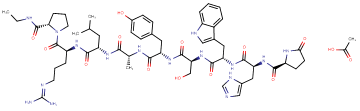
Alarelin
CAS No. 79561-22-1
Alarelin( —— )
Catalog No. M15981 CAS No. 79561-22-1
Alarelin acetate is a synthetic GnRH agonist.
Purity : >98% (HPLC)
 COA
Datasheet
HNMR
HPLC
MSDS
Handing Instructions
COA
Datasheet
HNMR
HPLC
MSDS
Handing Instructions
| Size | Price / USD | Stock | Quantity |
| 1 mL x 10 mM in DMSO | 117 | In Stock |


|
| 5MG | 50 | In Stock |
|
| 10MG | 83 | In Stock |
|
| 25MG | 111 | In Stock |
|
| 50MG | 147 | In Stock |
|
| 100MG | 176 | In Stock |
|
| 200MG | Get Quote | In Stock |
|
| 500MG | 442 | In Stock |
|
| 1G | Get Quote | In Stock |
|
Biological Information
-
Product NameAlarelin
-
NoteResearch use only, not for human use.
-
Brief DescriptionAlarelin acetate is a synthetic GnRH agonist.
-
DescriptionAlarelin acetate is a synthetic GnRH agonist. Alarelin is found in higher amounts than that of LH-RH in rat hypophyseal stimulation of gonadotropin secretion in vivo and in vitro and in ovulation inductions.(In Vitro):The cell viability in the presence of alarelin was significantly lower than that in the absence of alarelin. The maximum stimulatory effect on cell viability was achieved at a concentration of 10-5 M and it acted in a dose-dependent manner. (In Vivo):Alarelin could inhibit the gastric acid secretion both by direct actions on parietal cells in rats and by inhibiting vagous function. Alarelin could significantly enhance ratio of G1 phase and decrease ratio of S phase of GSMC of rats.
-
In VitroThe cell viability in the presence of alarelin was significantly lower than that in the absence of alarelin. The maximum stimulatory effect on cell viability was achieved at a concentration of 10-5 M and it acted in a dose-dependent manner.
-
In VivoAlarelin could inhibit the gastric acid secretion both by direct actions on parietal cells in rats and by inhibiting vagous function. Alarelin could significantly enhance ratio of G1 phase and decrease ratio of S phase of GSMC of rats.
-
Synonyms——
-
PathwayOthers
-
TargetOther Targets
-
RecptorOthers
-
Research AreaEndocrinology
-
Indication——
Chemical Information
-
CAS Number79561-22-1
-
Formula Weight1167.32
-
Molecular FormulaC56H78N16O12
-
Purity>98% (HPLC)
-
SolubilityDMSO: 10 mM
-
SMILESCCNC(=O)[C@@H]1CCCN1C(=O)[C@H](CCCN=C(N)N)NC(=O)[C@H](CC(C)C)NC(=O)[C@@H](C)NC(=O)[C@H](CC2=CC=C(C=C2)O)NC(=O)[C@H](CO)NC(=O)[C@H](CC3=CNC4=CC=CC=C43)NC(=O)[C@H](CC5=CN=CN5)NC(=O)[C@@H]6CCC(=O)N6.CC(=O)O
-
Chemical Name——
Shipping & Storage Information
-
Storage(-20℃)
-
ShippingWith Ice Pack
-
Stability≥ 2 years
Reference
1.Suocheng Weia, et al. Small Ruminant Research.2012,105 (1-3): 237-243.
molnova catalog



related products
-
IMR-1
IMR-1 is a novel class of Notch inhibitors targeting the transcriptional activation with IC50 of 6 μMol/L.
-
3beta-Hydroxyurs-12,...
The roots of Ilex cornuta.
-
6-O-galloylalbiflori...
Galloylalbiflorin (6′-O-Galloylalbiflorin) is an androgen receptor (AR) antagonist (IC50=53.3 μM) and can be found in the roots of Paeonia lactiflora. Galloylalbiflorin shows anti-androgens activity.
