


 Cart
Cart
 sales@molnova.com


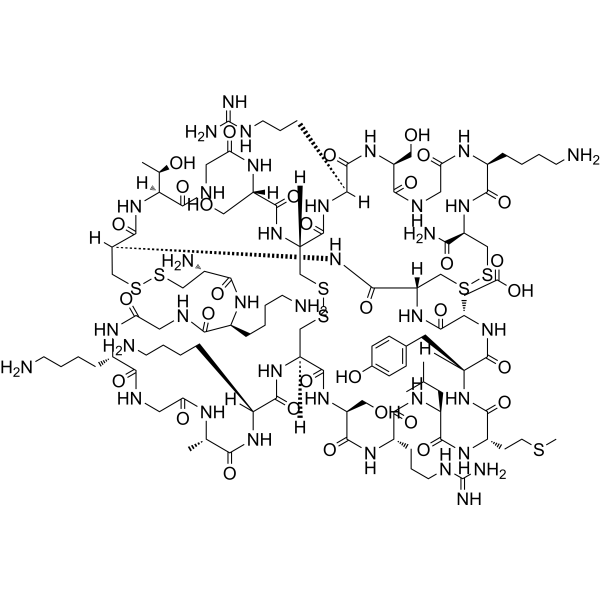
Ziconotide
CAS No. 107452-89-1
Ziconotide( —— )
Catalog No. M30258 CAS No. 107452-89-1
Ziconotide is an atypical analgesic agent for the amelioration of severe and chronic pain. Derived from Conus magus, a cone snail, it is the synthetic form of an ω-conotoxin peptide.
Purity : >98% (HPLC)
 COA
Datasheet
HNMR
HPLC
MSDS
Handing Instructions
COA
Datasheet
HNMR
HPLC
MSDS
Handing Instructions
| Size | Price / USD | Stock | Quantity |
| 100MG | Get Quote | Get Quote |


|
| 200MG | Get Quote | Get Quote |
|
| 500MG | Get Quote | Get Quote |
|
| 1G | Get Quote | Get Quote |
|
Biological Information
-
Product NameZiconotide
-
NoteResearch use only, not for human use.
-
Brief DescriptionZiconotide is an atypical analgesic agent for the amelioration of severe and chronic pain. Derived from Conus magus, a cone snail, it is the synthetic form of an ω-conotoxin peptide.
-
DescriptionZiconotide is an atypical analgesic agent for the amelioration of severe and chronic pain. Derived from Conus magus, a cone snail, it is the synthetic form of an ω-conotoxin peptide.
-
In VitroMost native cells express a variety of different calcium channels and as a result, Ziconotide only partially reduces high-voltage-activated calcium currents in differentiated human neuroblastoma IMR32 cells, rat superior cervical ganglion neurons, and rat hippocampal neurons. Ziconotide also reduces calcium currents that result from expression of the α1B subunit in HEK cells, tsa-201 cells, and Xenopus laevis oocytes.Ziconotide delivers its antinociceptive efficacy by reducing the release of pronociceptive neurotransmitters in the dorsal horn of the spinal cord, thereby inhibiting pain signal transmission.
-
In VivoZiconotide (i.t.; 25-100 pmol/site; 5 μL; on the 4 th, 10 th, 15 th, 20 th, and 24 th days) reduces the levels of IL-1β and IL-23 in the CNS, as well as IL-17 production in the spleen, 25 days after MOG35-55-elicited EAE, in the mouse model of experimental autoimmune encephalomyelitis (EAE). Animal Model:Female C57BL/6mice (18-22 g, 6-8 weeks old) injected with myelin oligodendrocytes glycoprotein Dosage:25 pmol/site, 50 pmol/site, 100 pmol/site Administration:Intrathecal injection; on the 4 th, 10 th, 15 th, 20 th, and 24 th days Result:Significantly reduced the mechanical hypersensitivity in animals with EAE.
-
Synonyms——
-
PathwayGPCR/G Protein
-
TargetCalcium Channel
-
Recptor——
-
Research Area——
-
Indication——
Chemical Information
-
CAS Number107452-89-1
-
Formula Weight2639.13
-
Molecular FormulaC102H172N36O32S7
-
Purity>98% (HPLC)
-
Solubility——
-
SMILES——
-
Chemical NameSequence:{Cys}{Lys}{Gly}{Lys}{Gly}{Ala}{Lys}{Cys}{Ser}{Arg}{Leu}{Met}{Tyr}{Asp}{Cys}{Cys}{Thr}{Gly}{Ser}{Cys}{Arg}{Ser}{Gly}{Lys}{Cys}-NH2(Disulfide bridge: Cys1-Cys16; Cys8-Cys20; Cys15-Cys25)
Shipping & Storage Information
-
Storage(-20℃)
-
ShippingWith Ice Pack
-
Stability≥ 2 years
Reference
Brinzeu A, et al. Ziconotide for spinal cord injury-related pain. Eur J Pain. 2019 Oct;23(9):1688-1700.
molnova catalog



related products
-
Jasmonic acid
Jasmonic acid (JA) is a phytohormone and plant growth regulator involved in plant defense and growth and development.
-
Procyanidin A1
Procyanidin A1 has antiallergic effects, it inhibits degranulation downstream of protein kinase C activation or Ca2+; influx from an internal store in RBL-2H3 cells.
-
Calcium channel-modu...
Calcium channel-modulator-1, a calcium channel-modulator (IC50: 0.8 μM), specializes in blocking aortic constriction.
