


 Cart
Cart
 sales@molnova.com


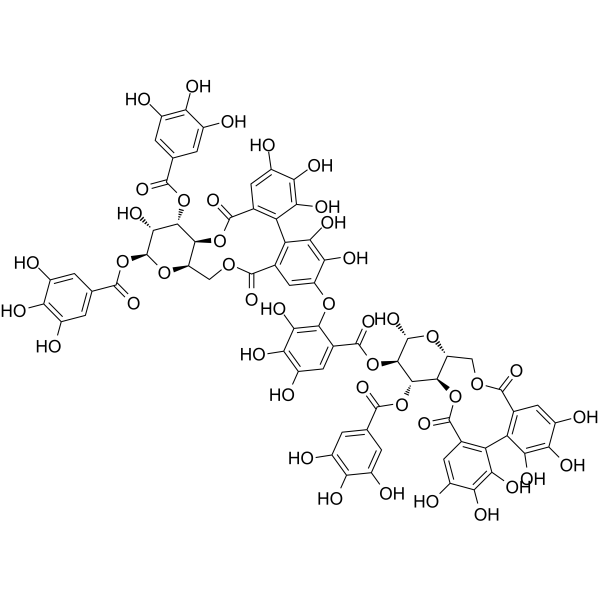
Oenothein B
CAS No. 104987-36-2
Oenothein B( —— )
Catalog No. M29376 CAS No. 104987-36-2
Oenothein B is a specific inhibitor of poly(ADP-ribose) glycohydrolase. Oenothein B shows antioxidant, anti-inflammatory, antifungal, anti-HCV, and antitumor properties.
Purity : >98% (HPLC)
 COA
Datasheet
HNMR
HPLC
MSDS
Handing Instructions
COA
Datasheet
HNMR
HPLC
MSDS
Handing Instructions
| Size | Price / USD | Stock | Quantity |
| 5MG | 267 | In Stock |


|
| 10MG | 406 | In Stock |
|
| 100MG | Get Quote | In Stock |
|
| 200MG | Get Quote | In Stock |
|
| 500MG | Get Quote | In Stock |
|
| 1G | Get Quote | In Stock |
|
Biological Information
-
Product NameOenothein B
-
NoteResearch use only, not for human use.
-
Brief DescriptionOenothein B is a specific inhibitor of poly(ADP-ribose) glycohydrolase. Oenothein B shows antioxidant, anti-inflammatory, antifungal, anti-HCV, and antitumor properties.
-
DescriptionOenothein B is a specific inhibitor of poly(ADP-ribose) glycohydrolase. Oenothein B shows antioxidant, anti-inflammatory, antifungal, anti-HCV, and antitumor properties.(In Vitro):Oenothein B (15-45 μM; 24 hours) not only increased the level of intracellular reactive oxygen species (ROS) but also induced the upregulation of intracellular apoptotic triggers (cleavage caspase-3, PARP, cytochrome c level in the cytosol, Bax). Oenothein B (15-45 μM; 12-72 hours) had a dose- and time-dependent inhibition rate effect on A549 cells exposure. Oenothein B (15-45 μM; 24 hours) effectively inhibited the proliferation of A549 cells by inducing apoptosis and arresting cells at the G1 stage.(In Vivo):In ICR mice, Oenothein B (100-300 mg/kg; p.o.) reduced neuroinflammation in the brain during systemic inflammation.
-
In VitroOenothein B (15-45 μM; 12-72 hours) has a dose- and time-dependent inhibition rate effect on A549 cells in the range of 12hours, 24hours, 36hours, 48hours, 60hours and 72 hours of exposure.Oenothein B (15-45 μM; 24 hours) effectively inhibits the proliferation of A549 cells by inducing apoptosis and arresting cells at G1 stage. Oenothein B (15-45 μM; 24 hours) not only increases the level of intracellular reactive oxygen species (ROS), but also induces the upregulation of intracellular apoptotic triggers (cleavage caspase-3, PARP, cytochrome c level in the cytosol, Bax).Concentration:15 μM, 30 μM and 45 μMIncubation Time:24hoursResult:Induced apoptosis in A549 cells.Cell Cycle AnalysisCell Line:A549 cells.Concentration:15 μM, 30 μM and 45 μMIncubation Time:24hoursResult:Arrested cells in the G1 phase.Western Blot AnalysisCell Line:A549 cells.Concentration:15 μM, 30 μM and 45 μMIncubation Time:24hoursResult:BAX, p53, cytochrome c (cytoplasm) and PARP were unregulated significantly; Anti-apoptotic Bcl-2 was decreased significantly in a concentration-dependent manner.
-
In VivoOenothein B (100-300 mg/kg; p.o.) has the ability to reduce neuroinflammation in the brain during systemic inflammation in ICR mice.
-
Synonyms——
-
PathwayApoptosis
-
TargetApoptosis
-
RecptorApoptosis
-
Research Area——
-
Indication——
Chemical Information
-
CAS Number104987-36-2
-
Formula Weight1569.08
-
Molecular FormulaC68H48O44
-
Purity>98% (HPLC)
-
Solubility——
-
SMILESOC1=C(C(C(O)=C2O)=C(C=C2O)C3=O)C(C(O[C@H]4[C@H](OC(C5=CC(O)=C(O)C(O)=C5)=O)[C@@H](OC(C(C=C6O)=C(C(O)=C6O)OC7=C(O)C(O)=C8C9=C7)=O)[C@H](O)O[C@@H]4CO3)=O)=CC(OC(C(O)=C%10O)=C(C=C%10O)C(O[C@@H]%11[C@@H](OC(C%12=CC(O)=C(O)C(O)=C%12)=O)[C@H](OC(C%13=C8C(O)=C(O)C(O)=C%13)=O)[C@@H](COC9=O)O[C@H]%11O)=O)=C1O
-
Chemical Name——
Shipping & Storage Information
-
Storage(-20℃)
-
ShippingWith Ice Pack
-
Stability≥ 2 years
Reference
molnova catalog



related products
-
EAD1 TFA(1644388-26-...
EAD1 HCL is a potent autophagy inhibitor with antiproliferative activity in lung and pancreatic cancer cells. EAD1 HCL also induces apoptosis
-
Myristoleic acid
Myristoleic acid is a cytotoxic component in the extract from Serenoa repens. Myristoleic acid induces apoptosis and necrosis in human prostatic LNCaP cells.
-
2’-OMe-Guanosine
2'-OMe-Guanosine is a modified nucleoside produced by the action of tRNA guanosine-2'-o-methyltransferase. 2'-OMe-Guanosine has a certain pro-apoptotic effect.
