


 Cart
Cart
 sales@molnova.com


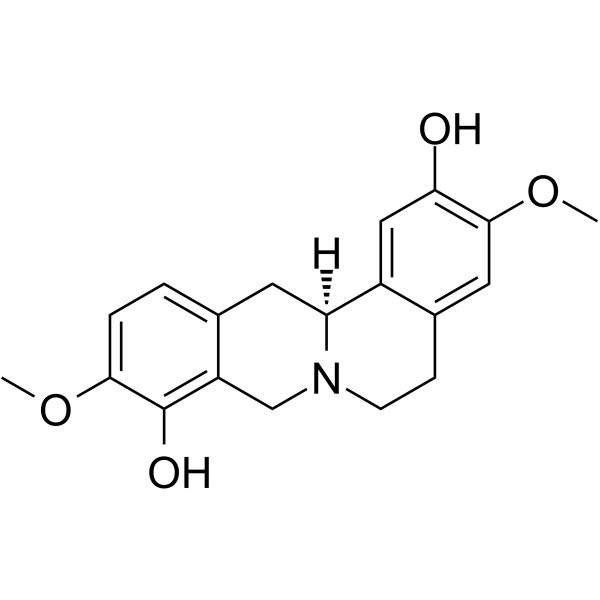
Scoulerine
CAS No. 6451-73-6
Scoulerine( (-)-Scoulerine | Discretamine )
Catalog No. M29229 CAS No. 6451-73-6
Scoulerine is an inhibitor of -site amyloid precursor protein cleaving enzyme 1(BACE1). Scoulerine a potent antimitotic compound that inhibits proliferation, arrests cell cycle, and induces apoptosis in cancer cells.
Purity : >98% (HPLC)
 COA
Datasheet
HNMR
HPLC
MSDS
Handing Instructions
COA
Datasheet
HNMR
HPLC
MSDS
Handing Instructions
| Size | Price / USD | Stock | Quantity |
| 5MG | 155 | In Stock |


|
| 10MG | 275 | In Stock |
|
| 25MG | 465 | In Stock |
|
| 100MG | Get Quote | In Stock |
|
| 200MG | Get Quote | In Stock |
|
| 500MG | Get Quote | In Stock |
|
| 1G | Get Quote | In Stock |
|
Biological Information
-
Product NameScoulerine
-
NoteResearch use only, not for human use.
-
Brief DescriptionScoulerine is an inhibitor of -site amyloid precursor protein cleaving enzyme 1(BACE1). Scoulerine a potent antimitotic compound that inhibits proliferation, arrests cell cycle, and induces apoptosis in cancer cells.
-
DescriptionScoulerine is an inhibitor of -site amyloid precursor protein cleaving enzyme 1(BACE1). Scoulerine a potent antimitotic compound that inhibits proliferation, arrests cell cycle, and induces apoptosis in cancer cells.(In Vitro):Scoulerine shows significant cytotoxic effects against both two cancer cell lines (Caco-2 and Hep-G2 cancer cells), with IC50 values 6.44 ± 0.87 and 4.57 ± 0.42, respectively. Scoulerine shows antiplasmodial activity with IC50 values of 5.4 μM and 3.1 μM against the antifolate sensitive and the multidrug resistant P. falciparum strains: TM4/8.2 and K1CB1, respectively.
-
In VitroScoulerine ((-)-Scoulerine) inhibits mini-panel of human leukemic cells, MOLT-4 (WT), Jurkat (TP53 mutated), Raji (TP53 mutated), HL-60 (TP53 null), U-937 (TP53 mutated), and HEL 92.1.7 (wild-type), with IC50s ranging from 2.7?μM to 6.5?μM.Scoulerine (2.5-20?μM; 24 hours) decreases proliferation of Jurkat and MOLT-4 cells.Scoulerine (2.5-20?μM; 24 hours) induces MOLT-4 and Jurkat cells apoptosis.Scoulerine induces G2 or M cell cycle arrest.Scoulerine (2.5-5?μM; 24?hours) shows an upregulation of p53 protein in p53 wild-type MOLT-4 cells.Scoulerine (2.5-5?μM; 24-48 hours) activates caspase-3/7, -8 and -9 in a dose-dependent manner.Scoulerine (5-10 μM; 24 hours) disrupts microtubule structure of A549 lung carcinoma cells .Cell Proliferation Assay Cell Line:Jurkat and MOLT-4 cellsConcentration:2.5, 5, 10, 15 and 20?μM Incubation Time:24?hours Result:Significantly reduced the viability and proliferation of Jurkat and MOLT-4 cells in a dose dependent manner.Apoptosis Analysis Cell Line:MOLT-4 and Jurkat cells Concentration:2.5, 5, 10, 15 and 20?μM Incubation Time:24 hours Result:Induced MOLT-4 and Jurkat cells apoptosis.Cell Cycle Analysis Cell Line:Jurkat and MOLT-4 leukemic cells Concentration:2.5-20 μM Incubation Time:16 hours Result:Induced cell cycle arrest at the G2/M transition.Western Blot Analysis Cell Line:MOLT-4 cells Concentration:2.5, 5?μM Incubation Time:24?hours Result:Showed an upregulation of p53 protein in p53 wild-type MOLT-4 cells.
-
In Vivo——
-
Synonyms(-)-Scoulerine | Discretamine
-
PathwayApoptosis
-
TargetApoptosis
-
RecptorApoptosis
-
Research Area——
-
Indication——
Chemical Information
-
CAS Number6451-73-6
-
Formula Weight327.38
-
Molecular FormulaC19H21NO4
-
Purity>98% (HPLC)
-
SolubilityIn Vitro:?DMSO : 100 mg/mL (305.46 mM)
-
SMILESCOc1cc2CCN3Cc4c(C[C@H]3c2cc1O)ccc(OC)c4O
-
Chemical Name——
Shipping & Storage Information
-
Storage(-20℃)
-
ShippingWith Ice Pack
-
Stability≥ 2 years
Reference
molnova catalog



related products
-
5-Amino-5-deoxyadeno...
5'-Amino-5'-deoxyadenosine (NH2dAdo) is an adenosine kinase inhibitor targeting malignant tumors of the inert lymphatic system with antitumor and anticancer effects.
-
HBDDE
HBDDE is a selective model inhibitor of the isoenzymes PKCα and PKCγ with IC 50 s of 43 μM and 50 μM, respectively.HBDDE has a higher affinity for PKCα/PKCγ than the PKCδ, PKCβI, and PKCβII isoenzymes.
-
WM-3835
WM-3835 is a novel and high-specific small molecule?inhibitor of Lysine Acetyltransferase 7 (KAT7, MYST2, HBO1)?, able to potently suppressed OS cell proliferation and migration, and leads to?apoptosis?activation.
